Activity
-
11 years, 8 months ago - View

JimTheFish replied to the topic General Open Thread – TV Shows
@bluepipsqueak, @purofilion, @ichabod et al —
Just to add that it’s worth checking out Tennant in Taking Over The Asylum and probably Single Father too for a full appreciation of just what he’s capable of on TV when he’s firing on all cylinders.
-
11 years, 8 months ago - View
JimTheFish replied to the topic General Open Thread – TV Shows
@purofilion and @ichabod—
Must admit I found Tennant’s Hamlet a bit underwhelming when I saw the televised version but I’m sure it had real power on the stage. With regards to his Doctor, I loved it at the time but find it a bit mannered and one-dimensional these days compared to Smith’s portrayal.
However, I did think both he and Colman did…[Read more]
-
11 years, 8 months ago - View
JimTheFish replied to the topic General Open Thread – TV Shows
@ichabod and @bluesqueakpip—
It’s certainly interesting how much of a reaction the L word has prompted. But personally I think I’d still prefer it to ‘incompetent’ which would seem to be the alternative in the particular context of Chibnall and Broadchurch.
I don’t dispute Pip’s general points or that it can be used incorrectly or as an, erm,…[Read more]
-
11 years, 8 months ago - View
JimTheFish commented on the post, Every girl who could have the power, will have the power, can stand up, will stand up – Buffy the Vampire Slayer Season Seven
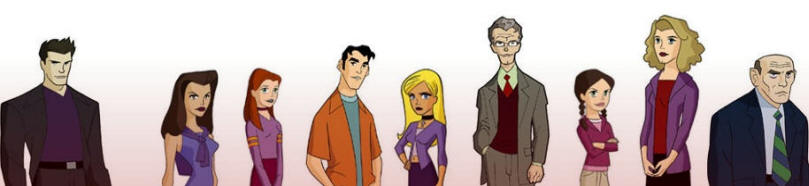
On the subject of the animated series, here’s a promo that was done at the time. Frankly, it makes me wish they’d done it.
-
11 years, 8 months ago - View
JimTheFish replied to the topic General Open Thread – TV Shows
It is not surprising however that McGovern would choose to dip into history in order to be able to express political ideas. History like Sci fi and fantasy can present controversial ideas by default.
True, but it can also take the sting out of them. People can turn around and say ‘yes, that was awful, but it was a long time ago and…[Read more]
-
11 years, 8 months ago - View
JimTheFish commented on the post, Every girl who could have the power, will have the power, can stand up, will stand up – Buffy the Vampire Slayer Season Seven
 @scaryb and @purofilion — many thanks for the kind words.
@purofilion — yes, we did lose the optimism in Buffy but at the same time it had no choice but to do go in that direction. An aborted spin-off was for […]
-
11 years, 8 months ago - View
JimTheFish replied to the topic General Open Thread – TV Shows
The US model was producer-led TV (and the producer might or might not be a writer). British TV series often did come directly from a writer’s pitch, and the writer would then write the entire series.
Absolutely. And this really only worked in the UK with series that had a run of six or seven episodes. Now runs are longer (as a…[Read more]
-
11 years, 8 months ago - View
JimTheFish replied to the topic General Open Thread – TV Shows
@pedant — I’m not sure with regards to the BC production teams. But I suspect ITV were so wowed by having such a surprise hit that they just let Chibnall have his lead with no one there to rein him in. A quick look on IMDB seems to suggest that BC1 has script editors/supervisors but that there are no similar roles on BC2. But then again IMDB is…[Read more]
-
11 years, 8 months ago - View
JimTheFish replied to the topic General Open Thread – TV Shows
If you ask me, I think the Whovian equivalent to the courtroom procedural problem is the Baby Moon Dragon.
Very true. To be honest, I wasn’t clasping my brow in outrage at the courtroom stuff but it did jolt me out of the action enough that the show ceased to be appointment viewing for me. I think the main problem was that it was…[Read more]
-
11 years, 8 months ago - View
JimTheFish replied to the topic General Open Thread – TV Shows
@purofilion — let’s not forget that Angel also tried ignore his soul and ‘stay evil’ and with Darla in Angel s2 before he was forced to confront his new state. Also the situation of Spike’s ensoulment is somewhat different. It’s a reward rather than a punishment. Whether it’s a deserved reward is open to question. But that’s undoubtedly going to…[Read more]
-
11 years, 8 months ago - View
JimTheFish replied to the topic On The Sofa (6)
Daemons definitely says I.
-
11 years, 8 months ago - View
JimTheFish replied to the topic General Open Thread – TV Shows
@pedant— As someone who can quite reasonably be accused of occasional snippiness, can I just say, abrasive much? Not sure there’s a need for quite that level of ‘tude. @bluesqueakpip does, after all, have a reasonable point to make and makes it well, and doesn’t really deserve that kind of snark.
RE. Broadchurch, I think I’m kind of in the…[Read more]
-
11 years, 8 months ago - View
JimTheFish wrote a new post, Every girl who could have the power, will have the power, can stand up, will stand up – Buffy the Vampire Slayer Season Seven
And here we are. End of the line for the Sunnydale crew. Season 7 is problematic and flawed but in the end it pulls a pretty impressive victory from the jaws of potential defeat and ends what is surely undoubtedly one of the most pivotal shows in TV history in fine style.
And said flaws are not the fault of this season per se but a combination of circumstance and the actual format of the series starting to fall apart.
A show like Buffy required a big finish but because the decision to actually end the series was taken somewhat late in the day, how this was going to be achieved was done on a rather ad hoc basis. Joss’s attention was still taken up on the now-disintegrating Firefly and that no doubt took its toll on Buffy (as it also did on Angel s4).
So, mistakes were made. The first of these was making The First the season’s Big Bad. The problem is that The First is too vague, a concept, rather than a tangible adversary. Literally in this case. As Buffy points out, the First’s non-corporeality means that it should be more accurately described as The Taunter. On the surface of it, it’s an odd decision. The First was barely a passable dramatic entity in s3’s Amends, let alone recurring across an entire season (but because the episode was essentially one of those laying the groundwork for s1 of Angel, it didn’t in the end matter too much). But here in s7, the return of The First promises much (like that nice ‘greatest hits’ of Big Bads at the end of the first episode) but ultimately is just not in any position to actually deliver.
Things improve greatly with Nathan Fillion’s arrival as Caleb. Fillion — great as the lead in Firefly — was another refugee from that show’s implosion (Gina Torres would similarly be slotted into s4 of Angel with, I think, less success.) And as a Night of the Hunter-esque misogynistic and unstoppable preacher, he brought a nice focus to The First narrative.
But either through accident or design, it is Caleb who is the true Big Bad of the season (and possibly the entire show). His religious garb is no accident. He is another version of the four men who started the Slayer line in the first place, and therefore of the Watchers’ Council who perpetrated their abuse of the first Slayer.
Caleb represents the institutions of control — the Watchers, prophecy in all its manifestations, the men who see Buffy and all the Slayers, and quite possibly all women full stop, as instruments of pawns in their respective games. The First is essentially the backdrop for that conflict, not the conflict itself. But because Caleb is introduced so late, The First has to adopt the role of the main adversary — a role that it’s not really up to — and this leads to the middle of the season feeling kind of flat. The whole thread of the hunt for the first Turok Hahn has a definite feeling of treading narrative water about it. (And interesting in how they quickly want from nigh on impossible to kill, to being easily dusted by the likes of Giles and Wood in the finale.)
A second problem is that the Scoobies in general had gotten too old. Part of the appeal of the best, earlier, Buffy seasons is that the characters were so engaging because they still had their whole lives ahead of them. They were embodiments of hope in their own ways — and this contrasted with the darkness of the supernatural enemies they faced. Their innocence, their being blank slates — full of hope and potential — were a big part of the point of the show.
Their lives are far from over, of course, but each of the Scoobies now carries too much baggage. And they’re all damaged in their own way. Buffy is humourless and harsh — more reminiscent of her Wish-Universe version rather than the s3 ‘real world’ equivalent, Willow is a recovering addict, Xander is a half-blind commitment phobic. Even Giles is rather sad now, having less life than he appeared to have when he was merely a fusty librarian cum Watcher. In seasons 1-4, we have a love of these characters because what we feel they’re in the process of becoming, the greatness and potential of their lives. Now it’s hard to escape the nagging feeling that they’re very close to becoming a bunch of losers.
Perhaps more so than many other TV formats, Buffy had a definite shelf life. We really weren’t meant to see them far beyond high school, I suspect. There is an unresolvable conflict here. The natural progression of the characters contains within it the demise of the show. It’s to be commended that it constantly pushed its characters out of their comfort zones but there comes a point when the characters are too old and a little too broken. Buffy as a 16-year-old calling Kakistos ‘kissing toast’ in s3 was endearing and funny, but as a 22-year-old she’s too old for the same trick to work with the Turok Hahn because it makes her look more silly and arch than anything else.
But this all sounds overly critical because s7 is actually perfectly fine aside from these structural problems. It’s got no really duff episodes (except maybe Him, which tried to be a pastiche of early Buffy but which I think did it far too self-consciously to ever have a chance of succeeding) and it has a lot of first-class ones, as good as anything in other seasons. And the season finale, did a fine job of bringing both the season, but more importantly, the entire series itself to an appropriate conclusion. (Although for my money, I still consider the Angel finale to be more satisfying than the Buffy one.)
A few brief notes on various characters:
GILES — he really should have been gone by now and served absolutely no useful purpose in this season, seemingly still hanging on in there because of sentimental attachment to the character. But this in the end caused more harm than good. It was right and necessary that Buffy be seen to be ‘cutting the strings’ from Giles but it was kind of done in a ham-fisted way. It didn’t seem credible that he would fall in Robin’s suggestion to kill Spike — especially as Giles had history with both Angel and of Spike. And by having his final significant act in the series being an act of betrayal, the character was ultimately done a disservice.
I feel it would have been wiser for Giles to have perished with the rest of the Watchers’ Council — heroically, of course. But this would have sent a devastating message to both Buffy (Giles’s head sent to her in a box a la Seven?) and the viewers that The First were something more serious than the common or garden evil.SPIKE — Having given Spike a soul at the end of s6, the writers were clearly at a loss as to what the hell to do with him and so we have yet more treading water — triggers, sleeper agents and so on — until they were ready for him. The reveal of the soul to Buffy is very well done though — an extremely affecting scene by Marsters and SMG — and his final sacrifice is a great moment (slightly undone later in Angel) and his laughter as he burns the Hellmouth is a great moment, and the perfect character beat. Spike has a poet’s soul — no, it’s not a poetic delusion, he’s the genuine article, just one born out of time in the stultifying era of the Victorians (we’ll see a scene in a future season of Angel that reveals that he finally finds his poetic place and affirmation). But a poet he is — and one who revels in chaos and irony at that — and that is why he both understands and embraces his ‘final’ destiny as a force of change, as well as conforming and confirming his original role as a puckish Lord of Misrule.
But the real power of the finale is that it chimes with the whole ethos of the show, confronts the constrictions that have dogged Buffy from the outset of Welcome to the Hellmouth and lays them to rest. Buffy’s victory is absolute. And it is a reward too. She finally gets what she’s most consistently wanted and asked for throughout the past seven years — to be a normal girl.
But let’s end with a couple of quotes from out own Watchers. First, @purofilion:
what I liked about Whedon’s vision was not shying away from the idea of empowerment for all girls who become women: and all ‘potentials’ as slayers. The fact he even mentions women bleeding together -in a commentary – was quite a shock. But a good one.
And I think @cathannabel sums it up nicely:
And that bit where the potentials become actuals – that beautiful sequence of young women taking that power on, without understanding it but knowing that its theirs, and standing up, literally or figuratively… Lord, that moves me so much, I can’t even speak about it without choking up. Over the last, very tough, year, it has played in my head at so many moments when I’ve felt powerless and defeated, and made me stand up straighter too.
On the subject of Buffy, very little more needs to be said than that, I think. However, do leave your thoughts and musings below. No spoilers for Angel seasons 2-5, which I’ll now try to zip through in short order.
-
11 years, 8 months ago - View
JimTheFish replied to the topic General Open Thread – TV Shows
And also Kennedy was exactly the sort of forceful character that would bring Willow out of her shell. Disappointing that he didn’t have the courage of his convictions. Sometimes fans are idiots and need to be told that.
Or they could, in fact, have a point. I agree that a forceful character was what was needed but Kennedy wasn’t it. Wi…[Read more]
-
11 years, 8 months ago - View
JimTheFish replied to the topic Local Hero
@scaryb — the remastered version of That Sinking Feeling is definitely worth picking up. Just got it in Fopp for £9. Both DVD and Blu-Ray included and has a shedload of excellent features with it too.
-
11 years, 8 months ago - View
JimTheFish replied to the topic Local Hero
@thekrynoidman — I’d say the three Forsyth films to watch are:
Gregory’s Girl. A brilliant, warm little film about adolescence, growing up and the essential absurdity of school. Very true and very funny.
Comfort & Joy. For me, Forsyth’s best film. Starring the mighty Bill Paterson as a radio DJ whose life and career goes on the slide at…[Read more]
-
11 years, 8 months ago - View
JimTheFish replied to the topic Local Hero
@scaryb — ah yes, That Sinking Feeling. Also a great little movie. I’d say stronger for script than direction as Forsyth seemed to be still to find his confidence in terms of directing actors (who are really great and more than a few of them find their way into Gregory’s Girl, I seem to remember.
I love Forsyth so much because, like Cassavetes,…[Read more]
-
11 years, 8 months ago - View
JimTheFish replied to the topic General Open Thread – TV Shows
@purofilion — not aware of there being an actual commentary for Seeing Red — it’s not on my boxset anyway. It’s possible that it was a region 1-only feature, or it could be an Easter Egg, I suppose. Maybe Mr P might know.
However, I have read a few interviews with Marsters where he’s talked about how difficult he found that scene and that he…[Read more]
-
11 years, 8 months ago - View
JimTheFish replied to the topic General Open Thread – TV Shows
@purofilion — on Firefly. It probably holds the distinction of being the only show I’m aware of that had its pilot aired last — no, seriously. Studios didn’t like the first pilot — which is actually awesome and asked for a second one — hence when you watch you’ll get a weird feeling of deja vu in the second episode. There then follow another…[Read more]
-
11 years, 8 months ago - View
JimTheFish replied to the topic General Open Thread – TV Shows
Anyway how can Spike come back. He’s dead. He can’t be a ghost! That’s mad.
And yet…
Spoilers are tricky but will do our best for you to remain unspoiled as much as poss for the remainder of Angel. It’s made trickier because you’ll have heard hints, been able to deduce things, from the later seasons of Buffy. But I think of that…[Read more]
- Load More