Category: Television
I think you’re seeing demons where there’s just life – Buffy the Vampire Slayer Season 6

by JimTheFish
Of all the Buffy blogs, this has been the hardest to write – partially because such a lot of the meat of it has been covered in the episode by episode thread and so would just be needless repetition here, but also because it’s such a tricky season to get a handle on.
He’s a shadow. A faceless champion of the hapless human race. Season One of Angel
by JimTheFish
By the end of Season Three of BtVS, the Buffy/Angel story arc had no place left to go. And the whole show was going in a new direction as the Scoobies left high school and went to college/real life. There was no longer going to be any place for Angel. His story was done. Wasn’t it?
I was going for ferocious-scary, but it’s coming out more dryly sardonic. Buffy the Vampire Slayer Season 4
by JimTheFish
Season three was the Buffy formula at its most perfect. Good blend of Scoobies. A strong arc. A cast and production crew now utterly confident in what they were trying to achieve.
But it couldn’t stay like that. They couldn’t stay in high school forever. Quite apart from anything else it would have looked ridiculous. Most Sunnydale High School students outside of the core cast seemed to look suspiciously well into their 20s as it was. And more importantly to have preserved the show in aspic would have been a betrayal of the show’s core ethos. Buffy is a show about development, about growing up. So it had to grow up already.
And college (or university to us back in the mother country) seemed the logical next step.
Love isn’t brains, children. It’s blood. Buffy the Vampire Slayer Season Three
by JimTheFish
Continuing the ongoing revisitation of Buffy The Vampire Slayer, season by season.
Season Three is the seminal season of Buffy. Not necessarily the best. Not necessarily the one with the best run of episodes. Or the best lines. Or the scariest Big Bad. But I’d still maintain it best distills the essence of the show into its most satisfying form. It has the strongest set of Scoobies for a start. Not that some of the later additions to the gang aren’t great. But this is the original crew, augmented by Oz and Wesley, their characters so well established that they can be playfully commented on and subverted in episodes like The Zeppo and Dopplegangland.
Love makes you do the wacky. Buffy the Vampire Slayer Season Two
by JimTheFish
Continuing the season-by-season revisit of one of the seminal and most influential TV series of the past 20 years. Turn on any drama series – from Who to Breaking Bad — chances are you’re seeing some traces, however oblique, of the Slayer right there.
In the first part of this blog series, I argued that the first (half) season of Buffy, essentially took most of its time to find its feet. There are some weaker, less consistent, episodes as it struggled with tone and theme but bit by bit it found its strengths, began constructing its own mythology. And by the time we got to the season finale, it had founds its voice. It knew exactly who it was. And where it wanted to go.
Blake’s 7: City on the Edge of the World

by PhaseShift
As we look towards episodes of Colin Baker for the first time, let’s take a look at the man in one of his celebrated pre-Who roles.

It’s widely believed that Colin used B7 as a back door audition for Doctor Who. Here he demonstrates his marvellous Sontaran impersonation.
Bayban the Berserker.
Bayban the Butcher.
Babe (to his dear old mum).
To be truthful, as an entry point to discussing Blake’s 7, this wouldn’t be my first choice. Acting on a request for some thoughts on pre-Doctor Who Colin Baker (from @TardisBlue and supported by others) this is a natural though, and highlights all the talents he brought to the Doctor.
That said, any episode of Blake’s 7 gives you a natural entry point to talk Doctor Who because the shows were almost stable mates during the four series it was on. Look at the credits for this episode and you’ll find the series was created by Terry Nation (Daleks), Produced by David Maloney (whose first director’s gig was Mind Robber), Music by Dudley Simpson, and the episode was written by Chris Boucher (Robots of Death, Star Cops).
It’s City on the Edge of the World. If you want an intro to the Blake’s 7 universe, it’s found below the episode.
If you have any thoughts on Blake’s 7, the episode itself and Colin’s turn, give us your thoughts below.
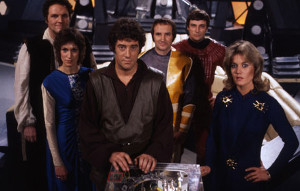
The Original Seven – Back (L-R) Gan, Vila, Avon. Front (L-R) Cally, Blake with hands on Orac, Jenna.
Blake’s 7 ran to four series of thirteen 50 minute episodes between 1978 and 1981. It told the tale of Roj Blake, freedom fighter against an oppressive totalitarian regime. He’s fitted up on child molestation charges (to discredit him) and shipped off world. Escaping on a deserted alien spacecraft with a not-so merry band of prisoners he wages a campaign against the Federation.
Over the first two series the campaign has highs and lows, with the recovery of super computer (cheap box of tricks) Orac, and the death of crewmate Gan, the “gentle giant” of the team. Blake gets some measure of revenge, but is ultimately shown to be a potentially dangerous mixture of idealist and extremist – at one point contemplating millions of innocent deaths to see the end of the Federation.
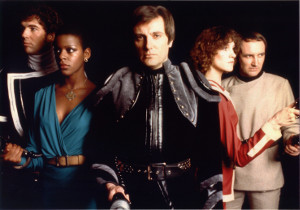
Times change: L-R Tarrant, Dayna, Avon, Cally and Vila
Throughout the early series, two of the emerging popular characters were Avon (cold calculating computer fraud specialist) and Vila (cowardly thief). They made an effective and entertaining team. While Blake was off doing heroic things, they occasionally embarked on wild get rich schemes. When not doing that, Avon was undermining Blake’s leadership. The third series saw Blake and Jenna absent, missing after a space battle in which the team was forced to aid the Federation against an alien incursion.
In series 3, Avon forms a new team, including survivors Vila and Cally (a telepathic freedom fighter committed to nobler endeavors). They’re joined by Tarrant, an expert pilot and Dayna, a weapons whizz. He commands the Liberator on a personal revenge spree, and occasional search for Blake. Avon perpetuates some of Blake’s work, but largely to his own advantage to keep the Federation destabilised. This episode is from that series. The culmination of the series saw the destruction of their fine ship.
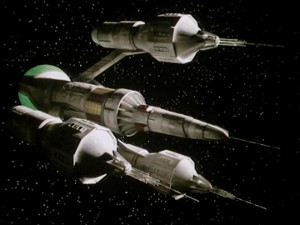
Even the mighty Liberator couldn’t survive Blake’s 7.
Series 4 sees the surviving team recruit a new member (after yet another casualty) and a new ship. It’s a downbeat affair, with Avon acting more and more paranoid as time goes on. It ends in an astonishing way, with Avon finally locating and meeting Blake. It doesn’t go well.
Blake’s 7 was an attempt at a space opera on a “cheap as chips” basis and actually one of the first examples of a Sci-fi series with a story arc in each series (although not as tight as they could have been). I doubt it could be made these days because, although the budget is laughable, and the performances variable, it does deal with stong stuff on occasion, for the pre-watershed timeslot.
It reached the magic 52 episodes for syndication in the US and PBS happily rotated it for many years where it came to the attention of J Michael Straczynski, creator of Babylon 5. He has a lot of good memories of it, and at a sci-fi convention once pronounced it “fucking awesome”. He based his earth-as-fascist-regime arc in B5 on it. It’s been cited by others involved in Lexx and Farscape as influential, and there are some similarities when you compare it to Firefly. For cheapness, it has lasted. The ending in particular, after you’d followed these adventures, was pretty devastating as a kid. There were many complaints to the BBC as it was shown quite near to Christmas. Happy Christmas Kids!!
There were quite a few near misses in making the relationship between Blake’s 7 and Doctor Who official – Tom Baker and Gareth Thomas both lobbied to have a walk down the corridor nod between The Doctor and Blake (which would have been used in both shows, from opposite perspectives). Terry Nation wanted the alien incursion at the end of Series 2 to be the Daleks (which would have been a jaw-dropping surprise to my ten year old self) and Chris Boucher’s Robots of Death society was to have been set in the Blake’s 7 universe. Alas – not to be.
It’s completely flawed, but so, so memorable for anyone of that era, and it has a lasting legacy. In Avon, Television produced one of the greatest anti-hero’s. A term that has become abused perhaps. Mal Reynolds, from Firefly, is not an anti-hero. Mal Reynold’s would not be willing to chuck his oldest ally (and the nearest thing to a friend he has) out of an airlock to save his own skin. Watch the episode Orbit, and see Vila crying in a hiding place as Avon seeks him out. It really is harrowing.
They keep threatening to make a US remake. Bigger effects – bigger budget. May Satan’s stinky demons keep it in the seventh circle of Development Hell. Because for all its faults, Blake’s 7 was special.
Buy it. Series 1-3 have been republished recently with Series 1 at under 17 of your earth squids at the moment.
Rewind TV: The Avengers “Too Many Christmas Trees”
by PhaseShift
As we await the latest Doctor Who Christmas Special, how about sampling another Christmas themed special of long ago?
Non-Fiction – Culture Show/Graham Norton Show/The Science of Dr Who

by wolfweed
The clip below has highlights from TSODW…
Blast from the Past – Star Cops
by PhaseShift
“I always preferred Sherlock Holmes to Dan Dare.” – Nathan Spring
As we dwell on the late 80s era of Who on our Faces strand, it seems like a good time to remember a small series which should have had a bigger impact. A combination of Detective drama and hard si-fi that went under the unappetising name Star Cops.
Read more…
Blast from the Past – Sapphire and Steel
by PhaseShift
“All irregularities will be handled by the forces controlling each dimension. Transuranic heavy elements may not be used where there is life. Medium atomic weights are available: Gold, Lead, Copper, Jet, Diamond, Radium, Sapphire, Silver and Steel.
Sapphire and Steel have been assigned.“
The phrase “ITVs answer to Doctor Who” was a familiar one at one point in journalistic circles. It has become much less used these days (the last time I think was for Primeval). Once upon a time though, commercial television competed in the worlds of bizarre realities, rather than relying on the rather mundane reality fare it focuses on currently.