


Forum Replies Created
-
AuthorPosts
-
21 September 2015 at 03:39 #43094
Yeah, slip of the fingers. I meant ‘Planet of the Daleks.’
By the way, if you freeze frame at the right spot, you can see the Special Weapons Dalek from Remembrance of the Daleks, McCoy era.
Of course, it all begs the question…
20 September 2015 at 23:58 #43086Okay, for what it’s worth, on the subject of Daleks. The original version of the Daleks looked like this.

Pretty bog standard right. But note that between the Dome rings and the chassis, it’s just straight, no up and down slats. Also, note the small fender at the base. The blue Dalek that Clara and Missy encounter is an original dalek form. They seem to be a little bit shorter in height than some of the other Daleks. These original Daleks, by the way, relied on an external power source – static electricity from their pathways. Take them off the pathway, onto a blanket for instance, and they were powerless.
The Daleks in Dalek Invasion of Earth were essentially the same models (literally) but with parabolic dishes mounted on their backs so that they could receive broadcast power, enabling them to move off of trackways.
Now, starting with the chase, they started adding the Neck Slats, that surround the arm and sucker. As we see here:
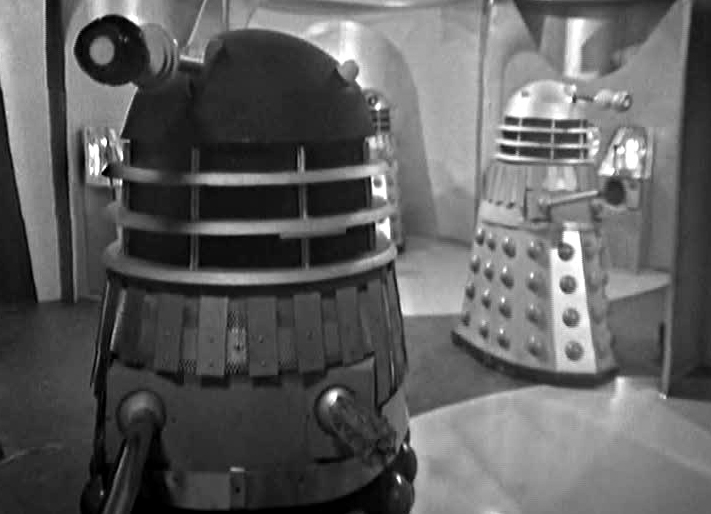
The Black Daleks were introduced in Genesis of the Daleks.
That big red bastard on a Pedestal is the Dalek Supreme
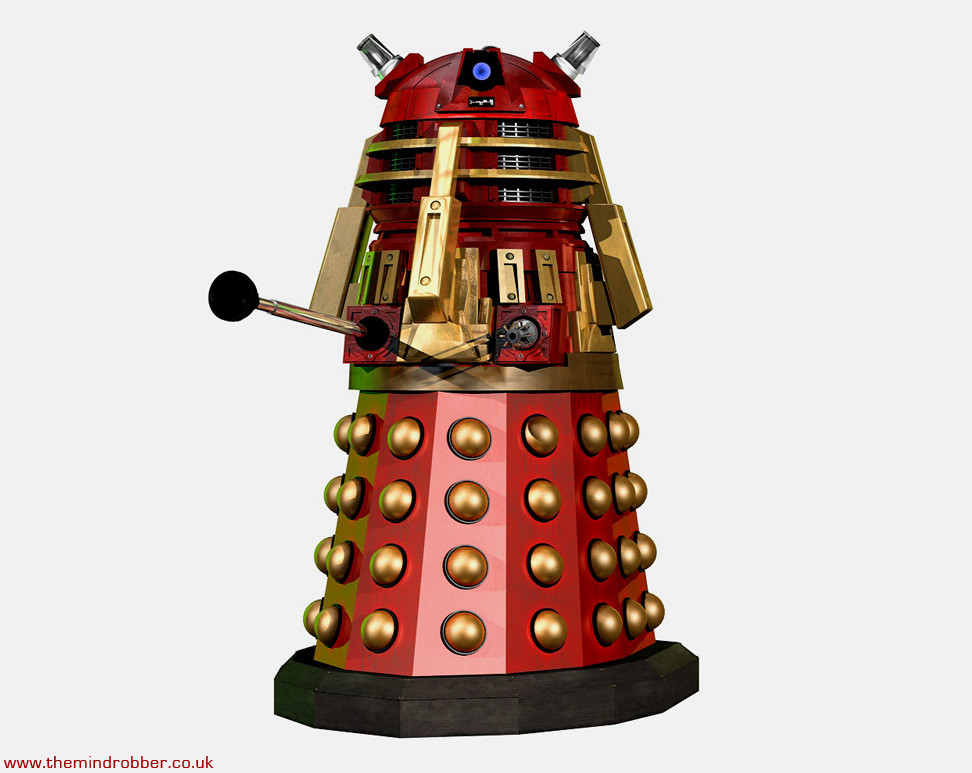
He appeared to menace Jon Pertwee in Power of the Daleks. Note the large fender at the base. That’s because the Supreme Dalek prop originally appeared in the second Peter Cushing movie. Terry Nation inherited the Daleks. The BBC borrowed one from him and refurbished it into the supreme.
The Bronze Daleks are basically Ecclestone/Tennant era.
17 July 2015 at 23:25 #41259To my recollection, it never played anywhere theatrically. It had a good run at festivals, and then straight to DVD. It was a low budget independent production which got picked up by a distributor on the festival circuit. There wasn’t much of a budget for promotion, and it was pretty off the beaten path in terms of ‘low budget sci fi’ – short on action and effects, and long on guys in white shirts and ties having elaborate complications. Extremely well constructed and intricate, it lacked a sufficient crescendo or emotional connection to really draw people or create a buzz. I’m glad you found it. I find I sift through piles of crap, looking for the occasional obscure gem. It’s always a thrill to find the gem.
If you’d like some random recommendations. Check out ‘What We Do in the Shadows’ a brilliantly funny little vampire film from 2014. There’s also Alex Proyas’ ‘Dark City‘ but don’t watch the opening title craw.
17 July 2015 at 22:35 #41257Primer has been around for a few years now. And yes, it’s a wonderfully intricate low budget movie about two gentlemen who learn to travel back in time a short distance and change their future.
15 July 2015 at 05:47 #41207@ichabod It’s entirely possible to take something quite good and make it sound completely idiotic and regressive by boiling it down and rendering it as a clichéd or regressive premise. Nothing really survives that treatment.
Certainly the whole notion of ‘Mighty Whitey’ is a rather jingoistic and juvenile fantasy that was really popular for a long long time and doesn’t stand up terribly well these days, not least because a lot of it was wretched and horrifically regressive.
On the other hand, one of the greatest English language writers was Joseph Conrad, a polish man. Another great English language writer, V.S. Naipal is an East Indian. Napolean was not French, but an Italian Corsican. Hitler was not a german, but an Austrian. Othello was a Moore. And America’s most famous Scientist, Einstein, was a European. Good, Bad and Fictional, it happens. Historically, and in literature, there’s a very very very long tradition of the “Outsider” who enters a society, culture, milieu, organization, and despite being an alien, excels and succeeds.
In folklore and fiction, its easy enough to assume it’s simply a masturbatory fantasy. But there’s enough real life examples that it cannot be dismissed. If I had to speculate, I would suggest that the social networks which bind and support us in society also restrict, we’re plugged into all these networks and mostly that’s a good thing, but the process and act of being plugged in brings responsibilities, offers limitations, distractions, diversions, it multiplies and divides or priorities. The Outsider, by being socially somewhat more disconnected may have viewer limitations or distractions, may be more driven, more opportunistic, they may simply be required or motivated to work harder, and their energy may be much more narrowly focused. Just a thought.
There is also, in literature, or real life the ‘adopted’ – a person who literally joins an alien or foreign culture, willingly or unwillingly. They leave their old life behind, and they become the other. White children raised by Indians was a popular subgenre at one time. Among the British, they had a term ‘going native’ for Company men living in China or India. Sometimes it was a fantasy/reality – Gauguin abandoning civilization to live in Polynesia. We have the old example of Gray Owl, and the more recent and now politically incorrect example of that blonde woman who so identified with blacks that she started claiming to be one.
So, basically, all I’m saying is that just because we can reduce something to something stupid, doesn’t necessarily mean its worthless. Those of cynical bent can reduce anything to something stupid.
Now, on the subject of Burroughs… Hmmm. I suppose I came to it at an impressionable age. Sometimes we just love stuff because it came along at the right time in our life, and that’s that. That right time can be teens for Burroughs, twenties for the Rolling Stones, or fifties for TS Elliot. It can be irregardless of the merit of the thing itself, and even merit can be arguable. Are the Rolling Stones lyrics shallow and moronic, is TS Elliot a whiny depressive who needs to get out more? There are people who swear by Atlas Shrugged, who embrace it as a profound, life changing, life defining work – to which I say “Ick!” But hard to say.
So is Burroughs stupid and trite? Well, I don’t think so. I can see some of that ‘Mighty Whitey’ shtick in a lot of his work. But if you look at his ‘Carson of Venus’ novels, he’s literally parodying that shtick – his Carson is stunningly inept, the only thing the guy really has is persistence, and my god, don’t ask him for directions.
Tarzan is arguably a ‘Mighty Whitey’, but really, he’s a feral child – psychologically, he’s a great ape, and while he can pretend to be an English lord… who he really is, where he really is, is a jungle creature. Mind you, Tarzan went well over 20 novels, and there’s a huge gulf between the worst and the best. I’d still think that that the best Tarzan novels, the handful of seminal ones really do stand the test.
Whatever Tarzan was, he hit some sort of cultural Zeitgeist. Bomba the Jungle Boy was a direct offshoot of Tarzan (a bit of Mowgli, but mostly Tarzan). As was Jan of the Jungle, Ki-Gor, Ka-Zar, Shanna, Sheena and about fifty imitators. Even Mowgli, the immediate predecessor, borrowed from Tarzan when Disney got into it – there’s a lot more Burroughs and Kipling.
Whatever that Zeitgeist was, it mostly passed away. Like Westerns and Pirate Stories and Aviator Stories, the Jungle hero is a thing of the past, perhaps the ‘Mighty Whitey’ story is gone or going. But I don’t necessarily think that the passing of a genre invalidates the best stories which might have had the misfortune of being set in that genre.
If we take a look at possible example of Mighty Whitey – Princess of Mars… Superfically, that’s what its like. John Carter ends up on Mars, ends up a prisoner among Tharks, and rises to a Chieftain among them. In particular, his horsemanship seems to work better than that of his fellow Tharks. He’s gifted with superhuman strength by virtue of being from Earth, and he eventually becomes the greatest swordsman in that world and a prince of the greatest empire. So, superficially, it’s a pretty shallow power fantasy and exactly what you have reduced it to.
But is it? Because on the one hand, it does some very different things. At heart, its a romance. At heart, all of Burroughs novels were romances, mostly in adventure clothing, but romances through and through. That was what really distinguished him from his imitators and most other pulp writers. The thing with Princess of Mars, is that the minute John Carter sees Dejah Thoris, he’s smitten. Love at first sight. His entire life tilts its axis and nothing is ever the same again for him. It’s not just that she’s a babe – she makes a passionate speech to the Tharks, she’s got fire and intelligence, and even though they mock it, he gets it. The entire rest of the novel is about that spark catching on, the relationship building to the point where he repudiates his adopted society of Tharks, to the point where she challenges the social bonds that tie her down, where it comes down to two people who love and need each other so badly that they’ll set themselves against the entire world, where every moment they have is literally stolen, and losing each other forever is no more than a page away. I don’t think that has anything to do with Mighty Whitey. But I think it’s powerful and impressive, and that there’s a genuine emotional core that drives the book.
The other thing I like about Burroughs and particularly about Princess is that his monsters are seldom monsters. The Tharks are typical bug eyed monsters. Six limbs, bug eyed, ears on stalks, walking stick insect thin, green skinned, hatched from eggs, thinking only about martial prowess. It would be so easy to just toss them up as horrific monsters or alien creatures and not go any further. H.G. Wells with his Morlocks and Martians didn’t bother going any further than that.
But Burroughs, when he talks about the Tharks, when Jon Carter is among them, goes into anthropological levels of detail. He examines every part of their lives, the relationships between the sexes, their approach to child rearing, the organization of their society, their philosophy, he makes them real and interesting. He makes them, some of them likeable, and even the ones we don’t like, the ones who just show up for a few scenes to do something dickish, he makes them people.
And most interestingly, when he criticizes them, its not an outsider criticizing them in the novel. It’s not a red martian saying it, or the omniscient narrater, or even John Carter. It’s presented as the Tharks criticizing themselves. It’s Tars Tarkas, coming to grips with some of the costs and emotional pain of his way of life, stopping and saying “You know, John Carter, we kind of suck. There’s downsides to our way of life, and I kind of wish there weren’t. That maybe we did, or should do some things differently”
Just some thoughts.
1 July 2015 at 18:24 #40908@hitch here are a couple of links to start you off…
http://geekbat.blogspot.ca/2012/06/doctor-who-reconstruction-retrospective.html
https://en.wikipedia.org/wiki/Doctor_Who_missing_episodes#Reconstruction
That should give you a good start on understanding and tracking down the reconstructions, and having some sense of what you’re getting for your effort.
Here’s the fan version of Masters of Luxor. I have a review of it up.
A Fan Animated version of Daleks Masterplan
Then there’s SF Debris, here’s the Daleks Masterplan episode
http://sfdebris.com/videos/doctorwho/s03e04.php
Good luck. Have fun. Remember to just feel free to poke around, it’s always fascinating to see where your nose might take you….
1 July 2015 at 15:19 #40904@hitch You actually have some options.
Back in the old days, when the technology of film and video was less sophisticated, continuity from one day to the next was often a challenge. To deal with this, television series would hire a photographer to be on the set, taking photographs of the actors and action on a steady basis. A half hour might produce anywhere from a dozen to a hundred photographs taken. The photographs could then be developed quickly, in a matter of an hour or two, and provided to the director, producer, actors, grips etc., to ensure that everyone found their place. In the absence of rushes, they were a valuable directors tool.
Back in the day, a photographer called John Cura perfected a method of photographing straight from a television image. This was useful. These photographs were called Telesnaps. Between 1963 and 1968, he was telesnapping Doctor Who, roughly 60 pictures to a half hour. These telesnaps, and other set photography in many cases became the only surviving visual material for the lost episodes.
At the same time, there was another phenomena. Audio recording. It was a thing back then. People would make audio tapes of their favourite radio and TV shows. So, often as a result of fans recording and sometimes copying and trading, there was a substantial audio record of these episodes.
Anyway, fast forward a bit, and fans started putting two and two together, combining the photographs and telesnaps, to create an audio track with a visual component of a succession of illustrated stills. It wasn’t animation. I suppose it was something like a comic book. But with a certain amount of generosity of spirit, it could recreate many of these lost serials for you.
BBCi, which was the online branch of the BBC in the and 90’s and noughties began offering up its own reconstructions – basically showing the lost episodes online. Back in those ancient days, bandwidth meant that while audio and photographs were viable, actual motion pictures were not. So BBCi’s lost series run matched the technology available and people were used to that.
So, I would suggest hunting them down. You can probably find reconstructions and sites devoted to reconstruction on the web.
Apart from that, I’d suggest the novels. Most, if not all of the novels or novelisations for the lost episodes were done concurrently. And most of them were done by the actual writers of those particular serials, or by Doctor Who writers like Malcolm Hulke, who had clear connections with the show. I suppose mileage may vary, but if its the original scriptwriters doing the novels, I imagine there’s some authenticity.
Online, you might look up SFdebris. It’s an interesting pop-culture review web site with a snappy sense of humour, but it also takes time out to delve into subtext, to examine why something works or does not work. SFdebris did a series of ‘reviews’ discussions on the lost serials, using an informative audio track that explained and discussed the story, punctuated by photographs or telesnaps. It’s quite enjoyable.
There have also been some fan film attempts to recreate lost or unmade serials. The best of these would probably be Tony Coburn’s Masters of Luxor. But be warned, quality may plummet.
And there have been stage plays of some of the lost serials starring Nick Scovell, although I suppose they’re inaccessible as well.
Anyway, hope this helps. This is all off the top of my head. So I can’t give you URL’s. But google a bit, and I’m sure you’ll find interesting things.
5 June 2015 at 19:59 #40523@arbutus Just a really quick note. I didn’t dislike Season 8 entirely, I found it deeply flawed. There were unquestionable gems. In general sense, I felt that series 8 floundered and lacked overall coherence. I haven’t really voiced an organized opinion on season 8, and this isn’t the occasion as, among other things, I try to be thorough in my exploration of ideas, and that’s not brief.
But then again, that might have been a deliberate decision. If you look at the marketing side of it, Doctor Who season 8 appears to have expanded its international marketing considerably, penetrating new venues in Latin America and elsewhere. They probably wouldn’t have done that if they’d gone with a more continuity laden, focused, overarching storyline. So I can’t really voice an opinion as to whether season 8 represents a series of dubious artistic choices, or very canny strategic marketing, which in and of itself, I suppose is a defendable creative choice.
With respect to the overall discussion, I do want to apologize for not participating in this discussion in more detail, as I believe I have been referenced a few times. This is not disrespect or disinterest on my part, but rather, limitations on time. I’m self employed, the nature of self employment means erratic schedules. The ends and beginnings of months tend to be frantic times, I need to get accounts done and out, to ensure that I will make my rents. There’s limited available time, I have to make choices as to where to throw that time. Which meant finishing reviews on Shakedown, et al. I will try and respond back, when my next window of time opens, and hope to contribute to a courteous and positive discussion.
2 June 2015 at 17:02 #40486I have to say, I’m not a science purist, and I’m not especially concerned by science in Doctor Who. My objection to KtM relates to consistency and logic, which I suppose relates to science, but its broader.
I don’t believe that the episode is consistent with its own logic. It sets up its rules, and then it breaks them. That’s just bad storytelling.
Purofilion has described the episode as a fairy tale, but I don’t think that frees it from the demands of logic.
Let’s take a fairy tale as an example: ‘Three bears.’ – Goldilocks encounters a house in the woods owned by bears. Well, that’s hardly scientific. But the story establishes a logic, a premise. Bears have houses – ie, bears have essentially humanlike qualities. Goldilocks then proceeds through the house, she finds porridge and beds, this follows the story logic. The porridge comes in threes, and of different qualities. The beds follow this logic, three beds and of different kinds.
That doesn’t happen at all in KtM. Premises are established to drive a narrative drama, and then abandoned. The story goes on at great length to establish that these are catastrophic events. Obviously, if the Moon’s gravity increases multif0ld enough to capture an atmosphere out of nowhere, then that’s going to be devastating for Earth. And characters show up to say ‘Hey, this has been devastating for earth.’
The notion of the moon breaking apart leaves the risk of Earth being bombarded by mountain sized chunks of rock. This is not nerd science. This is pretty conventional wisdom. Within our culture, we’ve assigned an asteroid impact to the extinction of the Dinosaurs for the last few decades. There have been several high profile movies about big rocks hitting the planet with very bad outcomes. There was that Russian bollide incident a few years back. There’s pretty regular articles about tracking space rocks. This isn’t high tech science, this is on the order of common sense. Big rocks in space => Hitting us => Bad things. And in fact, characters who show up on a shuttle are saying exactly that. There’s nothing in the script to suggest otherwise. The Doctor says ‘oh yeah, that could happen, or something else might.’
The reality of these stakes are emphasized by the commitment of the supporting characters. They flew a space shuttle all the way to the moon to crash and possibly die in a quest to save the Earth. They do die, some of them, and in pretty awful ways.
But in the end, this is all waved away. It’s as if, in the story of Goldilocks, she drowns because it turns out that bears live underwater all along. The premises of the story are abandoned in favour of an altogether magical solution for which the story makes no allowance. The magic space butterfly waves away all that space debris from its birth somehow? And magically craps out a new moon which looks and masses and is in all respects identical to the old one. Its’ not being nit picky to go ‘hold on a second there.’ What this is a ‘deus ex machina’ – literally a God From the Machine, and Deus Ex Machina is simply bad writing. It means you’ve created a situation that you’ve no way out of, and now you’re just making crap up. Might as well have just said ‘it was all a dream.’
Throw us a bone. Explain how this is supposed to happen. If you’re going to do that, set it up in the script. But I don’t see it being set up. I don’t think that there’s any plausible way it could be set up. In the end, it’s just a ‘shut up! that’s why’ situation of contempt for the story and for the audience.
I’m not rigorous. I appreciate surrealism. To use an example, Lexx was often surrealist rather than sci fi, as often concerned with images and moods rather than linear logic. But even surrealism follows its internal premises. Even illogic maintains its own logic. El Topo or Magic Mountain, Un Chien Andalou or Discreet Charm of the Bourgeousie… they’re all surreal, but they also embrace their own internal logic, their premises. Look at the McCoy era of Doctor Who, when most of McCoy’s oevre abandoned conventional sci fi to embrace deliberate absurdism. I find absurdism hard to take, personally, you have to be in the right frame of mind for it, and I really dislike McCoy’s absurdist adventures. But I can appreciate that that’s what’s going on, and I respect the integrity of the absurdism, even for disliking.
But I don’t see this integrity in KtM.
Now, it’s entirely arguable that KtM is doing something else. That the apparent story conceals a subtext or underlying story which is really what it’s all about. Yes. Symbolism, metaphor, subtext, parables, allegory. I know all that stuff. I get it. So let’s assume that’s what’s going on here. In fact, it’s pretty much a guarantee. The over-story is such a butcher job that they have to be doing something else.
But I have two problems in this case. The first is that the over-story is over-sold, they put way too much into setting up their story and concepts and then simply abandon them – they make an investment and they work hard to convince the audience. Having a metaphor doesn’t actually get you off the hook. What would people have thought of Alien if, at the end of the episode, Ripley strips down to her skivvies and discovers that the xenomorph was actually Jesus all along. You can’t sell one kind of story, and then just switch and tell us its another kind of story.
The larger problem though is that even if we go with ‘it’s another kind of story being told’ then really it still makes no sense. Is this an abortion parable? On the information given – we can’t distinguish the life form in the moon from a fetus or a cancer. We’re told its not just a possible threat to its mother… it could well murder everyone in the room, in the city, in the world. In the case of abortion, we are all agreed that what’s coming out of the womb will be a potential human. We don’t get that here, we don’t get to know anything about what’s coming, except that it’s shedding murderous spiders that kill people and it may destroy the world. If we go with an abortion metaphor, it seems childishly ham handed. The decision and decision making process prioritizes magical thinking, or non-thinking. The characters are given X information, they have to take Y risk, and they decide … ponies! It doesn’t happen that way in the real world. There are good reasons for that. When people go for that magical thinking – that’s five year olds running into traffic, or 12 year olds jumping off roofs because they figure a towel on their back is a cape and that they’ll be able to fly, its phony cancer cures. People suffer and die. But here it’s all magic, so people make the worst possible decision and it turns out to be the right one, and somehow everything is magically put right.
I don’t believe the metaphorical story, the allegorical story works any better, or is any more coherent than the overstory. I’ve read the arguments for them. But its not persuasive to me.
Finally, I don’t see the Doctor’s conduct as being consistent with the character. I’ll acknowledge arguments the other way. But I’m not persuaded. The Doctor’s conduct appears to be entirely inconsistent with everything we’ve ever seen of him or know of him, and this is regardless of whether we consider the entire history, or simply Capaldi’s version. The arguments that it is seem to rely on one of two points: 1) The Doctor is an alien, so he does alien stuff and he doesn’t get people. Well, sorry, no. The Doctor’s alien-ness is well defined at this point, it’s not a perpetual get out of jail free card. 2) All we need to do is simply infer a whole bunch of things we’re not shown or told -again, sorry but no. To me, the Doctor’s actions are dictated not by his personality or motivations, but simply because the plot requires him to act in such and such a way.
In the end, the only ‘real’ thing left in the narrative is the blowout/breakdown between the Doctor and Clara at the end. That’s emotionally authentic, to the point of almost being hard to watch. But the problem is that the process which gets us to that point is not honest or authentic, rather, its shabby, manipulative, arbitrary and dishonest. It’s built on a foundation of mush, and because it is so completely unsupported it fails. Yes, it feels authentic in the moment, but if every moment that’s preceded it is false….
Obviously, there are positives in the episode – the production design is quite extraordinary for example, some of the acting is absolutely top rate. But for me, this makes things worse. Gold plating a turd does not make it any less a turd.
To me, this really ranks as the worst. It’s in the same class as Underwater Menace, or the Twin Dilemma, Delta and the Bannermen, Dimensions in Time. It’s an episode that exhibits contempt for its principal cast, and contempt for its supporting cast, for its allegory, its premises and ultimately for the audience. It doesn’t even have the excuses that some of these other productions had.
Now, I appreciate that KtM does have its admirers and followers. That’s fine. I’ve read admiring and positive reviews, listened to the arguments for it, and given it fair consideration. I hold no post against people who like it. I don’t consider such people idiots or morally reprehensible or anything of the sort. It’s a big world, there’s room. Stuff doesn’t have to work for everyone. People all over the world groove on things that leaves other people cold, that happens every day. I’m well prepared to acknowledge the legitimacy of people liking it, even if I disagree with their conclusions or reasoning, or simply don’t get it in the way that they do. I don’t hold to any particular superiority.
But by the same token. I’m not stupid, I’m not an idiot, I’m not morally reprehensible, I’m not inferior and if I say I gave its supporters a fair hearing and continue to disagree that’s just what it is, its not me being stubborn or an ass. My views are as worthy of respect as anyone elses, I have a right to hold them, and I have a right to articulate them. If someone doesn’t like my face, try and punch it, and we’ll see how that turns out. Even if I’m the only person here who despises it, if I’m part of 1% who dislike it, compared to a 99% who think its brilliant. I am entitled to dislike it, I am entitled to say I dislike it, and while I’ll apologize for a lot of things in life, I’m not going to apologize for that.
It’s a big world, which means I get to live in it to.
1 June 2015 at 22:59 #40464@purofilion I apologize for offending you. You have been civil, it pains me to think I was rude to you.
1 June 2015 at 19:34 #40460@ichabod Watched the first season of Penny Dreadful, loved it. Vanessa is a compelling character.
@purofilion You might try Roger Zelazny’s ‘Lord of the Light.’ It’s an amazing novel, and I don’t believe that it ages. Zelazny had a gift for dialogue. The mixture of sci fi and hindu mythology is … I don’t think I’ve seen anything quite like it since. I’d also suggest ‘A Billion Days of Earth’ by Doris Piserchia.
For the early stuff… You might try some of H.G. Wells. For my tastes: ‘The Island of Doctor Moreau.’
And for another perspective, Burroughs ‘Princess of Mars.’ – Burroughs fell out of fashion, but Burroughs examination of his Martians and their lives and inner lives is damned near Napolean Chagnon in space. It’s both anthropological and sympathetic. It’s telling that when his Martians are criticized, it’s not the white man telling them what’s wrong with them, but the martians themselves going ‘you know, we’re this way, and it works for us, but it kind of sucks too.’
1 June 2015 at 16:48 #40458@purofilion One final comment on suspension of disbelief. What works for us and what we choose to overlook can be pretty arbitrary. Take a monster movie. You’re watching a monster movie – the big bad thingy is looming over the hero and heroine, claws are out, fangs dripping, screaming is going on. Suddenly you notice a flash of metal. It’s a zipper. The monster has a zipper. It’s a suit. Bang, suspension of disbelief is dead. Or is it? If you’re sufficiently in the moment, you might just ignore it and keep going. For some people the zipper stops them, for others, it doesn’t.
No illusion is perfect. It’s a spell woven on the audience, we are asked to forget we are in a movie theatre, or sitting in our living rooms, we’re asked to embrace the story. Some things get us in there, some things take us out. It can be a boom mike being caught in frame, or the fact that the camera accidentally shoots over the top of the set, or the sound mix is garbled. It can be a wobbly set, or amateurishly bad acting, or a story that.
It’s a funny thing. I didn’t mind a wobbly set, I was prepared to overlook it, so long as the story was engaging and the actors were giving it their best. On the other hand, I loathed Jurassic Park II, the lost world – why? Because the characters acted stupidly and inconsistently, because they made decisions that inadvertently and in some cases deliberately got dozens of people killed, and because their moral posture made no sense – they were horrible stupid people doing horrible stupid things, but the movie insisted on presenting them as virtuous, heroic and sensible. Incredibly expensive and polished movie, and yet it fed my suspension of disbelief through a meat grinder.
What we forgive, and what snaps the thread for us, often quite arbitrary, and it’s often tied to what we like and what works for us, and how compelling that is. If we’re sufficiently fascinated, we don’t just forgive, we don’t even notice, when a boom mike enters the shot.
1 June 2015 at 14:56 #40457@purofilion might I add this? If you truly believe this, then it must stand that to some small extent those who adore it are, if not idiots, then idiotic (at times); unable to appreciate or distinguish a performance (inconsistent or otherwise) and are possibly, pretentious!
I don’t know that I want to take that step, or that that step ought to be taken. It’s one thing to judge a work. It’s questionable to apply that judgement upon people who like or dislike that work. It seems to me that the latter ends up taking us to bad places. People are inherently idiosyncratic, art is inherently subjective. In the end, logic is a retrograde tool – it doesn’t decide what we like or dislike, it just explains it for us. But the impression is subjective.
So my point is, its perfectly possible for me to loathe KtM, without loathing someone who likes it. And generally, that’s a good idea. The trouble with strong opinions is that if they’re strong enough, then you have the urge to start chopping off the heads of unbelievers, which is a bad thing. The alternative, I suppose is to have no strong opinions at all, and therefore have no need to chop off heads… but then that makes you vulnerable to the head choppers if history is anything to go by. Me, I think there’s a third way, where we are entitled to strong opinions, but wise enough not to make them universal barometers.
Of course, there’s always exceptions. If you meet someone who is a big fan of the Turner Diaries… be cautious. But still, making a distinction between a person and their opinions is probably a good thing.
As for KtM, Ichabod liked it because she saw authentic emotional honesty in the characters and their interractions – it seemed genuine. Did the artifice bother her? Well, all art is artifice, it’s all lies designed to seek out a core of truth. So she got something out of it. I respect that, and to a degree I understand it.
For me, I can see where she’s coming from, but I can’t adopt it. The emotional honest she finds, is to me wrapped in a core of fraud. In order for me to get there, to the point of appreciating that emotional honesty, I have to get past the fact that the story violates its own premises, that it establishes its internal logic and then violates it, I have to get past the fact that the characters actions are entirely inconsistent with who they are and that they simply act without motivation because the plot requires them too, I have to get past the contradictory metaphors. I just can’t do it. Is this a human failing in myself? Or does it mean I’m a superior critic? I dunno. Neither I would say. It just is.
But this all comes around back to the principal of suspension of belief in storytelling and how you keep your audience. It’s a tricky thing. All art is artifice, all stories are lies. And the trick is to get the audience to go along with those lies. You do it by reaching for, by trying to develop some feeling of authenticity. There’s all sorts of ways to do it, I’ve talked about two of them – provenance and accumulation of familiar detail, you can do it with an accumulation of unfamiliar detail forcefully dragging a reader into your world, you can do it by embracing a first person narrative, or by establishing rules or premises for your audience that you follow, or by maintaining fidelity of characterization.
Suspension of belief is something we’re very used to, and it changes as we grow up, it changes depending on what we’re looking at. Look at Horror movies, the cliché of the heroine, against all logic and common sense going down alone into a basement where the monster is. That’s an oft-cited example of bad writing and bad characterization (it really is). It was mocked in Scream. Yet it worked for a lot of people, we all invested in it, we maintained our suspension of disbelief, we followed her down to the basement. It was stupid, but it worked. Go figure. But in a different movie, a different context, that sort of defiant character illogic would not have worked at all, and people would have booed and thrown popcorn at the screen.
And it stopped working. For some people, after they’d watched enough horror movies, or after they reached a certain point in their lives, it didn’t work, it was just stupid. For horror movies, it eventually degenerated from an effective tactic to a stupid cliché. For whatever reason, we stopped following that heroine down into the basement. The bar moves. It moves for us individually, based on who we are and where we are, how young we are, how drunk we are, what’s going on with us. It moves for us collectively.
And to state “it signifies nothing” is surely a starkly irrational definition. No? I could also ask how is it full of “convoluted pretension”? Time and its handmaidens are convoluted; they implode and re-grow. In so doing, their outer shell is reinterred, re-used or rematerializes completely.
Yeah, you got me there. I got caught up quoting MacBeth. It was one of my favourite soliloquys, MacBeth learning that his wife was dead and becoming completely unstrung from the world, losing all faith in existence, seeing nothing but a string of empty barren days. I used to be able to recite the whole thing from memory, back in the bad old days when my knuckles dragged the ground as I walked.
1 June 2015 at 07:45 #40450@ichabod “KtM’s failures, whatever they are, whizzed right by me, I think. I was watching faces, gestures, timing, and listening to how the voices worked, and these all pleased me. I’m not fussy, I guess. Well, all right, I may be fussy, but only about the things I care about, which are more likely to be qualities found in live theater than on TV.”
Yeah, I get that. For the people who like it, it seems to be about the subtleties of the relationship, the interractions, faces, gestures, timing. I’m a big fan of live theater, I practically live at the fringe festival. But even in theatre, there’s the rule of Chekov’s gun. I’m pretty ecumenical in my tastes, I love Jodorowsky and Spalding Gray, Richard Linklater and Ed Wood, I groove on Bunuel and Shwarzenegger. Hell, I enjoyed the dada movement.
So this isn’t about me being a science nerd. I don’t really care all that much about moon spiders, I can take em or leave em, and it’s been that way since cat women on the moon. There’s an incredibly diverse set of approaches to storytelling, and all kinds of stories that can be told in all kinds of ways. A story doesn’t have to be about plot, doesn’t even need a plot. It can be a mood, an instant, a memory, it can be about a relationship or a moral. But for me whatever form it takes, there’s always an internal logic and a story needs to work within its internal logic. For me KtM fails on every level, it’s a sludgy morass of contradictory metaphors, inconsistent performance, and convoluted pretension. It’s a tale told by an idiot, full of sound and fury, signifying nothing.
But you know what? It’s a big world, and there’s certainly room for all the people who like KtM. But that also means there’s plenty of room for me. It’s a good thing.
Hmmm. You didn’t write ‘A Billion Days of Earth’ by any chance.
1 June 2015 at 05:56 #40446@ichabod I actually had the honour of meeting Phyllis Gottlieb, one of the old era Sci Fi writers. She was in her 90’s at the time, a wizened little woman with gigantic ears.
As far as the Malazan stuff goes, I actually like Steve’s work, although it’s quite exhausting. It’s also subversive of the genre in it’s own way. Steve is an anthropologist by training, and did his field work in central America during the dirty wars there.
@purofilion I used to know a Native artist named David Morrisseau. He was the son of Norvel Morrisseau, who was probably one of the most famous native artists. Anyway, his artwork was in the classic style of the Oji-Cree, adapted of course with oils and acryllics. It was quite popular. But when he talked about it, he talked about it in terms of mermaids and fish people, teleportation and visits to other planets. But these were ojibway folk tales he was talking about. Essentially, he was rendering the Ojibway stories he’d learned growing up in his native language into English, but he was adopting the vocabulary of science fiction to describe it. He could have adopted a fantasy vocabulary, or a religious vocabulary, but for him the vocabulary of technocracy and science fiction was simply the most natural default for him, entering into the white world which was certainly not religious or magical in its outlook.
A lot of science fiction isn’t truly about science. Certainly there are whole genres and subgenres that have little to do with science. Military SF from Heinlein’s Starship Troopers, to Haldeman’s Forever War, or David Drake’s Hammer’s Slammers or John Ringo’s Aldenata, or the Honor Harrington stuff… nothing to do with science. Only marginally to do with technology. Science is just the clothing, the wardrobe that these stories wear.
There’s hard SF that wrestles with or is derived from science – Clement’s Mission of Gravity, or Forward’s Dragon’s Egg (Eye?) Maybe some of the esoteric stuff of Steve Baxter. But a lot of it, Neil Asher’s stuff for instance, or David Brin, just uses it as the wardrobe to tell good stories. It’s really all about telling good stories, sometimes science is the inspiration, hallucinatory visions and blueprints of the future, cautionary tales, dreamscapes. Sometimes its just the clothing we drape the old stories in to make them vivid and interesting.
We live in a present which is entirely ephemeral, our reality is ghostlike. Previous generations lived with decades and lifetimes of stability. Now, everything we knew, everything we thought the knew, is constantly being eroded away. It used to be that we had all these mythical landscapes that we projected our stories on – Olympus and squabbling gods, then in the 19th and early 20th centuries, we had the wild west, darkest Africa, the inscrutable orient, the Arabian nights. Most of those landscapes are gone now, and the only really fun landscapes left to us are the future unwritten and the past reimagined.
Why do we bother with sci fi at all. It comes down to good and bad storytelling. It comes down to suspension of disbelief. And that goes all the way to Plato and Atlantis. Every piece of fiction, every story, is by nature unreal and incredible. It hasn’t happened, not going to happen, its not this reality, whether it’s ‘While You Were Sleeping’ or ‘Star Wars.’
Good storytelling is the stuff that persuades us to suspend that disbelief, to go along for the ride. That’s the big trick of every story. Atlantis is a fable, its a fiction. But Plato sold it to us. How? By describing an elaborate provenance for it, a chain of continuity as to where he got that story from. Edgar Rice Burroughs did the same thing for both Tarzan and John Carter, explaining carefully to the reader how a Midwestern Yokel got hold of the life stories of a Martian Prince and the Ape Man. Sherlock Holmes writers have made a convention of describing the elaborate chains of provenance, a manuscript found in a secret compartment of an antique drawer which was purchased at an estate sale for someone who seems to have had a connection with Baker Street. Arthur Conan Doyle gave us the voice of John Watson.
Plato sold Atlantis by piling on plausible detail upon detail – he described its city, its gods, its form of rule, he said it had elephants and apes and canals. Again, all sorts of fiction works that way, piling on plausible detail. This is the secret of science fiction – plausible detail. A cultural language of plausible detail that’s built up. Will we have warp drive, starships, transporters and phasers in the future. Probably not. We sure as hell don’t have them now. All of this detail is essentially fantasy, its magical. But we’ve lived in an era that went from the Wright Brothers to Supersonic fighter jets in two generations, that has, in a few more, landed men on the moon, put robot insects on mars, put a space station in orbit and have sent probes out into the oort cloud. We’ve all grown up with a vocabulary of space travel and rapid change. We’ve all grown up with a rapidly transforming technology which would have been magical a few generations before. Transporters? Ridiculous. But 200 years ago, the thought of transporting our voices from one place to another was magical nonsense. Then we had radio. And Radio allowed us to imagine the crazy possibility, if we could send our voices, why not our images. Then we had television. So transporters, that’s not beyond our plausible conception. We live in a civilization that does not buy magical doors. But it does acknowledge the possibility of wormholes, and is willing to use them for storytelling.
But here’s the thing with suspension of belief. It’s a fragile thing. Fiction is lies, so suspension of disbelief is always working uphill. It’s not easy, even with a willing audience. Part of building and keeping that suspension of belief is that you got to follow the rules you establish. People will accept the rationality of an underlying premise and go along with it, but you have to keep to that premise. King Kong, when he is killed at the top of the Empire state building… he has to fall. He can’t sprout wings and fly away, or metamorphize into an ethereal being, he can’t let loose a stream of French invective. He has been established as a physical monster, and in the end, physics, gravity must take hold.
Good Sci Fi, good fantasy, good storytelling of any sort, must follow its own premises. Must lay out or adopt rules and then stick with them. Even Bunuel’s Discrete Charm of the Bourgeousie or Passolini’s Salo or Jodorosky’s El Topo remained true to their own obscure internal logics.
Sometimes its a pain in the ass – Star Trek’s writers invented the Transporter to save a little time and special effects money and to get their characters into a scene. Then for every episode after that, they had to come up with a reason why their characters simply didn’t transport out. If they didn’t, they’d lose that suspension of disbelief.
Kill the Moon and Forest of Whatever – I completely loathe those episodes as emblematic of bad storytelling on every level. I’ve seen reviews by people who loved them. The most persuasive positive assessment of Kill the Moon reduces the story to a marginal component and focuses entirely on the emotional and narrative arcs of the Doctor’s and Clara’s relationship, and the crisis that ensues.
But here’s how I see Kill the Moon – It establishes a premise where the moon has gone wonky. Where suddenly somehow, its gravity has increased to terrestrial levels, giving it a temporary atmosphere and producing ongoing catastrophe on Earth. That catastrophe is what follows logically if you suddenly magnified the Moon’s mass by a couple of orders of magnitude – orbital disruption, tsunami, tectonic plate rupture, runaway volcanism… we’re talking a massive planetary crisis. In fact, the story introduces several characters crashing in on a space shuttle who tell us that is exactly what is going on, no question. You see: Premise, rules, the story lays out its framework.
Next development – all this bad shit is happening because the moon is alive – oopsies. The notion of planetary bodies as Eggs goes back to the golden age, Jack Williamson, ‘Born of Fire’ I think. It’s been around. Blake’s 7 visited a living planet once upon a time. So it’s farfetched, but why the hell not.
But if we accept that premise, and why not, then the stakes go up even higher. Because if whatever is in the moon hatches out – its game over. Even if its benign and flies away… well, goodbye earth tides, goodbye lunar cycles, the stable orbits, the intrinsic effect on Earth – best case is the disruption will precipitate chains of cause and effect that will make global warming look like a joke, that will lead to mass extinction. And hey, if any of that eggshell junk falls on earth…. stuff which be mountain sized, chiculuxub sized, that’s human extinction. This is not bullshit, this is the logical extension – Jack Williamson followed it to the conclusion. Hell, once again, the characters in the story say that’s what’s going to happen. These are the rules given to the audience, the premises, the foundations of the story and we are given nothing else.
And then at the end, the moon hatches into a gigantic magical space butterfly and buggers off. Okay. The human race should be waving a tearful bye-bye as chunks of moon the size of mount Everest plunge into New York and London.
But that’s not what happens.
What does happen? The gigantic magical space butterfly shits out a brand new moon, the exact mass of the old one….
What about the conversation of mass, how can something lay an egg that’s as big as it is…. Shut up! That’s why.
And why is the new moon in the exact same orbit as the old one…. Shut up! That’s why.
And why does the new moon look identical to the old one, you know, with all the lunar geography, the maria, and rays and craters… Shut up! That’s why.
But the craters, they’re not natural features, they’re impacts, so…. Shut up! Shut up! Shut up! That’s why.
What about those chunks of Everest sized rock plowing into London at 50,000 miles an hour….. Are they still there? Did the magical space butterfly kindly hoover them up before it left? Did they disintegrate on their own? Did the moon capture them? That doesn’t seem plausible what with the escape velocity being so low. Oh, I know. ‘Shut up! That’s why’ ….. No, its just not important to the story, we don’t care to mention it…. But wait, its the logical outcome of the premise, characters specifically talked about this happening…. We don’t care…. So what about all the poor people in London, with Mount Everest coming at them? ….. Don’t matter.
So this story is all about contempt for the audience? Sure. We told you we were telling one kind of story, but then we didn’t care about that story and told another. Aren’t we clever? And aren’t you a sap.
So what is this story about? Glad you asked that. It’s about making a moral choice. Sometimes people just have to take a chance.
But was this an honest moral choice? The only option you gave in the story was planetary and human extinction. You didn’t give the characters any other option. You didn’t say ‘there’s a chance that it’s a magical space butterfly that will fix anything.’ Your moral choice was try to stop it and maybe live, or do nothing and guaranteed death. We didn’t say guaranteed death. Your characters did, and it was the logical outcome of your premise. Shut up! The other option was that they didn’t know what was going to happen if they let the butterfly live. Actually, no, that’s not the option that you allowed for with your premise, and even if it was you’ve created an entirely dishonest situation where you loaded the dice – the adverse outcomes were well defined and lethal, the positive outcome was indefinite, and yet you seem to argue for your characters to choose the latter in the face of all reason and sense – then you waved a magic wand to validate it all after the fact. That’s not how life works. Shut up!
Is this some sort of parable about abortion, as some have suggested? Might be. If so, then that seems to suggest that not only should the mother’s life be subject to the fetus, but that we should be prepared to slaughter whole families, even towns, for the sanctity of the unborn? Shut up! Since there was no way to tell what was being born, your situation was equivalent to morally arguing for a cancer to finish metastasizing regardless of the danger to the host. What? Logically, in the story premise, based on the information you give us there’s no way to distinguish whether its a cancer or a foetus, your premise doesn’t give us enough to get us to that point. So really, its just a leap in the dark. Shut up, it’s a story about a magical space butterfly you philistine!
Perhaps this story is really about the evolution of the relationship between Clara and the Doctor, so that she really blisters him for being an ass! Now you’re getting it. But isn’t this story contingent on the Doctor acting in ways he’s never acted before – he’s never bolted off and said to a companion ‘you figure it out.’ It seems to be entirely contrary to everything established about the character. It was necessary to the story. But doesn’t that violation of the character, making him act in accordance with the requirements of the story, rather than acting in accordance with the established personality, amount to a breach of suspension of disbelief. This is like those cheesy horror movies where a character goes into a dark basement for no other reason than that the script requires it. Yes, we were making a subtle comment on those horror movie tropes, this was a Hinchcliffe tribute, glad you picked it up. So you deliberately engaged in bad an implausible writing? Shut up!
Okay, well, let’s assume that the Doctor acts in an implausible and inconsistent way that’s a violation of everything ever established about his character. What the hell for? What was the plot point? It was that the Doctor wanted Clara to grow up and learn to make decisions. Using a possible planetary extinction event? Well, admittedly, that’s a little much. But he really wanted it to be a teachable moment for Clara. A planetary extinction event is supposed to be a teachable moment? So either Clara is the stupidest cow alive or the Doctor is the biggest prick who ever lived, because this seems to be colossal sadism? The Doctor probably really knew all along it was safe. Still, it just seems horrible bad behaviour by the Doctor. So the teachable moment was ‘ignore all evidence, reason and logic in favour of completely unfounded sentimental moral whims because things will magically turn out all right in the end.’ Exactly! Hmmm, so we can expect Clara’s life expectancy to be quite short. Why do you say that?
So…. the Doctor was ultimately doing the right thing for Clara. And she was wrong for tearing a giant strip off him. Because her passionate tantrum was in defense of her right to be infantilized, to take no responsibility, to make no decisions, never to ever have to be accountable or grown up for anything? No! Not at all! She was in the right!
What? How does that work in terms of the logic of the story you have established? It’s a key emotional moment for Clara, and a landmark in their emotional journey together. They’re on an arc you see, and this is an important point in the arc. You have to appreciate the entire season in context. So you’ve reached this important emotional crisis point in their relationship in the most dishonest way possible, creating an entirely artificial and implausible situation, violating the integrity of the characters and savaging the logic of the story on every possible level. Now you’ve got it.
Hmmm, this turned out longer than I intended. But hopefully, you see why I really don’t like kill the moon.
1 June 2015 at 01:37 #40441@ichabod One of those Troglodytes, by the way, now lives in Italy, and runs a small press in Finland, owned by a holding corporation in England. It seems that doofusery is international.
1 June 2015 at 01:35 #40440@ichabod Even back in the day, the genre sported female writers who brought emotional depth to their stories. C.L. Moore and Leigh Bracket were key personalities. Alice Sheldon (aka James Tiptree) would come along later.
But it’s emblematic of how messed up the gender and racial politics of the day were when you look at Leigh Brackett’s ‘John Eric Stark.’ If you read those stories, over and over and over and over again, she clearly describes him as black. And every single book or magazine cover would show him as a blonde blue eyed Nordic.
If you look at some of the letters and commentaries in early fandom, there’s almost a fear of women and sexuality. It was something that the writers didn’t necessarily have. Heinlein’s characters got up to all sorts of things, and even Asimov wrote a novel in which nudity was casual and universal.
I see this as reflecting not just the terminal insecurity of key editors like Campbell, but also a wave of misogynist repression that ran through American society, and were reflected in things like the Hays Code for movies, the Comic Code Authority, and obscenity prosecutions in every small town for everything in sight.
31 May 2015 at 22:36 #40436@ichabod historically, science fiction as a genre per se in the American market was traditionally aimed at young male readers, and this was persistent with occasional wobbles from Hugo Gernsback through the Campbell era. Personally, I’m not 100% persuaded, if we look at the works of Burroughs, for instance, starting with Princess of Mars, I’d warrant he had a much higher female readership than anyone suspected. It’s not like there were sophisticated demographic analysis. I suspect that a lot of the mindset of science fiction in the Campbell era reflected the mindsets of the editors – they shaped the genre to reflect themselves. John Campbell was something of a racist, and a bit of a libertarian kook, and these traits imprinted the early genre somewhat. Campbell reflected the sexual prurience of the era. The new wave, I think was a rejection of the artificial narrowing of the genre, and not a moment too soon. It’s ironic that the current Hugo Awards controversy reflect a lunatic wish to return to a golden age that was far from golden.
31 May 2015 at 05:39 #40431@IAmNotAFishIAmAFreeMan I believe that was either Arthur C. Clarke, David G. Hartwell or Peter Graham. Mr. Clarke and Mr. Graham have passed away. But Mr. Hartwell is still available. 😉
30 May 2015 at 23:45 #40426@ichabod Someone once said that the golden age of science fiction was twelve. There’s maybe a bit more truth to that than we’d all like to admit.
We can deconstruct both the original Star Trek and the Next Generation as inherently creatures of their time. In a sense, this is all science fiction. Good sci fi doesn’t show us the future, but rather shows us a mirror, in which our ideas and views are projected onto a strange pallet. This is probably true for all speculative fiction, including fantasy, magic realism, surrealism and horror.
But I think that if science fiction has an enduring strength, then it’s because it functions like historical fiction. It doesn’t depict the transient world that we live in, but rather constructs a world, an enduring pallet, which makes it accessible outside of its specific time and place, its specific cultural context. The world changes all around us, and the pace of that change and transformation has accelerated steadily, the past becomes a foreign country and the thoughts and experiences of those who lived there become alien to us. But science fiction in creating a pallet that was alien from the beginning remains accessible, it has stepped out of the world of its time, and tried to establish a world that we can visit more easily. That’s my theory.
As I’ve said, we can deconstruct the original Star Trek as a creature of its time. But that doesn’t begin to explain it’s incredible persistence and dominance as a paradigm. Space Patrol and Destination Moon came and went. But Star Trek went on to define a genre so profoundly that there’s now a huge body of work which is either an extension of it, or a reaction to it.
30 May 2015 at 21:47 #40423@phaseshift Good summation. The only major overlooks were Battlestar Galactica, the remake series, which was also created as an Anti-Trek, and a ‘take that’ to Roddenberry’s optimism. Very much a Trek for the noughties and an embattled, combative, paranoid America.
There’s also Gene Roddenberry’s Andromeda, which is basically another version of Star Trek with the serial numbers filed off – representing both the failure of the Trek Universe/Federation, and a struggle to cling to its ideals in a darker future, in its own way, an Anti-Trek.
On the other end of the spectrum, I suppose Starlost could be fit into the narrative – a space epic of the one eyed man, and the blind leading the blind. Boldly going where no man had gone before… into waiting disaster.
You can probably also add Alien and a lot of the filmic space operas that followed in those footsteps – they embraced the notion of a dangerous universe and a heartless state/corporation, with the only people that you could truly count on being your fellow crew – often explicitly working class, and anti-authoritarian.
Overall, most of the Space Operas tended to struggle a bit, now that I come to think of it. Lexx leapfrogged from one combination of backers to another, Farscape failed after three seasons but came back for the Peacekeeper wars, Babylon 4 almost died in the fourth season and only got a fifth through network change and its sequels died. Same thing with Andromeda. Blake’s 7 died on a cliff hanger. The audience seems to be lukewarm.
Ironically, Star Trek itself was basically the last great gasp of the previous generation of space opera which had been seen in Destination Moon, Angry Red Planet, Journey to the Seventh Planet, Forbidden World, etc., and had been popular on television in the 1950’s in series like Space Patrol, etc. All of these were based on a kind of postwar American sensibility of authoritarianism, military hierarchy and manliness, crossed with ‘frontierism’ and manifest destiny, a dollop of cold war sensibility. By the late 60’s, the Vietnam war had gone sour, the Youth movement was in full swing, along with Civil Rights, the Counterculture, Women’s lib, environmentalism, the emergence of the non-aligned movement, and Mao breaking out as third way communism.
It was pretty clear by that time that the authoritarian sensibility didn’t have all the answers. It didn’t even know half the questions. So you had a range of subversive science fiction like 2001, Silent Running, Planet of the Apes. For its time, Star Trek was seen by many as a weirdly and hopelessly old fashioned vision of the future – way back in 1960, Queen of Outer Space – featuring a planet of beautiful amazons ignorant of the ways of man was a ludicrous self parody at the time they were making it, in 1969, there’s Star Trek making Spock’s Brain without a twinge of self awareness.
I think Star Trek survived in syndication to become the dominant Space Opera paradigm because, despite its classical or conventional origins, it was at least willing to acknowledge the new cultural currents, even if it didn’t necessarily endorse them. Star Trek was prepared to say ‘okay, there is such a thing as hippies, even if we don’t approve.’ And it was prepared to go ‘okay, it’s not just the cold war, it’s a little bit more complicated with three sides.’
The next generation when it launched, I think, coincided with a period of broad American self satisfaction. Basically the right cultural window for its sensibility.
26 May 2015 at 22:51 #40380From the IMDB – “Doctor Who”
– The Witch’s Familiar (2015) TV episode, Played by Jemma Redgrave (as Kate Lethbridge-Stewart)
– Episode #9.8 (2015) TV episode, Played by Jemma Redgrave (as Kate Lethbridge-Stewart)
– The Magician’s Apprentice (2015) TV episode, Played by Jemma Redgrave (as Kate Lethbridge-Stewart)
– Episode #9.7 (2015) TV episode, Played by Jemma Redgrave (as Kate Lethbridge-Stewart)25 May 2015 at 00:43 #40339@gamergirlavatar It would be interesting to see what role international licensing plays for the series. I can speak with some familiarity about Lexx and it’s financing arrangements, which might offer some insight. Basically, a large market like the United States can self finance productions. Smaller markets find it more difficult and depend much more on international sales. It may well be that as a booming success overseas, Doctor Who is actually more lucrative and successful for the BBC than it was in the first year.
25 May 2015 at 00:07 #40331I’m sorry to hear that the ratings have dropped through the course of the season (in the United Kingdom presumably?) but not terribly surprised.
How do those ratings and the ratings trajectory compare to previous seasons?
I certainly hope that Doctor Who can recover its British audience, but overall, my impression is that their support with the BBC is very strong.
It’s going to be interesting to watch the creative personalities involved in the show over the next couple of years.
24 May 2015 at 21:24 #40323@Burrunjor It looks like the html or formatting is coming through. You might want to fix that for readability.
24 May 2015 at 21:23 #40322@gamergirlavatar The problem isn’t really Moffat per se. It’s almost a universal human condition. A long time ago, I had a epiphany – that the creative impulse has no discrimination. A creative impulse can lead to crap as easily as it can lead to genius, it doesn’t matter to the creative impulse. Artists and writers are seldom the ones to judge their own work -that’s for critics and artists. Basically, we’re the worst judges of our own talents, and we are often blind to our flaws.
In terms of Moffat’s role as head writer… I could even be okay with that. But he does need someone to rein in his flaws and say no. In a sense, Moffat needs a boss, or an Editor or a Critic – someone that can physically curb his excesses. Or he needs a team that can produce talent and work that covers his flaws. Instead, what he has is a Kingdom, where no one can tell him ‘no’ or say ‘that’s really stupid and we shouldn’t do it.’
Have the ratings kept dropping? I don’t know much about that side of it. What I’ve heard is that the show went from success to success. That the Matt Smith Doctor was the breakthrough Doctor for the United States, and that the Capaldi Doctor has expanded on this worldwide, particularly in Latin America. If anything, the Capaldi Doctor seems bigger than ever.
Which is odd, because I thought it was the most disappointing and lackluster season since the dregs of the Classic Series. But then again, that may be a matter of perspective. I was looking for something bigger, more ambitious, something that grew organically out of the events and promises of preceding seasons. This season, in contrast was wandering, a collection of single episodes of varying quality, no real direction, no focus, no ambition.
But perhaps this is perfect for a new audience to the show which doesn’t come to it with all the accumulated baggage. Perhaps what I consider the failure of this season, was in fact a deliberate choice by Moffat, for particular reasons and goals, and which succeeded in terms of those reasons and goals.
For whatever its worth, we have Moffat for another year, with both his strengths and weaknesses. It’s possible that he may end up venting his worst excesses once again. I expect that this new season will be better, if for no other reason than, from my perspective, I can’t imagine it being worse. But honestly, several of the changes suggested seem to be for the better. I have hopes for it. And if those hopes are dashed, I’ll watch it anyway.
But he won’t be in forever, and if this upcoming year represents his last year, or penultimate year, there may be changes in any case. We might see him easing his grip, turning it over to the next generation, or just letting people do more.
Consider John Nathan Turner, the Showrunner for the eighties – from Tom Baker’s final year, through to Sylvester McCoy. My view, and the view of others, is that his long tenure was disastrous for the show. It’s one of those things of having strengths and weaknesses, and once you get to a certain level, the amount of power or influence basically means that your weaknesses or flaws are uncontrolled and devour the production. I think that he’s a classic example of what happens when someone has too much power.
But if you look at the final seasons of the McCoy Doctor Who, there’s the impression that Turner had become disengaged from the show, no longer cared, was no longer so heavily invested. He was tired of it. And because he was getting tired, he allowed Andrew Cartmel in as script editor ….. again, a typical Turner choice, someone who had no real experience and therefore was not a potential challenger. But as he released the reins, Cartmel seemed to come forward as a creative force and it actually got better. The first season was abysmal, the second season started to have some good stories and ideas, the third was strong. I think that’s generally attributed to Andrew Cartmel making a difference, rather than Turner getting a second wind.
As far as Moffat goes, its complicated, its a mixture of the good and bad, and when he’s unrestricted in how bad he can be, he gets very bad. When he’s good, he’s brilliant. He’s had a few years, and he’ll have at least this upcoming year. We’ll see what happens. But there’s reasons to hope.
24 May 2015 at 01:26 #40304@purofilion Generally, people don’t thank me for reminding them of Torchwood. 😉
As for Silver Nemesis, I love it, but by god, it’s an unholy, pointless, derivative mess. Who thought the world needed a remake of Remembrance of the Daleks…. only two serials later? And then it just went downhill from there. But as foolish and misbegotten, I cherish it with that same unconditional love you might cherish a blind dog that craps on the carpet constantly. Some things just defy reason and sense.
Anyway, I really must be going. Work to do.
24 May 2015 at 00:38 #40300Actually, the character of Ianto was initially at least bi-sexual. You’ll recall the first season episode Cyberwoman. The entire plot of that episode revolved around Ianto being pathologically obsessed and in love with his girlfriend, Lisa Hallet. Y’see, Lisa Hallet worked for Torchwood, London, during the events of Army of Ghosts and Doomsday in Doctor Who. When the Cybermen took over, they just grabbed everyone in sight and started upgrading them. Lisa was one of their victims. But by that time, they were running out of spare parts to plant, so instead of full Cyberman, she got to be a fetish cyber-hot-chick.
Suddenly, my head hurts.
Anyway, after the Cybermen get thrown out of the universe, Ianto finds her and is so distressed, that he takes her body back to Torchwood Cardiff, and while everyone is out for pizza, he’s secretly bringing technicians to revive her. Lisa Cyber-Fetish-Woman kills a bunch of people and a pterodactyl and but Ianto still stands by her as his true love, until Jack slaps him around, and he goes and has an ‘Old Yeller’ moment.
Anyway, the point is that Ianto was at best, bisexual that season. Possibly straight. He didn’t go full gay until the second season. I don’t think Jack went full gay until the third season. The show really gave bisexuality the short shrift.
Jesus H. Christ. Look at this. Next thing you know, I’ll start blathering on about Nuance and Originality in Silver Nemesis.
23 May 2015 at 23:37 #40295@geoffers I don’t think that Torchwood has a fan base outside of Doctor Who. So far as I can tell, they’re a subset.
23 May 2015 at 20:43 #40290It’s kind of painted itself into a corner – television wise.
It’s essentially burned it’s premise, burned its backstory, its resources, its cast, you name it.
23 May 2015 at 20:42 #40289@gamergirlavatar Probably true. Moffat has produced some very good stories and series, and he’s also done some very bad work, both in and out of Who. If I have to make a principle complaint against Moffat, it would be the same complaint I would make against John Nathan Turner and even against Tom Baker at his height: Too much power or influence in the production magnifies weaknesses, not strengths. Basically, too much authority, and there is no one to gainsay or question or challenge bad decisions, bad impulses, or weaknesses in writing or production. The strengths have nowhere to go, they remain and do not increase, but the flaws and weaknesses bloom like flowers in the desert. This is Moffat’s problem. There’s some things, a lot of things he does very well. He keeps on doing those things. Then there’s things he’s completely for shit for, and the problem is, there’s no one to rein that stuff in, stuff it in a mattress, get it under control or simply say ‘no.’
Moffat has great ideas, he can do and get away with some very avante garde and head turning stuff. He’s also got a good sense of pace. On the other hand, he often doesn’t know what to do with his ideas. He loses track of his narrative. And he’s crap as a closer. He’s genuinely not one for deep nuanced characterization. Not much good with handling an arc. Take a look at his Jekyl, which I love dearly, the strengths and flaws are both there – deeply moving scenes, complete nail biters, intriguing narrative trickery and a segue into near incoherence.
I can pretty much guarantee that the upcoming season will be better than the last season.
23 May 2015 at 19:45 #40286@phaseshift Go watch ‘How To Stop a Timelord.’ Regarding the prior discussion, I have no particular wish to re-engage in it, it was moving onto an unpleasant threshold.
I will make a general comment. Recently I was in an argument over an American case. Basically some numbskull jurisdiction fell under the sway of the NRA, and passed a law that said anyone who sues a firearms company and loses must pay the entire court costs. There was one of those horrific mass shootings. One of the families of one of the murder victims sued a gun store or gun company on grounds of negligence, that they had irresponsibly sold an arsenal to an obvious maniac. They lost. The gun company is now claiming $200,000 in court costs from the bereaved family – so not only did they contribute directly or indirectly to this family’s tragedy and loss, they now propose to take their house and life savings.
I think that this is outrageous and reprehensible conduct. But you’d be surprised at how many Americans defended the gun company and its conduct. A repeated assertion was that they got what they deserved for bringing a frivolous suit.
I kept having to explain that just because the family lost, did not mean the suit was frivolous. There are frivolous suits and bad arguments out there. They implode pretty much on the spot. You don’t spend $200,000 in court costs defending a frivolous suit. You spend twenty minutes drafting and filing a motion to have it thrown out, and bill your clients at hourly rate, or even do it free and chalk it up to good will.
Just because an argument or case is unsuccessful does not mean that it is worthless. It’s not an either/or proposition. Every party in a lawsuit believes 100% in their position. Every lawsuit will have both a winner and a loser. That doesn’t mean that 50% of the people who go to court are frivolous, morally bankrupt, troll scumbags. It simply means that their argument, their case, was tested, it was evaluated, the evidence was assessed, the evidence and arguments of the opposing case were assessed, and the other case was better. Sometimes it’s clearly and definitively better. Sometimes the differences can be as fine as the breadth of a hair.
Burrorjar brought an argument based on extratextual content. It was not a frivolous argument. It was not crazy bananas, not collapsing instantly under its own weight. It deserved to be taken seriously and deserved a response. I considered and evaluated its merits. There is in fact, a long history of extratextual content informing and media. I considered the evidence and arguments against it, which are essentially the ‘soft’ of ‘fuzzy’ nature of extraxtual content and the inherent ambiguities. I applied both to the situation. The evidence and arguments against it, the opposing side was simply better. It didn’t mean his argument was not legitimate, it only meant, that in my view, he was wrong. The fact that he made this argument did not make him a troll – other things he said or did may have done that, but that’s not an issue I am canvassing. But my point is that just because we can evaluate his argument and find it wrong or inferior to another argument, that doesn’t mean that his argument was worthless or frivolous or trolling, or that he was a troll for that reason.
It’s childish to think that a person who disagrees with you is a fucking idiot, simply for disagreeing with you. That will produce more heat than light. And worse, it will guarantee we never learn anything. We’re obliged to consider things that we disagree with and things that we don’t like. Sometimes, we end acknowledging we were wrong after all, and we learn something. Sometimes our positions are affirmed, but they have been affirmed through having been tested and challenged and come through, and in a sense, we learn something. Sometimes we just learn new things through the process.
Burrorjar brought forth a number of other comments and arguments. I’m not going to parse them all. I certainly didn’t agree with all of them. I’m quite in disagreement, for instance, with his views on a female Doctor. But there wasn’t anything he said that I couldn’t look at and say ‘well, that’s interesting, but on the whole, considering all things, I disagree for these reasons.’
He didn’t just bring comments and arguments. He brought passion, which can be appreciated, and anger and bitterness, which are never helpful. But he was not alone in this. Whether he started it, or someone else did, doesn’t really matter. He was at that level and he had company.
Now, personally, I know anger. I have a fiery temper. Through the process of reflection and self knowledge, I have learned that I am not a good person, but I strive to be civil and I try to do good. I can tell you something about anger – every single time I ever lost my temper, it did me no good, it did nobody around me any good, it usually caused harm, and I have regretted it. I don’t think I’m singular in this, and I don’t think that other persons anger benefits them or anyone else, except in the most toxic ways. I try not to go there.
Now, perhaps you’ve found all of this maddeningly indirect, or not concise, or evasive in some way. But if you want the short version from me, it is this: I’m not going to engage that discussion further, because it was on the verge of becoming quite ugly, and I’d rather not.
I’m not sure if I’ve made my position, and made my reasons and reasoning clear. But courtesy requires me to make this effort. I will not comment further.
22 May 2015 at 03:16 #40265Both are intellectual property rights, so that’s not irrational In simple terms, here’s how it works:
1) Copyright is, very simply, the right to make copies. It’s the recognition of the ownership of a creator in the creative work. A creative work is deemed to be a unique product of skill, work and artistic impulse, which is embodied in a fixed (sculpture, novel, movie) or transient (dance, song) manner. That creation has value. The reproduction of that creation would potentially steal value from the creator, so it is protected. Thus, the creator has a right to control the copying of his creation.
2) Trademarks are, also very simply, marks in trade. They’re not about being inherently creative. Rather, they are marks which a producer uses to distinguish their particular wares, service or product from those of other producers. Trademarks include words or names, logos, images, can include things like the shape of a coca cola or pepsi bottle, the name of a band, etc. Trademarks say ‘this is the genuine article’. Trademarks, unlike copyright, are not automatic with creation – you have to register them. And you have to defend and enforce them, or they can go public domain (Zipper – that used to be a trademarked product, now it applies to every locking metal fastener.) It can be easy for the layman to get confused sometime – copyrights expire and when that happens, companies may lose potentially valuable intellectual property, so they will try and trademark them instead. Mickey Mouse, for example, is now a trademark I believe. I think the Mouse is 90 years old, copyright expired a long time ago – if not for trademarks, he’d be public domain. Same with Sherlock Holmes and Superman. The Doctor, although not necessarily his adventures may be public domain as far as copyright goes – but I know that the word Tardis, the Iconic blue box, etc. have all been trademarked. Hmmm maybe not public domain yet, I believe that they upped the lifespan of copyrights for corporate owned products to 75 years from 50.
22 May 2015 at 02:56 #40263@purofilion There’s an entire section of the entertainment industry based around rights and clearances. Not just copyrights, there are moral rights, publicity rights, privacy rights, image rights, trademarks. That’s not even speaking of Errors and Omissions Insurance, Title Insurance, the registrations, etc. I’ve done some of this for local film and video makers, mostly the arts crowd, so I have some window into it. But there’s people out there, that’s all they ever do.
21 May 2015 at 14:17 #40255@purofilion Essentially correct on both counts. David Whittaker, script editor, and Ray Cusick, production designer, actually both had a lot to do with the creation and design of the Daleks, but they were both BBC employees and their contributions belonged to the BBC as ‘Work For Hire.’
Mostly, it comes down to practical issues though.
21 May 2015 at 02:30 #40250It’s both more and less complicated than that.
There are a number of rights issues regarding the BBC, which derived from its practice of contracting out to writers.
Part of it was that the impact and fluidity of mediums like television was not understood at the time. And of course no one at all expected or understood the impact of forms of electronic rights which didn’t exist.
To give you the very short and simplified version (perhaps excessively so):
1) Television evolved initially as a licensing agency. Television in England and America, when it started up, was not creating new content. Rather, the custom was to buy intellectual property – novels, plays, songs, etc., which were already owned by someone and already in use and producing or potentially producing revenue. Sherlock Holmes, 1984, the Beatles…. etc. The owners of these properties were not prepared to sell the whole thing to television for a one time fee, or even a royalty. Rather, the custom was that they simply sold a ‘license’ a limited right to use the property in a television broadcast. It’s important to understand this, because that establishes the playing field, it set the ground rules for people who came in later, and for other situations that evolved.
2) Initially, because of this, the BBC basically had a policy of very limited rights and useage. You bought a script, you paid actors, it wasn’t forever, it was for a license of one or two uses. That was it. That’s what lead to the destruction of so much of the early seasons – it wasn’t seen as valuable or reuseable properties. It was just taking up space. Doctor Who had already had its two showings. If they wanted more showings, they would have had to pay more. If they wanted all rights in perpetuity, they would have had to pay a lot more.
3) In Copyright Law, there is this thing called ‘Work For Hire’ – that’s how Corporations get to be copyright holders. A corporation or an employer hires someone on as an employee with the task of producing the work – that work and the copyright is owned by the corporation or the employer.
4) Now, apply this to the BBC. When the BBC puts on a production of Sherlock Holmes or 1984, it doesn’t own the copyright in those works. It gets a license to use those works.
5) But if the BBC as an employer or corporation creates a work ‘in house’ – ie, its employees and underlings, its staff, producers, executives, technicians etc. create something – that’s owned by the BBC: Doctor Who, the Tardis, Timelords, Gallifrey, Regeneration, the Master, etc.
6) Here’s the thing though – the BBC is hiring outside creative talent – actors, singers, music and musicians, artists, and of course writers. They aren’t employees. They’re contractors. Contractors own their own copyright in their creation. So in contracting these people on, they don’t own the rights, they license them. The ownership of copyright remains with the contractor.
7) Apply that to a script – what it means is that the writer owns the script and has licensed his script to the BBC. This means that the writer outright owns all the unique elements and characters in a script…. Say Robert Holmes Sontarans. The BBC owns the Doctor, Tardis, etc. in the script. You have this situation where the script represents divided rights – some owned outright by the BBC, some owned by the writer and licensed to the BBC.
8) Why did they Brits do it in that stupid cockeyed way? Were they stupid? No. Partly it was the evolution of industry practice. As I said, television started out by licensing everything, they were working from previously owned or outside owned properties. That set the templates and industry standards that followed. Imagine you’re a writer – you sell your short story or novel to the BBC, its a license. You deal with the BBC a year later, writing a script for a television program…. why would you agree to a worse contract, or give up more rights than you had to the last go round? Industry standard, as I said. Writers were not cattle – they were unionized, there were standard contracts, rates, collective agreements, etc. The other part was economics: Sure, the BBC could have bargained for and bought all rights, forever and ever and ever. But in doing so, the writer would potentially forego revenue and opportunities… so if you wanted the whole enchilada, then you would have to pay whole enchilada rates. If you were only going to broadcast a program twice…. why bother. You had a budget to think of, and that budget didn’t include buying unnecessary lifetime rights worldwide.
9) This is why, if you look at all the old Doctor Who novel adaptations, it was usually the script writer who did the adaptation. That’s because they owned the script. They couldn’t do much with it normally, because it contained BBC property (the Doctor), but the paperback novel company, or comic strip company, already had its own license to use the Doctor. So the script writer would do the paperback, as an added source of revenue, a nice pat on the pocketbook. Of course, this made the writers even more insistent on retaining their rights and going with license… because they knew they could cash a second paycheque with the novelisation.
10) As to who owns what, well that’s a matter of research. I believe that the Master is BBC property. The Monk? He might be private. Daleks, Yeti, the Great Intelligence and Sontarans are all private property…. sort of. Jamie and the Brigadier, I think are BBC.
11) Let’s take a quick look at the Daleks and Sontarans. They’re owned by Terry Nation and Robert Holmes (estates) respectively. However, they’re not completely owned. The ‘concept’ of the Daleks, and some of the design elements are directly from the script by Nation. The physical design – the peppershaker look, those bumps, eye stalk, plunger, that was all in house design by the BBC. The same with the Sontarans – owned by Robert Holmes, but the look is owned by the BBC. That was why the Reeltime productions ‘Shakedown’ a non-BBC production which licensed the Sontarans for use from Holmes estate, had to tweak the design a bit. Similarly, while Frankenstein is in public domain, Karloff’s particular flat headed-bolt necked look was owned by Universal Studios, so when Hammer did Frankenstein, they had to make the makeup very different.
12) Now, here’s the thing with the Daleks: They were very hot! Hot! Hot! Hot! Did I mention, they were hot! Dalekmania, the crazy wave of success. Christmas with a Dalek. Two Peter Cushing Dalek Movies. Appeared in eight serials in the first four years. Daleks were viral before there was viral. Daleks had been the make or break for the first season – transforming a mildly interesting show to a full fledged phenomenon. After the first appearance of the Daleks, the BBC was crazy desperate to use them again and again. Do you know what that is? That’s leverage! Terry Nation, and his agent, had unprecedented leverage in bargaining with the BBC. He had them by the balls. They wanted the Daleks… all he had to do was say ‘no, I don’t think so…’ They’d say ‘well, what do you want?’ He’d say ‘I want to do a stage play’, ‘I want to try and sell it in the states’ ‘I want a solid gold toilet’ and they’d say ….’ done!’ Nation got to drive a fairly hard bargain on the BBC.
13) A lot of the confusion in terms of BBC rights in Doctor Who involved the Daleks, because they were so intrinsically bound with Doctor Who conceptually. But really, there was no legal confusion. The BBC owned all the Doctor Who properties and part of the Daleks, Nation owned the rest of the Daleks and he’d had a very good bargain, but it wasn’t more complex than that. What happened was that the rights issues there turned into this whole BBC myth that would get trotted out when some ass in the BBC structure between 1989 and 2003 would start talking about re-launching the series. Well, the way to shut him down and shut him up would be to go ‘well…. hmmm…. good idea, all for it, hmmm, but, hum, the problem is the rights issues, hmm, you see, afraid nothing can be done…’
14) Now, after the Daleks, what the BBC wanted was ‘new Daleks’ – the thing with viral is that it sputters out, people lose interest. Dalekmania faded away. The second Dalek movie flopped. The American series never materialized. After the first Troughton season, the Daleks disappeared until the third Pertwee season. The BBC was looking for lightning to strike once again, something to catch the popular gestalt and go wild. The Cybermen were a sort of success – did very well under Troughton, got used a lot. But the wave wasn’t nearly as big. The best candidates during the Troughton years were the Quarks, the Yeti and the Great Intelligence. The BBC was actively trying or contemplating trying to turn them into the next Daleks, trying to catch the viral waive. Except that when Lincoln and Haisman sit down to negotiate, they want the same gold plated toilet that Terry Nation got. But they weren’t dealing with the same BBC, they were dealing with non-hysterical executives, who had a much firmer grasp on a mature show, and their own ideas about what to do with the ‘new daleks’ and what sort of agreement they were going to have. Well, you’ve got two sets of parties with sky high ambitions and incompatible positions – you get ‘boom’ – it got real ugly. Eventually, Lincoln and Haisman went ‘FU’ picked up their toys and went home.
15) The basic underlying rules remained in place – indy writers still owned their properties. At the 1994 Worldcon I got to talk to a fellow who had had a script that was cut from Trial of a Time Lord. Nice guy. He owned the rights to the script. BBC paid him a kill fee for his work, but he owned it. He could have taken it and sold it to a Doctor Who novel series. And actually, I think some of the lost scripts from the hiatus got sold as novels.
16) Robert Holmes, as I said, owned the Sontarans. They paid him and licensed them every time they brought them back. (He might have volunteered them pro bono for ‘A Fix With Sontarans’ – it was charity sort of, and he was already being paid for them in The Two Doctors.) (Same thing with Dimensions in Time – charity. Were they in that?). The Sontarans got licensed outside the BBC to Reeltime and the BBV for Shakedown, Mindgames, Mindgames 2, Do You Have a License to Save This Planet, and possibly one or two other things – some Big Finish Audio, who knows.
17) Autons are another licensed property. I think that the Cybermen are BBC, or maybe not. Those rights are not easy to get.
18) Now, in the last twenty or thirty years, there’s been a whole lot of new things that came up on the copyright-technology horizon that no one ever thought of or imagined – Beta and VHS, cable television, video on demand, the 600 channel universe, online streaming, electronic rights, etc. You couldn’t sell or license rights that didn’t exist. So for a lot of intellectual property, there was a protracted period of negotiation, establishing industry standards, fighting between corporations, screenwriters guild, performing arts (some of the key cases came down from the son of Bela Lugosi, who was representing the three stooges) (I did not make that up), working out the deals, etc. Keeps a whole forest of lawyers working away. And some teams of them were working on the Doctor Who properties. Mostly it’s sorted, somewhat. But that’s a whole different set of clams. Or worms.
19) As to what the ‘state of the art’ in television licensing and scripts right now… I’d have to dig. But keep in mind, there’d been fifty years of contract evolution, the marketplace is very different, the rights and expectations are different, the money is different.
So anyway – short version. I’ll caveat that in making things so succinct, I might have fudged a few things. So don’t jump all over me.
18 May 2015 at 21:14 #40184@jimthefish I’ll politely ask you to reconsider some of the comments you’ve directed at me.
18 May 2015 at 21:01 #40182@craig I will certainly apologize to you if I seem to be becoming short tempered. I note that this is the second time you’ve been forced to intervene.
18 May 2015 at 18:47 #40180A Raging Sense of Entitlement, you say? Hmmm.
But in terms of canon, which is what was being originally discussed, it’s utterly irrelevant. If it ain’t on the page, it ain’t on the stage. It’s nothing more than trivia essentially and it doesn’t form any part of the overarching mythology of the show. Yes, it can be taken into account in discussions such as these, but, no, it has no real weight, unless it’s been made explicit on-screen.
I disagree. You seem to adopt a binary yes/no, off/on approach to canonicity. Frankly, that’s a dubious proposition and supported by… nothing much. My own view, which is at least as legitimate, is that it is a matter of weighting and evaluation.
But can I just say, condescending much?
Hmmm. Was that a little drive by Jim? A bit of sticking the knife in? Was that the back of your hand? Is that a zinger there? Were you putting me in my place? Slapping me down? How amusing. Did I insult you Jim? Did I hurt your feelings? If so, please accept my apologies. It certainly wasn’t intentional.
No, it’s a fact. And can be see in all aspects of popular culture. Look at a political interview in 1970 compared to now. Or a soap opera. Or a medical drama. Or a cop show. People are much more media and narrative literate. Pretty much any show today has and needs a greater degree of sophistication. That really shouldn’t be in doubt. In terms of drama, British TV back then was also much more closely aligned to the theatre and this very much reflected production values and attitudes. These days, TV considers itself much more closely aligned to cinema and that has reflected a sea change in attitudes in how it is produced.
No, I’m going to continue to disagree. The notion that people of the past were somehow less sophisticated than they are now seems to be a common currency. But I don’t think it stands up. If we look at 1970, we see a set of clearly delineated cultural and political lines – it was the era of the Vietnam War, the anti-war movement, the student rebellions, union activism, the environmentalist movement. It was an era where there were a dozen different graduations of communism, where the political spectrum was incredibly diverse. It was an era where people were actively re-examining literally every facet of life. Nixon’s impeachment was in the wings. It was the era of Norman Mailer, Tennessee Williams, Gore Vidal, William S. Burroughs, Andy Warhol, Robert Altman. It was an era when television addressed poor urban blacks with Good Times, feminism with Mary Tyler Moore, divided families and bigotry with All in the Family, the Vietnam war with MASH, when Monty Python overturned comedy and so forth. I simply do not think your analysis is accurate.
I should compare a political interview from 1970 with one from today? Again, in terms of sheer volume, you can find superficial blather. But on the whole, there was a lot more political sophistication then, than now. A lot more nuance and effort to grasp and wrestle with hard issues rather than reach for generalities and simple solutions.
Let’s take an example from the show – a recurrent theme of the Pertwee era was the complex and often uncomfortable relationship with the military industrial complex. Several serials explored that to one extent or the other – Inferno, the Silurians to name a couple. Pertwee’s Doctor was not a handmaiden to UNIT and the show didn’t celebrate UNIT as an unalloyed good, but as a matter of compromise. This is in the overall context of social examination of the military industrial complex, the shortcomings of official authority, the contradictions of third world military adventures versus the cold war. This was in a series where actual socialists were among the writing crew.
Now compare that to the approach to the military of the Capaldi era “Well… uh…. soldiers are icky, you see… and …um…. I don’t like them.” Which is resolved with a heartwarming sentimental moment. I don’t think you can say that the Capaldi approach to the military is more sophisticated and nuanced than the Pertwee approach. Quite the opposite. Now, I don’t particularly want to get into a raging debate over Capaldi. In my view, Capaldi’s Doctor wears his ‘war views’ on his sleeve, it’s a 12 year olds black and white sensibility. Now, maybe there’s room to argue about that. But my point is that we can’t argue that Pertwee didn’t approach the issue, or that his era didn’t approach the issue with some sensitivity and depth.
You argue that stage influenced television is somehow less worthy and interesting than cinema influenced television. That strikes me as a simple value judgement, rather than something intrinsically true. The stage has an extensive history and a vast amount of diversity in terms of handling stories, themes, subject matters. Production costs for stage has always been profoundly lower, and thus far more accessible. There was much more emphasis on stories and stories well told, on performances, on effective dialogue. I would argue that stage influenced television is entirely valid. To choose one over the other is just a preference between flavours of ice cream.
It’s very true that television in the day was constrained. They couldn’t get away with many of the things that are commonplace now. Mary Whitehouse would have conniptions. But that doesn’t mean people involved did not deal with real issues and concerns in sophisticated ways. It’s equally true that the very nature of the television marketplace has changed, with digital channels, a multitude of specialty channels, and the fracturing into niches which have allowed the production of very specialized works. I will acknowledge that modern television has an array of tools in digital technology that the medium simply could not access. But let’s not confuse better or more flexible tools with better concepts. To keep beating a metaphor – Michael Bay has better tools than Elia Kazan. It doesn’t make him a better director.
You can argue that 50% of Doctor Who was inferior to the contemporary british television of the time. That strikes me as a bold claim, but I feel that’s a rather sweeping generalization. I don’t know that it holds up in any meaningful sense. As you’ve pointed out, sometimes there’s an apples and oranges issue at work – how does one compare Doctor Who to Monty Python of Fawlty Towers when the two series were contemporary in the 70’s? Or how do we compare Peter Cushing’s production of 1984 to Hartnell Doctor Who? But assuming comparison – I don’t mind saying that some contemporary productions were better. But I’d also point out that the vast majority of contemporary productions are now forgotten.
You go on to argue that 80% of it ‘doesn’t stand up today.’ I’ll argue that’s a meaningless statement. I’ll concede that much of the black and white stuff is inaccessible to modern sensibilities. That doesn’t mean it doesn’t stand up. It means its different. “The past,” someone once wrote, “is a foreign country.” We don’t talk like Shakespeare no more, paperback sales of the Canterbury Tales are not selling, and Beowulf is not a hit. I would not argue for the inherent inferiority of any of these things. I would simply say that the past is a foreign land, and that we engage more easily with the contemporary.
I’m not arguing that there was no crap at all. Some amount of that’s kind of an inevitable outcome of any creative process. Certainly, I’ll happily be cruel to outright failures and substandard product. But I make a distinction between the objectively bad, and material which does not engage me because its sensibilities are no longer my own.
Now, full disclosure, a few years ago, I conceived a project – to collect and give my ex-wife as a present DVD’s of every serial of the series, old and new. It simplified things – birthdays, Christmas, special occasions, you name it, I always knew what to get. So I collected it all – all the Tom Bakers, all the Pertwees, the Davisons and Colin Bakers, the Ecclestones and Tenants and what there was of the Hartnells and Troughtons, I even picked up the Cushings, the McGanns, the Atkinson, the Grant. It was a lot. Something like 100 or 150 DVDs. I did something more, I watched them all, here and there, often in order, sometimes not.
I watched them with a certain degree of sophistication. I’m a published writer, I’ve got a bunch of short stories to my name, good reviews, written some novels, did a bit of journalism, collected a couple of university degrees, worked on some short films, even did an abortive book about the Lexx television series. I’d like to think I’m not a stupid man, and that I have some degree of insight.
So, as I was saying, I actually went back and watched all these things, a lot of it I hadn’t seen in 20 or more years, or only dimly recalled. Quite a bit I’d never seen at all. I was surprised by the amount of nuance I’d missed. There was a great deal more going on in many of these stories than I’d picked up the first time around, possibly due to the circumstances of watching back then. I was less critical then, and perhaps less appreciative. What surprised me was how very much of it turned out to be very good. I expected a warm glow of nostalgia, a fond visit with toys now outgrown and left behind. But what I found were stories that drew my attention and kept it, performances that were engrossing, productions layered with nuance and subtext. Sure, there was dodgy bluescreen once in a while, there were things they tried that didn’t come off.
There were negative as well as positive re-evaluations. I’d been quite fond of the Peter Davison era and on re-watching, it was considerably more uneven. I had a lot less sympathy for Colin Baker’s first season, as an example. I had trouble with some of the Troughton and Hartnell stuff, but I could also appreciate and understand it in a way that in a shallower age I would not have bothered with. I’d hated Sylvester McCoy’s work back in the day, and I still found it ugly and difficult, but there were some surprising bright spots.
In short, over a period of two or three years, actually watching the entirety of the Classic and New series, I came to a whole new appreciation of the classic series. It was better than I remembered. A great deal of it, perhaps 80% is genuinely good to excellent. Much of it compares favourably with modern television. I’m surprised by how much remains contemporary. Certainly it holds up well.
So, Jim. I consider you wrong. I consider you decisively wrong. This is why I consider you wrong.
Now, maybe you’ll come back to me and say that you two have spent the last three years watching the entire classic series available to us, etc. etc. etc. Possible.
But for now, I disagree with your judgements.
Your Streetcar/Transformers analogy doesn’t really work either. You’re comparing apples and oranges, basically. It would only work if you compared, say, Streetcar with Birdman or something else remotely in the same genre. And Transformers with, say, an action blockbuster of the time. Say Rio Bravo.
I think it’s a perfectly apt metaphor. My point is that both the technology and the marketplace of movies has changed profoundly, but that does not lead to inherent superiority of one over the other. Both Streetcar and Transformers were ‘imports’ – not originally conceived as movies, they were adapted, they were the top dogs of their day.
True. Some use forthright language on occasion. Some use passive-aggressive condescension, Muchacho. Neither is helpful.
I’m sorry, Jim. Did that offend you? Did being addressed as Muchacho irritate you? To my understanding, there are no pejorative connotations to the term ‘Muchacho.’ As I understand it, it’s a term of endearment that means ‘friend’ or ‘brother.’ Does it offend you that I call you ‘friend’ in even a casual way in the context of an apparently civil disagreement? Did I presume too much? Sometimes, online, it’s hard to tell.
Just say so, and I will happily apologize. I politeness is important to me.
Just for the record JimtheFish, there’s absolutely nothing passive aggressive about me. I’m either polite or I’m not.
I’d say that’s quite clearly not true.
I’ll disagree.
18 May 2015 at 15:32 #40174@jimthefish And how are yours not combative, aggressive and with a bit of ARSE? You didn’t just make your point. You did quite a bit of drive by shooting.
Where I come from, Jim, there’s a saying “It’s all fun and games when someone loses an eye.” There are better ways.
As to the level of discourse on this Board… well, sometimes its not all that. My impression is that the ‘kool kids like to smack around the newbies’, that people who step out of line get shouted at pretty hard.’ Don’t bother me none. But I do notice.
And no, I don’t suppose you have to justify your posts dealing or engaging with people in the slightest.
But as I said, there are better ways.
Your call, Muchacho.
18 May 2015 at 14:21 #40172Leaving aside the idiocy of most of @Burrunjor‘s post,
In the kindest possible way, even if you legitimately considered Burrunjor a troll and his post as being without merit….
Do you feel that kind of thing is actually constructive or helpful? Personally, I’m not a nice person, but I try to avoid that sort of thing.
Like it or not, whether you disagree, Burrunjor actually had some points to make, and even if I disagreed, it was the sort of disagreement that I had to contemplate, reflect upon and reach differing conclusions.
Less flame, more light?
Burrunjor’s arguments are not completely without merit. To play devil’s advocate, for instance, like it or not, the collateral evidence of actors or directors is often relevant to understanding characters and stories. Any good novel or movie or television series has a greater backstory than is shown on the screen. There’s always a background mythology. That mythology is relevant. It informs the Actors, their choices, the directors, the production processes. If Jon Pertwee and Roger Delgado saw their characters as estranged brothers, simultaneously murderous towards each other, but with ties they could never truly severe, then that informed their performance. Information, insight derived or driven like that is often relevant. You can’t dismiss it entirely.
Rather, what we have is a process of nuanced weighting and interpretation. As I said earlier, before the Time Lords stuff, there were multiple interpretations of who or what the Doctor was. In the McCoy era there was the Cartmel Masterplan – a new backstory and history for the Doctor. There’s a great deal of nuance that affects performance and production decisions, we take it into account, but it’s not as definitive as what goes up on the screen. It has weight, but less weight than certain other things. Background decisions can be validated or invalidated as time goes on. Missy and the particular interpretations that Moffet spun her into were not inevitable developments. They could have gone elsewhere, they could have done other things. Perhaps they will.
Like it or not, Burrunjor’s argument was not illegitimate, particularly in a show like Doctor Who where it’s history is so massive. It warrants consideration. It’s a matter of weighting and sifting. I come to a different conclusion than him, but I come to it thoughtfully.
Burrunjor’s dislike of a ‘female Doctor’ doesn’t make much sense to me. But he’s far from alone in that perspective. Oddly, I think that people were much more open to a female Doctor in the 1980’s, we’ve become more regressive and repressive as a society. People are on the whole more narrowminded, less open to heterodox views. The internet offers up the world, but all too often, people simply use it as a mirror to reaffirm their prejudices. It’s called confirmation bias.
To suggest that the period between the sixties and eighties was ‘more innocent/less sophisticated’ back in the day is hardly accurate, and perhaps naïve. I would not say that about the popular culture. I would not say that about the show.
Was Osgood’s death important to the narrative of the episode? Only in the sense that Moffet had fifty minutes to occupy, and Osgood’s death helped him get rid of two or three of those minutes. This was not a Whedonesque moment. The character was created as a rather snide backhand to the show’s fans. Osgood wasn’t more complicated than that, and while she subsequently got a moment or two that suggested more potential, there wasn’t the sort of investment that you’d see in a Whedon piece or say the Walking Dead. Does it shock the audience that Moffet disposed of a minor supporting character? No. Is it transgressive to bring her back? No.
As to the old show versus the new show – I’d dispute much of what you had to say. I don’t concur that the misses far outweigh the hits. I am not a huge fan of the Hartnell and Troughton eras and feel that the storytelling is overly pedantic and the acting too formal, it doesn’t grab me. But the fact that it doesn’t grab me does not make it illegitimate or sub-par, it means that the standards and values, the likes of the era were different. I used the analogy of comparing A Streetcar Named Desire to Transformers. A Streetcar may not be to everyone’s taste, and it may not accord with modern tastes, but only the foolish would suggest that Shia LaBoeff or Megan Fox outweighs Marlon Brando and Vivien Leigh, or that Michael Bay is a greater artist than Elia Kazan or Tennessee Williams.
To call it ‘Shoddy and Slapdash’ for the standards of its time is, in my view, ill considered and not well founded. There’s a huge volume to select from, of course and you will find ‘shoddy and slapdash’ by any standards if you go looking for it. Is it legitimate to define the whole thing by its worst examples? I don’t think so. But on the whole, it’s much better than you give it credit for, and I’d argue that the storytelling and characterization was frequently more sophisticated than in the modern show.
The characterization of the classic series as some lumpen caterpillar from which the glorious new show eventually sprang… I don’t buy it. That seems prone to overlooking both the actual elements of the series and the real history of the classic series in which it was both a genuine popular success as well as a cult item for an immense span of time, and which could maintain an audience for a decade after cancellation. I feel that this is objectively wrong.
The internet is a strange place. Bereft of faces, posture, body language, stripped of the nuance of actual voices, there’s a weightless quality. We can go from casual conversation to full blown rage ons in no time at all. Does that stuff do any good? I don’t think so.
I think it’s best to keep in mind that there are objective and subjective matters. That often the line is blurred, but we can argue objective matters by resort to facts. Subjective matters are much more a matter of opinion.
Mostly, I think we do better and get further by trying to be polite and keep it respectful, even if we disagree with what’s said, or perhaps dislike the person saying it.
18 May 2015 at 08:52 #40162@janetteb I do acknowledge that Season 8 had some good stories – Flatline is a standout and would be brilliant in any season, Mummy on the Orient Express is likewise a solid, polished piece, Time Heist is also well above average. On the other hand, certain other episodes make Dimensions in Time look like Shakespeare.
I appreciate the fact that Kill The Moon and In the Forest of the Night have their proponents. That’s fine. For myself, I consider them utterly disgraceful and catastrophic fails on every possible level. But I don’t feel the need to debate their merits here.
18 May 2015 at 07:16 #40159[quote]To insist that anything from BG Who as cannon is an act of willful blindness. I loved old Who but would have been the first to admit that there was no story consistency. The acting was often awful and there were some very dodgy scripts. The special effects were occasionally laughable and the “baddies” were comedic. [/quote]
What you are saying is that nothing has changed? 😀
Canonicity in Doctor Who is a dicey topic. Both the classic series and the new series contradicted themselves, separately and together. But having said that, the classic series is definitely canonical to the new series. That issue was completely laid to rest when Sarah Jane showed up in an episode with David Tenant.
Everything you’ve said about Classic Who is absolutely true. There was inconsistent stories, awful acting, comedic baddies, poor special effects and dodgy scripts.
On the other hand, this was also the series whose technicians and specialists Douglas Trumbull consulted with when he was doing the Academy Award winning special effects for 2001: A Space Odyssey. It was a series which for its first decade and a half was as often as not at the forefront of television effects work, it was a series which innovated and took chances Even as late as the Davison era… well, I stand second to no one in my condemnation of the Myrka, but I can at least respect the ingenuity, the creativity, the initiative that went into that epic failure – it was an attempt to create a completely nonhuman, dragon costume with multiple stuntmen and internal electronics and armature – they were trying to do something more comprehensive than Lucas struggled with at the same time, with a fraction of his budget.
As to awful acting? Yes, certainly. But also a great deal of very good acting, and an overall level of acting generally superior to American television of the era. The truth is that British television drew on stage tradition with centuries of provenance, and an acting and artistic community second to none in the world, and that certainly showed in Doctor Who.
Dodgy scripts. Oh my yes. From the Underwater Menace to the Twin Dilemma to Delta and the Bannermen, quite a few stinkers. But also the Unearthly Child, Edge of Destruction, the Daleks, Caves of Androzani, Pyramids of Mars, Inferno, Horror of Fang Rock, Warriors Gate, Terror of the Autons, War Games, Claws of Axos, Seeds of Doom… etc. etc.
Classic Doctor Who also worked a unique storytelling production of serial formats – multiple serials, each serial running from 2 to 10 episodes, with plot and subplots and internal arcs, a baroque storytelling system that allowed supporting characters to breath and establish identities, which allowed stories to progress in unanticipated directions, and which reduced the standard 3 act formula to childs play. I fell in love with the series because it was willing to tell stories in a way I’d never seen before.
I can both admit everything you’ve said, and simultaneously call bullshit on you simply because in the first 28 years, there is so much of it. What are we talking about? Over 600 25 minute episodes? 150 serials? Much of it produced at a breakneck pace, with far more episodes and far less money and technology. That’s a staggering volume of work, and when you have that much you’re going to turn up a reasonable amount of crap, of bad effects, inconsistent stories, poor actors, etc.
I’m not prepared to say that the classic series was inherently inferior to the new series. I think that is a conversation not worth having. We can criticize the rather laboured style and serials of the black and white era, but that’s like criticizing 19th century novels, or criticizing Charles Dickens. It was simply a different time, and conventions were different then. It’s unfair to measure the storytelling or pacing of the Hartnell or Troughton era by modern standards – you might as well say that Brando’s Streetcar Named Desire is crap compared to Bay’s Transformers.
Indeed, I could make an argument that the new series has failed to live up to the standards set by the classic series. I mean – what do we have? Daleks, Cybermen and the Master as major villains/adversaries? We’ve seen the Great Intelligence and the Sontarans recycled, the Ice Warriors. But what’s the new series offered in terms of similarly iconic or at least durable nemesis? – So far, the Silence and the Weeping Angels, both of whom have exhibited what I’d call…. limited staying power. Given the frequency with which New Who mines the classic series for adversaries, tropes and ideas, perhaps it’s New Who that should deserve contempt for being ultimately derivative?
New Who has the advantage of vastly larger budgets, of CGI, of digital photography, online computer assisted editing, a much smaller workload. Classic Who had plenty of constraints – in the early years, they were doing up to 42 episodes a season, editing involved physically cutting and splicing tape.
New Who doesn’t have those excuses – so what’s with the lousy stories, dodgy effects, bad acting? Is it really crafting an ‘arc’ to keep sticking ‘bad wolf’ or random clips of ‘Ms Gomez’ in episodes? No it’s not. Once in a while, they decide to impress us all with a two episode cliff hanger…. big deal, that was Colin Baker’s entire first season – two 45 minute episode cliff hangers. Jon Pertwee and Tom Baker could hold a half dozen episodes together.
Why is season 8 such a listless, rambling, directionless mess? Why, with possibly the finest actor in the series history, has it produced some of the absolutely worst episodes of the in the entire 50 year history. Why did the Matt Smith era have to tolerate gigantic plot holes and loose threads.
Why can’t we just respect and appreciate the accomplishments of both the old and new series? Why is there such a need to take a shit? Why can’t we acknowledge that imperfection, that foibles and failures are part and parcel of striving and effort, that they are inextricable from greatness and accomplishment. Why can’t we accept that any large body of work will contain flaws as well as triumphs. That you cannot have triumphs without the failures, that by definition, the commitment of time and effort and creativity and talent that will produce a masterpiece will also combine to produce a disaster now and again.
17 May 2015 at 22:51 #40148@Burrunjor Wowsers. No holding back is there. I would note that the discussion was a few weeks ago.
I agree that yes, there was a huge gap between the Delgado Master and the Gomez Mistress. But that’s not an irreconcileable issue. Within the series continuity, between the two of them there was the ‘walking corpse’ Master, there was the Ainsley Master who was severely loopy and apparently fairly obsessed with the Doctor, there was the Roberts Master, the Sims Master.
One could argue a progressively intense fascination with the Doctor. The whole subtext of the Deadly Assassin is that the Master refuses to let the Doctor go and embroils him in his scheme unnecessarily. The Ainsley Master is so consumed by the Doctor that he meddles with the Doctor’s favourite planet in mischievous ways, even the Rani comments on his obsession and remarks the he is unbalanced. The Sims Master’s fascination with the Doctor verges on homoerotic. So the approach given to Gomez is not impossible. Not what I would have done but not beyond the pale either.
As to the relationship between the Pertwee Doctor and the Delgado Master, while I appreciate the behind the scenes commentary and backstory, it’s of dubious canonicity. Originally, before Time Lords were invented, different actors and writers had different theories as to what the Doctor Was. At some point, they were going to be voyagers from the far future of Earth. Another writer though the Doctor was completely inhuman and had just put on a ‘human suit’ to study us. Another had the Doctor and Susan as last survivors. Behind the scenes stuff is fascinating, but not necessarily definitive. Doctor Who is a show with a … flexible … approach to canon, even for the stuff that has aired. So… it’s open. You’ve made a good argument, but the matter simply isn’t definitive.
16 May 2015 at 20:33 #40135I’m not sure that this is a spoiler.
14 May 2015 at 16:34 #40119@skytardis – please accept my best wishes and compliments for your project. It is a very difficult undertaking, no matter how it turns out. I would suggest you keep a production diary.
9 May 2015 at 02:15 #40004@lisa Yes, living template is still required for the Zygon’s duplication biotechnology. It doesn’t matter whether the Zygon knows its a duplicate or not. The duplication seems to require a continuing feed. Cut the feed, the Zygon would revert automatically.
The memory wipe stuff only lasted for an hour or so anyway.
9 May 2015 at 00:32 #39994Zygon’s need a live template to carry out their impersonation. That’s why they would keep their victims alive. If it was the real Osgood that was killed, the Zygon’s wouldn’t be able to reproduce them. On the other hand, if it was the Zygon Osgood who was running around, that would mean that they’d have the real Osgood tucked away somewhere.
8 May 2015 at 18:55 #39992@jphamlore I thought the Zygon Osgood actually did have to use the inhaler. In putting out a perfect duplicate of Osgood, she incorporated Osgood’s asthma.
I hope it’s not Missy. That would just be obvious and boring.
8 May 2015 at 16:48 #39982Hmmm. So basically, the Osgood in Dark Water and Death in Heaven was a Zygon all along, and had been since the Day of the Doctor.
That raises some interesting issues. If UNIT’s specialized technology can’t spot an alien infiltrator, they’ve got problems.
Alternatively, if Kate Lethbridge knew Osgood was a Zygon infiltrator what was going on? Was it a double blind game, with Lethbridge spying on the Zygons spying on her? Or was fake-Osgood with UNIT as part of an exchange agreement with the Zygons? In which case, Osgood’s not going to be happy being a pawn.
The most intriguing and frisky hypothesis might be that Osgood and her Zygon have struck up a relationship, and have been sharing a life together. That would be really interesting, particularly in the aftermath of fake-Osgood’s death. “Damn you! She was my Zygon, and I loved her!” It’s the sort of thing that RTD might go with.
But this is Moffet, so instead, I expect we’ll see something flashy, stupid and mawkish, with a subtext of writer’s resentment at having to bring the character back
-
AuthorPosts


