Forum Replies Created
-
AuthorPosts
-
11 May 2013 at 18:18 #8567
Favourite companion? Such a tough question.
So, I will go about it a different way (how odd for me!)
In Hartnell’s time, the most important companions were Ian and Barbara. But my favourite companion was Vicki – mostly because of the change she wrought in Hartnell. She made him happier, lighter, and friendlier – and I loved her for that.
In Troughton’s time, the most important companion was Jamie. But Zoe was my favourite companion of the Troughton era. She sparked so well with both Jamie and Troughton that she brought the absolute best out of them both.
In Pertwee’s time, the most important companion was Jo Grant. But Sarah-Jane Smith was my favourite companion of the Pertwee era. Pertwee’s dynamic with Jo was very different to his dynamic with Sarah – and she never let him get away with bad conduct. I thought she made Pertwee’s Doctor work harder and at a more sophisticated level and I never thought Pertwee was better than in his final year.
In Baker’s time, both Sarah-Jane Smith and Romana (both of them) were the most important, but Leela was my favourite. I don’t think Tom Baker was ever better than in Robots of Death and Talons of Weng-Chiang and the wonderful Higgins/Eliza relationship between the two of them was original and alarmingly good.
In Davison’s time, Tegan was the most important , but Nyssa was my favourite. There was something ineffable about Sarah Sutton, something graceful, vulnerable and worthwhile and she worked easily and smoothly with Davison. Her character had suffered more than any other companion, before or since, and yet she was always cheerful, positive and smart.
In Colin Baker’s time, Peri was the most important companion but my favourite was Mel. And only because she was fresh and Terror of the Vervoids the best Colin Baker story by a county mile.
In Sylvester McCoy’s time, Ace was both the most important companion and my favourite. She had no competition because Mel was not good with McCoy. But, in her own right, Ace was a new take on a travelling companion – she had her own mystery and she was cheeky, irreverent and she worked well with her Professor, even in the ghastliest of stories.
Mc Gann only had one outing so there is no contest there.
For Ecclestone, Rose was the most important character but my favourite was Captain Jack. Jack was so off-the-scale, so unexpected, so disturbing and likeable at once – he shook up the status quo in the TARDIS beautifully – and he made Rose work harder and better.
For Tennant, Rose and Donna were equally important, but Donna was my favourite. Her season with Tennant is, for me, the high-point of the rebooted series. Everything Donna did was wonderful and her journey so beautifully plotted and so achingly ended. Both Rose and Donna were taken from the Doctor, but it was Donna’s loss, I think, that affected him more.
For Smith, Amy has, so far, been the most important companion, but Rory is my favourite. Rory made the dynamic between Smith and Amy work, he provided the heart which was otherwise sorely lacking and he was a complete and questioning character in his own right. He never point a foot wrong in my view – and he brought better work out of both Smith and Gillan.
But – ask me, overall, on an entire run of series basis, who the five “best” companions were and I would say:
Sarah-Jane Smith
Jamie McCrimmon
Donna Noble
Ian Chesterton and Barbara Wright (they were an inseparable Double Act)
LeelaEach of those helped “make” their Doctors who they were in distinctive and diverse ways. And I love them all for that.
Sarah did it twice. And she certainly made an impact on Tennant’s Dr too.
Of course, there are two other characters who should be mentioned honourably, neither of who are “companions”: Alistair Gordon Lethbridge-Stewart and the TARDIS. Without them, honestly, where would we be?
11 May 2013 at 18:02 #8565@phaseshift Nothing wrong with PhaseShifty as far as I can see…
Please feel free to edit format in any way you think best – I tried to break the Power quote up but failed. And, yes, by all means add pictures too – I am afraid I do not have the skills for such cleverness.
Cheers
11 May 2013 at 16:20 #8556@scaryb @phaseshift JNT was indeed a “piece of work” both in what he did to the programme over time and what he did to divide and conquer fandom. A hideous creature.
That RTD could possibly revive the programme after JNT’s demolition of it speaks volumes for RTD’s skills and exact sense for the time and the audience.
If you ever get Janet Fielding tipsy and mention the names Tom Baker or John Nathan Turner, you find out quite a lot…
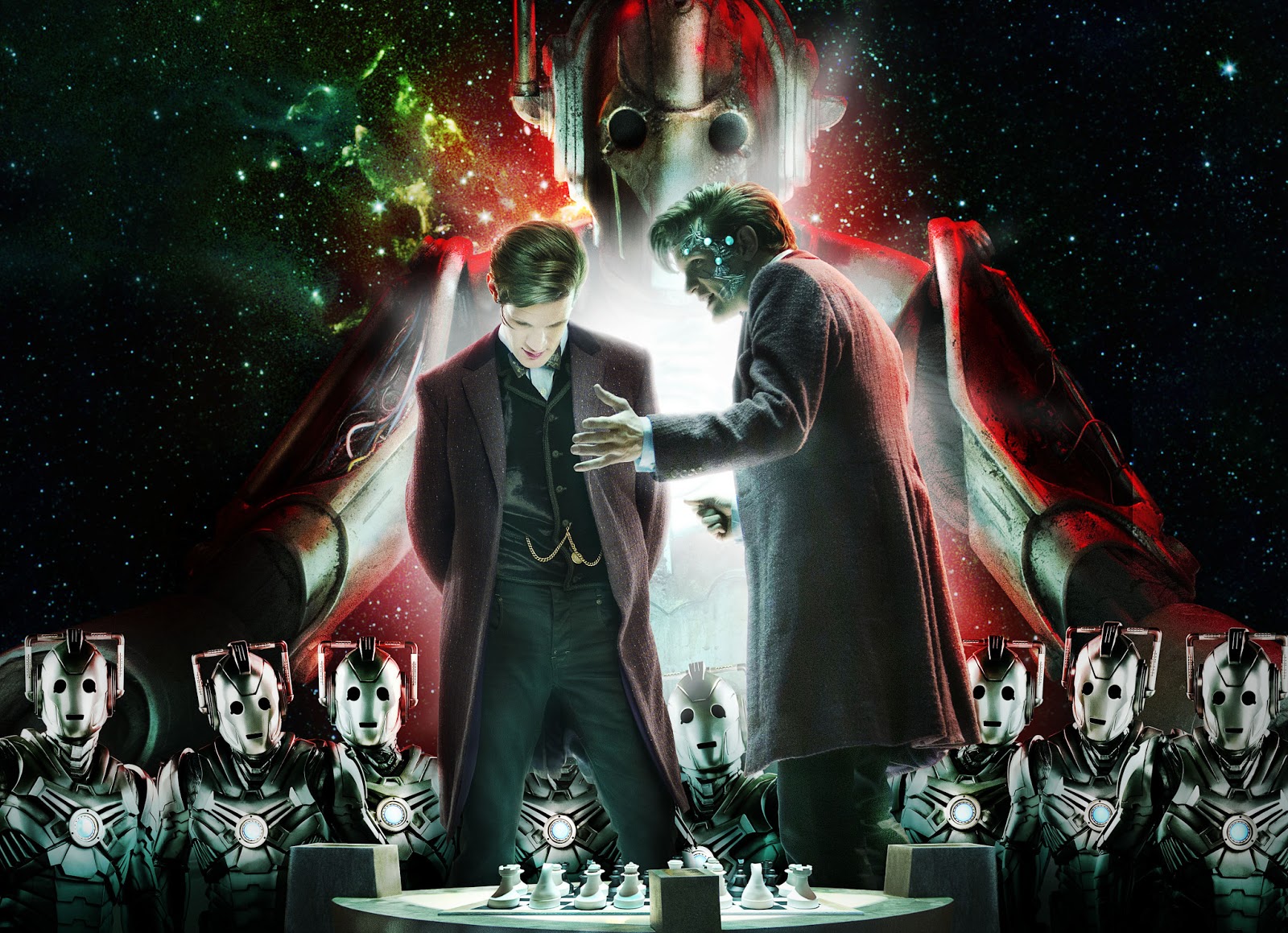
11 May 2013 at 16:08 #855411 May 2013 at 15:34 #8539Hope this works – No, pressure, Mr Gaiman…
http://ontv.deviantart.com/art/Doctor-Two-and-the-Cybermen-96270418
11 May 2013 at 15:33 #8538I just want to feel like I felt when this showed:
11 May 2013 at 11:08 #8500What an excellent series of posts. Posts which clearly encapsulate why Doctor Who can be so many things to so many people all at once.
I particularly like @phaseshift‘s Batman and Key to Time musings and @scaryb hits the nail on the head with her music analogy methinks.
I guess I have always ( well, not always, but when I was old enough to be reflective about such things and did not simply get carried away by the sheer fun of it all ) thought of the Doctor as a Best Friend, someone you admire, love spending time with and can learn and laugh with. Sometimes, though, the BF does things you would not do yourself, or hangs out with women you don’t like who seem to change him, or betrays you, or is unexpectedly cruel or unforgiving. But he is still your BF and you cope, and eventually you get over the bump caused by whatever and go back to being best friends. Even if the BF decided to have a sex change it would not matter really.
I think too that it is absolutely right that the Internet has changed everything. In two key ways. Firstly, it means anyone can say anything and that those who want to be “cool” or part of the “cool majority” can adopt other opinions as their own and in quite short time those mass views can be taken, by some, as the Gospel. Secondly, it means that the opinions of “official” reviewers have a greater audience than they ever did in the 60’s to 80’s.
The second can affect the first, either positively or negatively, by whipping up an issue or by uniting people in either accepting or rejecting a stated opinion.
While it might be that the Doctor does not believe in the afterlife, there do seem a lot of people who think Doctor Who is its own religion. It is these people who called for blood when Hurndall was cast in Five Doctors – as @phaseshift pointed out. These people, these self-appointed priests of the sacred temple of TARDIS, do more harm than good by their idiotic blinkered ways. They hold onto precious missing episodes to give themselves power; they have props and other paraphernalia which they stole and which they lord over newer fans. They make the Daleks look benign. The Daleks do what they do because that’s how they were made; these people, ostensibly devotees of a Television show which has decency, fairness and tolerance at its core, do what they do for personal gain, be it social, monetary or sexual.
It is the ones who called for blood over things such as the casting of Hurndall who were silent about the casting of Matthew Waterhouse ( for instance ). Because Nathan-Turner was behind the anti-Hurndall protests as he saw it as good publicity. His repugnant engagement with “senior fandom” and very young male fans was another moment which changed Doctor Who fundamentally – and not in a good way.
Doctor Who, both programme and character, has never been stuck to a particular path or character. There are all-embracing concepts which, for the most part, are consistent, but to think Doctor Who is a particular character or genre is nuts.
The only thing you can rely upon Doctor Who for is the unexpected. And that is it secret of success.
10 May 2013 at 10:38 #8411@bluesqueakpip. Brave heart! It is spoiler free – and right now a funny caption competion is raging!
Spoiler are for the Spoilers page.
There is some speculation, but mostly cool Cyberimages.
🙂
10 May 2013 at 00:57 #8405Use appropriate voice: I told you – he uses a Police Box…
10 May 2013 at 00:08 #8403@bluesqueakpip. @ardaraith. @thommck
I would not get too concerned. I am sure it is managed information which will fit in with actuality but is designed to send us all into a spin.
On the other hand….
9 May 2013 at 23:55 #8402@craig. Okay – cool. Once you have moved them I will post something about Memories and Companions then.
And I did not think you were staying I had posted in the wrong place – all I meant was that you should feel free to move anything I post anytime without asking me if you think it is better elsewhere.
Your Mum is, obviously enough, a generous and kind woman.
Thanks!
9 May 2013 at 22:32 #8397@craig. Forgive my innate Luddite tendencies, but truly, if you want to reposition things I have posted please do. You have my complete agreement.
Because it is Anniversary Year, I did wonder if there might be a couple of discussions we could start that could include everyone easily – such as : Favourite Companion and Why?; Best Adversary of the Doctor and why?; Best all time favourite episode ending in Classic Who and why?; Best writer for the series and why?; Favourite Nu-Who story and why?
Too cheesy? I would be happy to write some starting posts for any or all of those if it helped?
This site has been a post-operation Godsend!
🙂
9 May 2013 at 17:23 #8340I think the greatest issue with the TARDIS crew in the three companions Davison era is the false need for “tension” between them.
When there were three in the TARDIS in the Sixties, essentially, with the odd spat, they all got along – and it was a matter of them, as a cohesive but interesting whole, on the one hand and the Doctor on the other. Ian and Barbara and Vicki worked this way as did Ben, Polly and Jamie.
Nathan-Turner just had a specific idea about bickering in the TARDIS – something he allowed reach its zenith in the 6th Doctor/Peri combination.
You are right about Peri in Caves of Androzani – she is really quite good there. I was remiss to leave that out. But she wasn’t good in Planet of Fire and I never thought she was ever much good again. But, there is that lingering sense that with good writing and Davison, Peri might have been a better valued companion.
I never thought of Ainley as a carbon copy of Delgado – he just had no style, even though there was a superficial physical resemblance. But I take your point – and agree – the sensible choice would have been to give the Master a fresh look, so Ainley could be his own creation. I convinced myself that the Master was the vain type and had decided that the Delgado look was the one he liked best and, therefore, chose it upon regeneration, rather like Romana chose the body she wanted in Destiny of the Daleks.
I don’t know why people didn’t like John Simm – I quite liked him and he was infinitely better than the dreary dribbling disastrous dog-turd that Ainley was.
[PhaseShift Edit at authors request: The comment about Ainley is clarified here]
As to Tegan, it always seemed to me that the production focus was on her to the exclusion of Nyssa, but that Sarah Sutton always did her very best and excelled in ways that the script and the direction/production did not expect. She was, as well, playing a shy, lost but smart Trakenite – not a human – and she had lost her father but kept coming in touch with a maniac who had stolen his body. I always thought it was a hard ask but that Sutton really did the job. She is subtle and underplayed – everything Tegan is not.
Indeed, I think the truth is that Nyssa shines most before Tegan arrives and Tegan shines most (Kinda aside) after Nyssa has gone.
Its odd to think about Sarah-Jane Smith travelling with Davison – personally, I think that Liz Sladen could have made anything work – but, mostly, I think if he had started with Sarah-Jane instead of Tegan, Nyssa and Adric, Davison’s Doctor would have been different. Probably fundamentally different.
Its why companions matter.
9 May 2013 at 16:08 #8337Not sure if I can risk Colin Baker though

Quite right too.
Who needs Guantanamo Bay when you have Twin Dilemma?
9 May 2013 at 16:06 #8336@Charlie Cook
Welcome
Re osakaHunter comment about Brain of Morbius’ – in the mind battle Morbius’s past lives show on his ‘screen’ so the pre-Hartnell pictures must be the doctor. Mind you if you go by that, the Doctor has passed his twelfth generation so we are in other trouble elsewhere…
I have always taken the view that we, as viewer, do not know who is winning the mind fight at the point when the Hartnell image disappears and the new series of faces appears. It may be the Doctor and therefore they are earlier incarnations, but, equally, it may be Morbius, who does, after all, lose the fight.
I have always thought it better to think that Morbius pushed Tom Baker backed to Hartnell but then he rallied, knowing he was at death point, and fought back with renewed vigour – a bit like an arm-wrestle where one participant almost has the other beaten but the other gets a new wind and thrusts the other arm smack down the other way.
Anyway, its all up for debate that ole Brain of Morbius question – if only some writer who cares would sort it out! Moffat does seem a proponent of Hartnell was the first (see Vincent and the Doctor) so…
9 May 2013 at 13:47 #8315@ardaraith Not in that way, no. Caves of Androzani does provide some interesting direct-to-camera work, but it is not in the league of Feast of Steven.
9 May 2013 at 13:42 #8312@Shazzbot Don’t mean to mislead you – I think Tegan does change, quite a lot really, during her travels with the Doctor. She has a wider world view by the end of her time – compare her in Four to Doomsday and then in Enlightenment and you will see what I mean – but she is also exhausted by it and by the way the Doctor lives (and thus makes others live).
This is her final exchange:
TURLOUGH: Shouldn’t we inform Earth’s authorities? DOCTOR: Er yes. Yes, indeed. Come along. TEGAN: I’m not coming with you. DOCTOR: I beg your pardon? TEGAN: I’m tired of it. DOCTOR: What’s the matter? TEGAN: A lot of good people have died today. I think I’m sick of it. DOCTOR: You think I wanted it this way? TEGAN: No. It’s just that I don’t think I can go on. DOCTOR: You want to stay on Earth. TEGAN: My Aunt Vanessa said, when I became an air stewardess, if you stop enjoying it, give it up. DOCTOR: Tegan TEGAN: It’s stopped being fun, Doctor. Goodbye. Turlough. TURLOUGH: Goodbye. TEGAN: I’ll miss you both. DOCTOR: No, no, don’t leave, not like this. TEGAN: I must. I’m sorry. Goodbye. (Tegan leaves in tears.) DOCTOR: It’s strange. I left Gallifrey for similar reasons. I’d grown tired of their lifestyle. It seems I must mend my ways. Come along. (The Tardis dematerialises. Tegan returns.) TEGAN: Brave heart, Tegan. Doctor, I will miss you.
Its interesting when you say “there really isn’t anything new under the sun” – because that, I think anyway, is very true of Doctor Who in some ways.
Tegan’s departure was just a re-working of Victoria’s in Fury from the Deep:
DOCTOR: Well, we have to wait.
VICTORIA: Wait? But what for? For one of those awful creatures to come and attack us all?
DOCTOR: Now, Victoria, it’s not as bad as all that, you know.
VICTORIA: Isn’t it? Even you don’t know really how bad is it, do you?
DOCTOR: Well, no, not exactly.
VICTORIA: Every time we go anywhere something awful happens. Daleks. Cybermen.
DOCTOR: Yeti?
VICTORIA: Yes, and Yeti. Why can’t we go anywhere pleasant, where there’s no fighting. Just peace and happiness.
And Donna’s fate echoes the horrible punishment meted out to Jamie and Zoe by the Time Lords at the end of War Games:
TIME LORD 3: It is time to say goodbye to your friends.
ZOE: There must be something we can do?
DOCTOR: No Zoe, not this time. Well, goodbye, Jamie.
JAMIE: But Doctor surely we could
DOCTOR: Goodbye, Jamie.
JAMIE: I won’t forget you, you know.
DOCTOR: I won’t forget you. Don’t go blundering into too much trouble, will you?
JAMIE: Oh, you’re a fine one to talk.
DOCTOR: Goodbye, Zoe.
ZOE: Goodbye, Doctor. Will we ever meet again?
DOCTOR: Again? Now, Zoe, you and I know, time is relative, isn’t it?
(Jamie and Zoe enter a SIDRAT which dematerialises, taking them back to their respective time-zones)
DOCTOR: They’ll forget me, won’t they?
TIME LORD 2: Not entirely. They will be returned to a time just before they went away with you. They will remember their first adventure with you, but nothing more. But come along. Your fate has been decided.
The inter-racial aspect, as well as the sexual identity issue, occurs only in Nu-Who because times in the real world have changed thankfully – and the world is a much more accepting and tolerant place. Sometimes, anyway.
I like to think that Doctor Who has contributed to that change. 🙂9 May 2013 at 12:46 #8304@bluesqueakpip Clara is here to change the story. She may not know that’s what she’s doing – but that’s what she’s here for.
Yes, that is my thought too – and she will change the story by saving him…again…and creating her own impossibility. I feel sure that must be right.
But it still leaves the question of whether she is just Clara or someone else…
9 May 2013 at 12:44 #8303I would love to see the Monk return – so long as a really good actor with comic skills was up to playing him – Simon Russell Beale perhaps? or Alan Davies? His character is bumbling bad, not malignant like the Master or the Rani.
But remember that the Meddling Monk was not actually a Monk – he was a Time Lord pretending to be a Monk in order to meddle in Earth’s history.
So, I think it very unlikely that he will turn out to be amongst those seen in the Monastery in Bells.
but, as you say, SatsumaJoe, anything is possible.
I think my favourite exchange with the Doctor and the Monk is this one from Dalek Masterplan:
SARA: Doctor, look! DOCTOR: Ah, tut, tut, tut, my dear Monk. Now don’t be so ridiculous. Put that down at once. MONK: Well, hello, Doctor. Keeping well? DOCTOR: Oh, no complaints, no. And you? MONK: Oh, so so, you know, just so so. SARA: Who is it? MONK: Delighted to see you again, young man. STEVEN: Thanks. I wish I could say the same for you. DOCTOR: I suppose congratulations for your escape are quite in order. MONK: Oh, thank you. Most kind of you, Doctor. Yes, it took a bit of time, but I finally managed to bypass the dimensional controller. DOCTOR: Yes, a very interesting solution, yes, I’m sure, though I think it would make for rather an uncomfortable ride. However, I don’t suppose it affected you very much, being an amateur. MONK: Yes, it was rather uncomfortable, but then, we can’t have everything, can we? As for being an amateur, we shall see. Anyway, it was better than 1066. DOCTOR: Yes, I suppose so. SARA: What’s he talking about, 1066? STEVEN: It’s all right. We’ve met the Monk once before. I’ll explain later. DOCTOR: And you returned here for one obvious reason, did you not? MONK: I’m afraid so, Doctor. Revenge is a strange thing, isn’t it? DOCTOR: Yes, yes, quite, quite. Tell me, any plans? MONK: And all carried out as well. Oh, ho. Doctor, you remember you left me in 1066? Now I’ve marooned you on the planet Tigus. Look! Oh, it’s funny this. Forgive me laughing, Doctor, but I don’t seem to be able to control it. Well, goodbye, Doctor. Perhaps I’ll come back one day and rescue you
It really sums up Hartnell’s preening arrogance and sense of intellectual superiority in relation to a fellow Time Lord, decades before Deadly Assassin, as well as highlighting the mischief-maker and grudge bearer the Monk was as played by Peter Butterworth.
Funnily enough, I always thought Bernard Cribbins would make a good Monk…
But thank you for making me think more deeply about Dalek Masterplan – the first time the programme ever broke the fourth wall occurred there, when Hartnell wished the viewers at home a Merry Christmas. So, for those who are rooting for the Dalekisation theory…you have a direct co-relation between Hartnell in The Feast of Steven and Clara in Asylum of the Daleks – maybe it is a new Dalek Masterplan after all? 🙂
9 May 2013 at 11:17 #8299@Shazzbot As the Doctor would say, “the human mind is a remarkable thing”. Mostly, these thoughts come from memory, although occasionally I have to check a DVD or CD or transcript if I want to get a detail exactly right.
But my childhood memories are very vivid – I remember a few years ago hearing the CD of Power of the Daleks for the first time since first broadcast and, totally bizarrely, knowing what the Doctor was going to say in certain sections – because it was so burnt into my memory.
Didn’t mean to drop a bombshell re Davison – acting and the world of television is very small and I have been involved in both my entire professional life (although never with Doctor Who). Actors are people – they have friends and associated and colleagues just as we all do – and sometimes they find themselves away from their home, on location for something, chatting with complete strangers. As Peter Davison did that night.
I have not said anything yet about Troughton, Pertwee or Tom Baker – I thought I should join in the Fifth Doctor discussion as we were, as @Phasehift says, in the month of the Fifth Doctor in this anniversary year. I will come back to the others along the way though.
Remember too, please, that these are just my own thoughts – they are not fact or canon – and anyone and everyone is free to disagree!! 🙂
As to my moniker, the initials are the Doctors who I think of as “my” Doctors: the ones who got the spirit, essence and joy of the programme (as I see it) and who regenerate my inner child each time I see or hear one of their stories. The ones whose initials are not there, do not – and, as I will explain when the time comes, that is not necessarily about the actor.
But bless you for your kindness – this site has been very good – essential my favourite nephew tells me – in my recuperative process. So, thanks again to humble @craig. And everyone else.
9 May 2013 at 10:00 #8293Davison
I forgot to say – my top five Davison era programmes? Caves of Androzani, Kinda, Earthshock, Enlightenment, Five Doctors.
Top ten? Add – Terminus, Snakedance, Resurrection of the Daleks, Visitation, Mawdryn Undead.
For what that is worth….
🙂
9 May 2013 at 09:55 #82929 May 2013 at 08:27 #8291@zaphod. More likely I think that it will be 1, 10 and 11 – with always the possibility of 12 at the end…
9 May 2013 at 01:12 #8285@shazzbott
I live to serve.
In Classic Who, all of the companions were human except Susan, Leela, K9, Romana, Adric, Nyssa, Kamelion and Turlough. But apart from the robots, none were presented as “aliens”, really.
However, there were exotic “normal” companions – Susan, Victoria, Jamie, Zoe, Leela, Romana, Nyssa, Turlough, Peri, Ace – in the sense that they were out of their own time and place, which might not be Earth, when travelling in the TARDIS.
In Classic Who, by and large, the companion’s back story was told in clear, but uncomplicated ways, when they were introduced. The audience knew who they were and what they represented. The real exceptions were Turlough and Ace, and to a much lesser extent Mel and Romana.
In Nu-Who, the focus is quite different. Every companion, pre-Clara, comes with a family and some with boyfriends/girlfriends. That is an entirely Nu-Who innovation.
It worked, in my view, with Rose, Donna and Rory, but not at all with Martha or Amy ( although her family was, to say the least, complicated ).
But the role of the family members, by and large, is to question and object to the Doctor. In Rose’s case, the family is more intricate to the dynamic of the ongoing narrative and, for me anyway, that works very well. The story of Rose’s mother’s transformation because of the Doctor is as profound if not as heart-breaking as Rose’s.
Another way that Nu-Who is essentially different from Classic Who is that the Doctor is forced to deal with consequences: that has never happened before. When a companion departed in Classic Who, that was that; you never heard from them again. ( I am discounting the out-of-timeline events, Five Doctors and Two Doctors) The only real exception was Jo Grant, who returned in Planet of the Spiders in spirit if not in fact – her return of the Metebelis Three crystal started the race that would cause Pertwee’s Doctor to die. (Harry Sullivan also came back after he travelled in the TARDIS but just once (Android Invasion) and not for any reason other than he was part of the UNIT family.)
Planet of the Spiders was the only time – pre-NuWho – were the Doctor faced a consequence because of something he had done for or with a companion.
School Reunion changed all that – the Tenth Doctor was made to face up to his sudden betrayal and abandonment of Sarah Jane Smith in Hand of Fear. It was a game changing moment.
Since then, the Doctor has faced the consequences of taking Rose in the TARDIS, taking Donna in the TARDIS, taking Adelaide in the TARDIS, taking Wilf in the TARDIS, not keeping his promise to Amelia and taking Amy and Rory and Brian in the TARDIS.
Compared to Classic Who, Doctors Ten and Eleven have faced up to the consequences of their adventures more than any other incarnations – and that takes a toll.
Also, in Classic Who, companions ( at least prior to Pertwee ) always stayed with the Doctor from the time they commenced travelling to when they left. The first two Doctors could not control the TARDIS so the companions were always stuck in the TARDIS until they decided to leave ( or in Susan’s case, the Doctor left her behind ) or died ( Katarina, Brett Vyon and Sara Kingdom ).
As Pertwee was exiled, the companions could come and go, but there was always a sense that the Doctor was not doing things without them. This continued with Tom Baker to a degree – as I say, Harry came and went – but really once he started to helm the ship, the companions were with him for the duration.
Tegan provides an odd exception to that in the Davison era – she leaves at the end of Time Fight but then rejoins in the next story.
It is not really until we reach Nu-Who that you get the sense of the companion being dropped home for some R&R. But that notion has pervaded all three Nu-Who Doctors to a greater or lesser degree.
I vastly prefer it when the TARDIS cannot be controlled by the Doctor with the result that the companions must stay and cope and the Doctor has to work harder to find solutions. But that is not, so far, the way of Nu-Who.
Please ask anything you like – others here will soon let you know if my take is wrong I am sure.
Hope this has helped.
9 May 2013 at 00:20 #8284Davison
By the time Castrovalva came along, I was a father and my first son ( then 2) reacted very favourably to the Doctor Who theme tune and so my memories of the Davison era are indelibly linked to him sitting on my lap, pointing at the screen, burying his head in my chest or calling out “Doc-Doc Whooooo”.
I was ready for change, had been really since Armageddon Factor. Tom Baker stayed two long and people seemed to think he WAS the Doctor.
He wasn’t.
And Peter Davison, quietly but forcefully, showed precisely why.
To digress, when he was announced as the Fifth Doctor, my heart sank. At first when told it “was the vet from All Creatures Great And Small” I assumed they had cast Robert Hardy and was momentarily thrilled beyond measure. Hardy is an actor’s actor – and a force of nature. He would have given it a fantastic whirl.
But, no, it was Tristan. Too Young. Too pretty. Too bland. I confess to being appalled and worried. With Tom Baker overstaying his welcome and Davison as a wet passive type, what hope was there?
Boy, was I wrong.
Firstly, and this is often ignored, Davison reverted to type. His Doctor assumed a persona and stuck to it. Like Hartnell and Troughton, he chose an outfit and stuck to it. Unlike Pertwee and Baker, he did not change his sartorial style. Which was cleverer than it sounds – because it meant you focused on the performance rather than the trappings.
Secondly, he was blessed with Anthony Ainley. I hope you can understand my meaning: Ainley was appalling as the Master in every possible way, and his constant appearances during Davison’s time helped shore up Davison as the solid, reliable and mercurial actor that he is.
Ainley made Davison good just by showing up: in a kind of reverse-the-polarity-of-the-neutron-flow way, Ainley ensured Davison’s success by his incompetence as an actor, in much the same way Delgado had ensured Pertwe’s success because he was such a good actor.
Thirdly, he was blessed with terrible companions ( mostly ) and this, too, made him the focus.
But mostly – he was just a good guy. He was the Time Lord you would invite for tea and never be afraid of his behaviour; the one you would lend money to; the one you would call when the kids needed a sitter; and the one who was colder and meaner than his youthful good looks suggested.
And he was wry and witty. He did not revel in his alien qualities, but he did not try to be an Everyman either. He managed that rare feat – scientist, dabbler, fusspot, sex symbol and teacher.
He could also put up with Tegan – which, in his first season, was really quite a feat. She was, unique of the companions to date, a tiresome whinging busybody. Yet, Davison found the good in her, focused on it and made her better. He made an effort with her when the Fourth Doctor could not be bothered.
It made for a fascinating interaction – and despite the age of the programme, a quite unique one. You could not have had the glorious Kinda without the investment Davison’s Doctor gave to the development and calming of Tegan.
In that first season, Davison had three excellent stories ( Visitation, Kinda and Earthshock – that first episode of Earthshock is the best first episode of any Nathan-Turner produced story in my view), two odd ones ( Castrovalva and Four To Doomsday) and one of the all time turkeys: Time Flight.
As Tom Baker might have said: There were three types of stories in that first Davison season: the great, the good and the bad…and then there’s Black Orchid…
But, the one thread through it all, even in the dross that was Time Flight, was the exemplary talents of Davison. His Doctor was the perfect blend, really, of the first, second and third Doctors. In hindsight, what Davison did was incredibly brave and intelligent: he did his own thing, while fitting in with the past in a way that his immediate predecessor had entirely eschewed.
Adric: there is no way to escape discussing Adric when reflecting on Davison. After all, Davison killed him. No Doctor had overseen the death of a companion in quite the way Davison oversaw Adric’s death.
But, who could blame him? Adric was an interesting character, but played badly, impossibly badly, by Matthew Waterhouse who had no business being in Doctor Who. Nathan-Turner’s worst decision, however motivated, was casting Waterhouse – because denying the character of Adric a proper actor ensured two things- that Tom Baker’s Doctor would be unnecessarily diminished by him and that Davison’s Doctor would have to kill him.
Because, actually, the kindest, nicest and best thing the Doctor could ever do for Adric was to let him die a hero. Because unless the Doctor let that happen, Adric would have amounted to nothing.
People say that Davison is not as alien as Tom Baker, not as dark, not as dangerously unpredictable. Perhaps. But Tom Baker did not walk away and leave a companion – not much more than a child really – to die. Tom Baker would not have let Adric take that stand: Davison did.
And not from self-interest; but because it was the best thing for Adric – a tormented, lost, lonely and difficult child would just would not learn, grow or assimilate. Letting him become a hero was both the best and worst thing the Doctor could do.
But, dear God, it was dark…
In his second season, the Curate’s Egg pattern continued with the adventures Davison got: Snakedance, Terminus and Enlightenment ( all great ), Mawdryn Undead and Kings Demoms (okay, but slightly troubled) and Arc of Infinity (ghastly).
And then there was Five Doctors – where, compellingly and without effort, Davison walked away with the programme; not even Troughton could dim his light. He did not make Pertwee’s Three Doctors mistake – the programme was not skewed to him; he just let everyone have their moment, and that grace, that dignity, that style defined him more than pretty much anything else he did. He was THE Doctor; the others, including the magnificent Hurndall, were the past. Nothing could have been clearer.
To me, Davison’s best companion, and the one that Nathan-Turner had no idea what to do with, but who was the best actress and whose character had the best potential, was Sarah Suttom’s glorious Nyssa. She stuck me as a fusion of Susan to Hartnell, Victoria to Troughton, Jo to Pertwee and Romana 2 to Baker – she and Davison worked perfectly together and complemented each other magnificently.
Davison was the first Doctor since Pertwee not to have a single female companion – and it is both his strength and a lost opportunity. If he had one series where he was just with Nyssa, I think time would look differently, more approvingly, on him.
I had dinner with Davison just after Five Doctors was aired and before his final season started. He told me that night he was going to leave because he did not think that Nathan-Turner would ever let him be “free of the boys that he thinks brings viewers”. He was melancholy about it – because he loved the programme, but he did not feel like his opinion was taken seriously enough. He felt, probably rightly, that Nathan-Turner would not make the mistake that had been made with Tom Baker in the latter years – the concept was the star, not the actor.
He was unhesitating that Nyssa was his favourite companion. He liked Fielding and Strickson, but felt, again rightly in my view, that the chemistry was there with Sarah Sutton – but the writing let them both down. After some serious alcohol, I had thencourag to agree with him. He said ” You didn’t need to say it, your eyes told me I was right about two hours ago”. (And my career as a spy was abandoned there and then) ( And I felt like I had just met THE Doctor)
I tell that story for only one reason – you would never know that Davison was leaving if you look at his final season. In Every moment of every story – no matter how badly written or directed – he delivers. Not since Troughton had the programme been so well served by its star. Just as Troughton rose above Dominators, Davison rose above, well, everything except his final glorious tale. And there he more than met the challenge.
The 21st season is not good: Warriors of the Deep sets a new low ( You would have thought they would have learnt about Ingrid Pitt in Time Monster but no…) and the Myrka makes one long for the Drashigs; The Awakening is utterly pointless and possibly the most boring Doctor Who story ever; Frontios tries to capture the Kinda magic but fails spectacularly; Planet of Fire is notable only because never before have companions been so clearly and unambiguously reduced to sex objects ( and no one will ever convince me that Peri’s outfit was merely a cover for what Nathan-Turner made Turlough do there). Four repellant adventures with a damn decent Doctor.
Turlough – one of the great missed opportunities of Doctor Who. Mark Strickson was a good actor – he would have been a sensational Adric in my view – but the scripts gave him nothing. There was no defined arc for his character. He was in the TARDIS so that the Mary Whitehouses of this world would not complain about orgies in the TARDIS – I always found this odd. Why did people think that two attractive men and one/two attractive women might not have an orgy? Nathan-Turner’s logic was, well, illogical.
Especially as Davison went to great pains to be an entirely sexless Doctor.
Peri was a disaster from the start. I loathe her more than any other companion who has travelled with the Doctor. She made Tegan seem affable. Irksome, dumb, whiny and petulant – she may have been the perfect English conception of an American but she was wrong with a capital WRONG!
Resurrection of the Daleks was really the first story since Genesis to try to take either the Daleks or Davros seriously. It did not work entirely, but it gave it a good damn try. And, as @jimthefish rightly says, Tegan’s departure was both surprising and shattering – and a profound indictment on the Doctor. It was, and is, the only departure of its kind – and in that moment, Fielding gave her very best performance. It took me utterly by surprise, the way she went- and it was profoundly affecting. Tegan found her brave heart at the very end.
Then there is Caves of Androzani…a Robert Holmes masterpiece. No Doctor, apart perhaps from Troughton, has had a better swan song. And just as well, really, because Davison deserved to go out with a bang.
And, entirely fittingly, his Doctor sacrificed himself to save his companion. Just as the right thing for Davison to do was leave Adric to his heroic death, the right thing for Davison to do was to save Peri – he did not know then what a complete waste of space she was and so he gave her the benefit of the doubt and saved her, unsure whether he actually could regenerate. Those final scenes in Caves are as harrowing as anything ever in Doctor Who.
Indeed, Caves of Androzani is in the top five best ever Doctor Who adventures – entirely because of the sheer strength of Davison’s performance.
No wonder, then, that David Tennant thought of him as his Doctor.
Because he was an exceptional Doctor – and one who rarely got the chance to shine as he might have because of bad writing, ghastly production values and conceptualisation and the worst motley TARDIS crew in the history of the programme.
As I have said elsewhere, my anger about the final scene in Caves Of Androzani, the one that introduced Colin Baker to an unsuspecting public, was unbounded. It was so disrespectful, so rude, so bewilderingly inappropriate as to viscerally shock the audience coming to terms with the passing of the Fifth Doctor. It is the single most ill-judged moment in the entirety of Nathan-Turner’s era, an era not known for its wise decisions.
But all it did was make Davison’s light glow brighter – and amen to that.
In Twin Dilemma, Colin Baker would label Davison “effete”. In so misjudging his predecessor, Baker set the stake in the ground for the entire misjudgment of his incarnation.
Davison had done what many thought was impossible – he successfully replaced Tom Baker. In a way, he did the second hardest job in the history of the series, Troughton’s being the hardest in taking over after Hartnell.
In another way, Davison did something no one else had done – redefined the parameters of the role by drawing on the past and being his own self simultaneously – something that each of the Nu-Who Doctors would go on to do in varying degrees, both in aspiration and achievement.
But Davison did it first.
And as Caves of Androzani proved, wearing that celery was an inspired idea.
8 May 2013 at 22:19 #8274You raise interesting and, in my view, complex issues.
I don’t have any answers – but I do have thoughts.
Firstly, the sequence in Unearthly Child is over-thought. In truth, if you were somewhere you did not intend to be and your grandchild was possibly in peril, would you prioritise the needs of a complete stranger over your grand-child? Because, that is the question. Ian and Barbara were on their first journey in time and space – they were excited, scared, blown over – they could afford altruism. The Doctor, knowing that the human race was not in danger if one person in the time they were died, prioritised Susan over that person. It’s a no brainier in my view. ( And, yes, that is a deliberate pun!)
Secondly, and more importantly perhaps, there is a single clear distinction between Classic Who and Nu-Who: the Time War. We don’t know the details, but we do know that it cost the Doctor dearly.
So when we rediscover him in Rose, he is a very different shade of Time Lord. He is grey, edging on black. And he does not like himself very much.
Rose changes that, and not ( in my view) as most believe because she fell in love with him, but because he was exciting to travel with and he literally changes her horizons, makes her a better person by what he lets he see and do. In this, Rose is the traditional companion type.
Equally, because she is who she is, Rose challenges the Doctor. This is especially clear in Dalek, but elsewhere too.
For my money, the Ninth Doctor is simply tired by the time he comes to regenerate. He has endured the Time War and possibly decades of solitary mourning and second-guessing. Rose makes him come to see that what he did was for the best, because, actually, he is incapable of making seriously bad choices. Seeing the truth finally, he can rest, renew.
Doctor Ten is a much happier, more confident Doctor – much more a Classic Who doctor. And this one Rose does fall in love with. But the Doctor does not love her the same way and that inability gnaws at him – you see it most clearly in Satan Pit. It is almost as if (and this is an analogy not a statement of fact) Rose is the equivalent of a fag-hag to his unreadable unattainably perfect( in her mind) Doctor.
But he is unprepared for her loss to the alternative world and it disturbs him. He tries to put on a brave face with Martha, but, to his horror, she falls in love with him too. So he decides upon a solitary life again.
Then Donna barges in and forces him to be her companion ( because make no mistake, that is what he is to her. She is sorting him out matey) and she makes marvellous progress – and then Donna Donna happens and she is lost to him.
That is three women whose lives he has destroyed ( in his mind ) and he goes into a spin – revisiting the delusions of grandeur that haunted his sixth and seventh incarnations and saw him capable of sealing theTime Lock.
Wilf eases him out of that – because, faced with self-importance or the death of one frightened old man whose granddaughter has already suffered profoundly, he elects suicide.
We don’t know how much time passes between that regeneration and the start of the Pond era – importantly, we don’t know what has happened to the TARDIS.
But Doctor 11 is both nothing like any one face that came before him and at the same time a constantly changing kaleidoscope of them all. He is an unsettled soul – he revels in being a mad man in a box – and curiously, for the very first time in his life as we have seen it, he seeks out or is drawn to abnormal humans: Amy, with her crack in time; Rory, who can wait 2000 years for a woman who he does not believe loves him as much as he loves her; Clara, the impossible girl; River, the mysterious gun-toting lipstick wielding force of the Universe who defies classification and who says she is his wife and knows him well – and seems to; Vastra, Strax, Jenny, Nefertiti and Redding – all weird and fascinating not quite ordinary Earthlings.
He can’t travel with normal people – because normal people could not cope with him – look at Brian, for instance.
So – the dynamic of the companion is quite different now – for reasons which, in my view, stem from the Time War. And between 9 and 10 on the one hand and 11 on the other, the companions are different again.
I have left out Jack because I don’t really count him as a true companion – much like the Brigadier. He comes along for the ride, but his life is not entwined with the Doctor’s in the same way as Rose or Martha or Donna. He is a passerby, touched by the light of the TARDIS and enriched by his friendship with the Doctor.
Earth has always been a special place to the Doctor – after all, he picked it as the place to school his grand-daughter. The first, third, fourth and tenth Doctors all die on Earth and the second is effectively executed by the Time Lords and then his body, changed into the third, is sentenced to imprisonment on Earth. All of the early Doctors talk, one way or another, about the incredible resilience and inquisitiveness and spirit of Earthlings – the apex of this is Tom Baker’s “indomitable” speech in Ark in Space.
They are all, all eleven incarnations, passionately interested in Earth. And given that the Eight maintained he was half-human, you could be forgiven for thinking that one of his parents was human. Even without the Eighth, you could think that.
I don’t think any of the Classic Who companions had the function of either egging him on or restraining him.
I think it is unfair to suggest Sarah Jane was encouraging the Doctor to commit genocide (even though she was!) because her words need to be seen in the greater context: the Time Lords had told the Doctor that the Daleks would become the dominant life form in the universe and ordered him to destroy them for the greater good; Sarah had seen the Daleks in action in Death to the Daleks and she knew what they were capable of; the Doctor had come to that very point in Genesis intending to destroy them. What is surprising about that scene is not that Sarah advocates the destruction, but that the Doctor does not do it. Remember, Hartnell had finally destroyed them when he first met them ( timey wimey ) and Troughton thought he had in Evil of the Daleks. Every other time the Doctor met the Daleks he was calm about eradicating them entirely – and that is the right position. Yes, truly it is.
The Genesis decision, actually, is the out-of-character decision – but it is the moment when Tom Baker’s Doctor establishes without question that he cannot be anticipated. He is a Time Lord, not a human. That is the significance of that moment and it should not be overlooked.
With the exception of Ian and Barbara, whose role was, specifically, to humanise the Doctor, ( which really meant make him stop molly coddling Susan at the expense of everything else) all of the other companions have been just that – companions.
They are in the adventures together, but they bring their own personalities to the journey and, accordingly, they shape the Doctor’s behaviour. All the key companions, at different times, call the Doctor on his behaviour: Vicki, Ben and Polly, Jamie, Zoe, Liz, Jo, Sarah, Leela, Romana, Tegan, Nyssa, Ace…one way or another, in their own way and to varying degrees of success, they help shape and enlighten the Doctor. The Brigadier does this too. Even the tiresome Adric, in dying, significantly affects the Fifth Doctor.
So – although we talk about the Smith Doctor being different and darker and whatever else we say, in my view, the truth is that the 11th Doctor is, truly, the first Doctor not to have “ordinary” companions. It is almost as if Moffat believes that the modern audience can’t be bothered to invest in “ordinary” companions.
I think he is wrong about that.
Leaving aside whatever her mystery is, Clara is, apart from that and always saving him, quite ordinary. Like a cross between Zoe and Sarah-Jane. That is her special appeal – to me anyway. ( I love her. I just want the Impossible stuff over so she can settle into her true self, whatever that is – mind you, I am quite prepared for the fact that she will die and the story about her continuing next year to be a simple Moffat lie)
So, my hope is that she will move from Impossible Girl to ordinary Clara (even if that turns out to be Susan or, say, the child of Rose and the other Doctor 10) – and going forward the format will return to the Classic style – the remarkable Doctor and the confused/excited/querulous/questioning companion.
Not sure if that helps – but for what it is worth, they are my thoughts on Shazzbot’s bone.
Cheers
8 May 2013 at 17:55 #8236@jimthefish Yep – he is pulling the Fish chain…for sure. Some sort of dream or other reality or higher consciousness – perhaps part of the fight for conversion of the Doctor to full Cyber-mode?
Now that is an interesting question – if the Cybermen started to cyberise the Doctor, at what point would his body consider a regeneration was necessary?
8 May 2013 at 17:09 #8233@thommck Well, Mondas was Earth’s twin – and the notion was that the Modasians were human-like. I shared your terror of the “Silver Piper” coming to take me away into the night to become like them…
Can’t wait!
8 May 2013 at 15:10 #8225Okay – Spoilers: do not look if you dont want to know something about Nightmare in Silver
Spoilers
Spoilers
SPOILERS
++++++++++++++++++++++++++++++++++++++++++++++++++++++++++++++++++++++++
From inside the BBC…
http://4.bp.blogspot.com/-uSDcZppNmyI/UYk9bf_jD6I/AAAAAAAAdm4/XY-3UWnLgZY/s1600/doctor-who—series-7b_final_4176198_4176188.jpg8 May 2013 at 14:38 #8223@fulcanelli Thanks. Upload it to where? Sorry – am not good with technical stuff and my nephews are not here…
8 May 2013 at 14:26 #8221I have been sent a spoilerific photo from Silver Nightmare press stuff – i have it as a jpeg but no idea how to post it here?
Help!!
8 May 2013 at 14:17 #8220@scaryb I agree. I cannot see any sign of the Doctor fixing things til they are right. Don’t think 3 Sisters will help either…I remain convinced that there is but one Clara who is yet to make herself the Impossible Girl but which she will do in the finale via some sort of timey-wimey paradox.
I think this arc is about, in its simplest terms, how the Doctor needs his friends to survive.
But, like you, I don’t expect to be right! 🙂
8 May 2013 at 14:03 #8218@bluesqueakpip OMG! Someone told you the ending of Utopia before you saw it? I hope they died a long and lingering and very very painful death…
8 May 2013 at 12:34 #8212@JimThe Fish @scaryb @whisht @whohar @craig
Thanks all for your generous comments about my ramblings. I really do appreciate your kindness.
We should, really, demand that @craig changes to @DoCraig or @DrcCraig – because, like the Doctor, he has created a safe place for a group of disparate people to go on journeys, laugh together and grow to understand each other, based upon a simple trust in him. Its a rare and blessed thing – and, from my point of view, there can never be enough kudos for him.
There is no shared or gestalt response to Doctor Who – something the dozens of idiotic posters on the Guardian don’t comprehend. Rather uniquely, Doctor Who is capable of speaking individually to its audience and I am sure that one day there will be Phds given for social studies about what Doctor Who did to encourage a couple of generations of broadcasters, actors and other creatives, as well as contributing, significantly, to tolerance in society.
I have never understood the people who insist that one era or Doctor was THE best and that anyone who thinks otherwise is an idiot. These are people who have never really paid attention to the programme they purport to be expert on – because, at its heart, always, Doctor Who is about acceptance and different points of view – the utter rejection of the tyranny of “I am Right”.
I admit to the fact that I was afraid to make the Hartnell and Regeneration posts – I was worried that there were not what you younger and cooler folk wanted – so especial thanks for making someone who feels 1000 also feel welcome.
When I watch Nightmare in Silver, my nephews will be with me. One of them carries my lost brother’s name (of course, he is my godson and favourite) and he is the age I was when I saw Moonbase. He is so excited. And so am I.
What I love most about Doctor Who is how it makes me feel 12 again – and like anything is possible.
8 May 2013 at 12:20 #8209@jimthefish How I would love the Tenth Planet voices….but, more than anything, I want them to be the silent killers they used to be – the mechanical clunking can be impressive in a war-chant kind of way but it does limit their potential for surprise scares. I am praying Gaiman fixes that.
It looks like a homage to Moonbase though, don’t you think?
8 May 2013 at 12:15 #8207@phileasf Or maybe, just as Zoe controls the UNIT forces in Invasion at one point (when calculating how to destroy the Cyberships), the situation requires her to take control? Maybe the soldiers are trainees and she is in full Mary Poppins mode?
7 May 2013 at 22:58 #8174@Shazzbot My Nanna was an amazing woman – but she was a believer in a simple thing: always tell the truth to children. She always did and I was much the better for it and I have tried all my life to treat my children the same way.
One of the things I don’t like about later Doctor Who is that the Doctor keeps secrets – sometimes important ones.
I used to write a lot – but not lately. But thank you. 🙂
@phaseshift Cheers – I will keep rambling on then… 🙂
7 May 2013 at 19:05 #8137Thanks @jimthefish. I appreciate your kindness. I am sure you can capture your feelings and emotions as well as me – you have no trouble communicating your feelings in the posts on the pages above. 🙂
7 May 2013 at 15:43 #8120Regeneration
Quite a lot happened in my life on 30 October 1966: my youngest sibling died in a tragic accident which saw my parents split up and me, temporarily, sent to live with my maternal Grandmother while the adults sorted things out.
The accident happened the day after Tenth Planet finished.
I was almost catatonic with grief – I had lost my brother and the Doctor had died. I remember crying a lot.
My Grandmother was a very wise woman – imagine Amelia Rumford from Stones of Blood fused with June Whitfield and you are somewhere near the mark. She was a former vaudeville dancer, then Matron at a hospital. Formidable but fun.; kind and understanding.She had never seen Doctor Who but she had patiently endured me babbling on about Zarbi and Thals and Aztecs and Time Meddling Monks and Celestial Toymakers and Cybermen (she knew they really scared me).
And she knew how vulnerable I was, at 9 years old, given what happened to our family on 30 October.
She wanted to calm me, to comfort me, to help me through the loss of my brother. She had to – because my parents were not up to it. And she realised quickly that Doctor Who was the key.She got me to stop being sad and crying by cajoling me to tell her the story of my favourite Doctor Who story.
So I told her about Dalek Masterplan. It took ages – she made scones and we had a little tea party while she came to grips with the various planets, the trickery of Mavic Chen and the deaths of Katarina, Bret Vyon and Sara Kingdom. She used those deaths to get me to talk about my brother and how I felt and she held my hand while she told me that he was playing with Katarina and Bret Vyon and Sara Kingdom now.
She sat on the roof of her terrace house with me at nightfall and we counted the stars and looked for the TARDIS. She spent hours making me feel okay, and opening an escape door into Doctor Who, a place where I felt entirely safe and where the Doctor would always be there.
Then, after about two days, she asked about the episode that would play on the next Saturday. I got immediately agitated and explained that “the Doctor has a new face; the Cybermen killed him and he has a new face”. She had no idea what I was talking about but when I asked her when I would see my brother’s new face, she knew she had work to do.
So, she got me to talk about Tenth Planet and she made a special journey to the shops to buy the Radio Times to see if she could find out anything. She quickly discovered, from the man at the shop, that Patrick Troughton had been cast in the role and would be starting as a new Doctor that week.
So she went to work. She reminded me that she had taken me and my siblings to see three theatre productions – two Peter Pans and one version of Cinderella. She asked me what I remembered and we discussed that. She made lunch and while I was distracted by her perfect toad-in-the-hole, she asked me which Peter Pan I liked the best.
I remember being struck silent by the question and some brown sauce dripped onto my shirt because I had stopped eating, the fork poised in mid-air.
“What do you mean Nanna?” I said.
“Well, we saw two versions of Peter Pan, remember, one with the puppet crocodile and one where we did not see the crocodile” she reminded me.
“The one with the crocodile we didn’t see. That one was scary”
“Yes, it was. But which Peter Pan did you like best?”I was flummoxed. I did not know what she meant. So, she came and sat next to me and produced the programmes she had kept for the productions. She showed me that two different young women had played Peter Pan. I was more surprised that there were two of them than they were women!
“You see” my Nanna said very carefully “Peter Pan is a part that people play. He is not real. So anyone can play him really.”
“Can I?” I remember asking, thinking that I really wanted to be able to fly.
“Yes, one day. Sure. And that is what is happening with your Doctor. From this week, someone else is playing him.”
“So, he is a different doctor?”
“No, darling. The same doctor, different actor. Different face. When you are talking about a part in a play or on telly, lots of people can play the part, so the part can have many faces. But your brother, well, he was real and so he only ever has one face. His own face.”She held me for a very long time then. But that was the point that I accepted my brother was gone and that I accepted that the Doctor was not real and that he could change his face.
Not that anything about what happened was, on any view, lucky, but I think my circumstances meant that I came to Power of the Daleks more ready than many others might have. Thanks to my grandmother.
David Whittaker helped too. His script was magnificent and he attacked the central conundrum head –on:
BEN: Now look, the Doctor always wore this. So if you’re him, it should fit now, shouldn’t it? BEN: There. That settles it. DOCTOR: I’d like to see a butterfly fit into a chrysalis case after it’s spread its wings. POLLY: Then you did change! DOCTOR: Life depends on change and renewal. BEN: Oh, so that’s it. You’ve been renewed, have you? DOCTOR: I’ve been renewed, have I? That’s it. I’ve been renewed. It’s part of the Tardis. Without it, I couldn’t survive. Come here. DOCTOR: Come here. DOCTOR: The Doctor kept a diary, didn’t he? POLLY: Yes. DOCTOR: I thought so. I wonder where. I wonder where. POLLY: He’s a very different Doctor, Ben. BEN: Yeah, maybe. Just where do we stand, though? POLLY: Doctor? POLLY: Doctor, what’s going to happen to us? DOCTOR: I think. I think we must have landed for some time. I think it’s time we went for a stroll. POLLY: But you don’t know where we’ve landed! BEN: No, you haven’t checked the oxygen or the temperature or anything! DOCTOR: (reading his diary, not looking up or at Ben or Polly) Oxygen density 172, radiation nil, temperature 86. Strong suggestion of mercury deposits. Satisfied, Ben? Now, are you two coming or are you not? POLLY: He does know us. He said Ben. Didn’t you hear him? BEN: Yeah, I heard. But he might just have been copying you though, mightn’t he?
My Nanna held my hand the whole way through the episode. That helped.
I identified with Ben – he was handsome, brave, tough and Polly liked him. Since Smugglers, I had wanted to grow up to be him. I quite liked Polly too. So, it was interesting – and involving – that the two reacted differently to the new face of the Doctor. Because that’s how I thought of it – Hartnell’s doctor with a new face.
Ben was wary, thought the new face was possibly an imposter; although, even at 9, I did wonder why Ben was so stupid – he did see the Doctor change. Polly, obviously smarter, seemed willing to accept the new face. I can vividly remember not wanting to grow up to be Ben during that first episode.But as the adventure on Vulcan began, I quickly realised that I was wrong. This was not just a new face, but a new Doctor. Entirely. And he did things the old Doctor would not do – he was gentle, eyes always on the move, a thinker more than a speaker and he made points in a quiet calm voice – and he was not afraid to be seen as silly. In fact, he rather liked it.
By the end of that episode, when the Doctor inches forward into the spaceship, brushing aside the cobwebs, and quietly but with a voice suffused with horror and intense fear, introduces Ben and Polly to the Daleks…I was totally convinced by the new face, the new Doctor. Totally.
Indeed, by the time I got to bed that night, I had started forgetting about Hartnell and that didn’t seem fair. But the new face…such excitement. All helped by it being Guy Fawkes night.
We had buried my brother that same day; the day Ben, Polly and the new face went to Vulcan. And my Nanna and I told a photo of him all about what had happened before I went to bed. I felt sure he would have liked the new face too.
Skip forward three years and War Games is approaching its climax. Jamie convinces the Doctor to make a final run for it while the Time Lords are distracted and I remember thinking “Yes! They are going to escape!”. But, of course, they didn’t.
I always found the fate of Jamie and Zoe especially cruel. To have the most exciting part of their lives wiped out – I cried and cried for them. But there was worse to come: the Time Lords effectively executed Troughton’s Doctor.
Just as I had hated the Cybermen for killing Hartnell, I loathed the Time Lords for killing Troughton.
As his final scene played out, and I could see Troughton pulling faces (just for me, I thought, just to make me feel better about this) as he was regenerated against his will, I was immeasurably sad. So many tears.
I always associate that moment, Troughton’s regeneration, with growing up. Innocent childhood ended there.
It was a masterstroke of the new production team not to show the new face at the end of War Games. I doubt I would have ever forgiven Pertwee if he had set foot on Troughton turf.
As it was, I resisted Pertwee for years. I did not care for him at all, so so different was he from Troughton. This was a new face I didn’t like. But I loved the Brigadier and Liz so I coped.
Then Three Doctors happened – and the reality of regeneration and the fact that the Doctor accepted and coped with the fact that his face would change with his personality made everything better. If Troughton could help Pertwee and accept that he was him, if you like, then who was I to hold a grudge?
Terrance Dicks’ greatest contribution to Doctor Who may well have been ensuring Hartnell said the immortal lines:
“So, you’re my replacements, eh? A Dandy and a Clown!”
Three Doctors was the watershed moment for the concept of regeneration in the programme. From that point on, it was as unremarkable as the fact the TARDIS looked like a Police box.
But personal reactions still mattered. I never adored Pertwee, but I cried when he regenerated. And that glimpse of Tom Baker at the end of Planet of the Spiders told you nothing, echoed Tenth Planet and gave you a real thrill for the promise of new things to come: all at once.
Seven years on and I could not wait for a regeneration. Tom Baker had stayed too long for me – I thought Pertwee’s five year stint was stretching it, but this was ridiculous!
But what was fresh about Logopolis was that the whole story was really about the regeneration, getting to that point. That had never really happened before. Pertwee’s swansong evoked his era just as Troughton’s had done, but none of the first three regeneration stories was about the regeneration in the way Logopolis was – in tone, sub-text and style. The end was nigh.
Davison’s doctor was a breath of fresh air and I accepted him immediately, just as I had accepted Tom Baker immediately in Robot.
Caves of Androzani was a sensational way for the Davison doctor to go out and I think that story is easily the best of the Davison era and I think he gives his finest performance in it. I cried when he regenerated too.
But my tears soon stopped as anger over took me, the lustre of Caves and the entire Davison era marred by the very final scene, when we are given a taste of the next face, Colin Baker:
PERI: Doctor?
DOCTOR: You’re expecting someone else?
PERI: I, I, I.
DOCTOR: That’s three I’s in one breath. Makes you sound a rather egotistical young lady.
PERI: What’s happened?
DOCTOR: Change, my dear. And it seems not a moment too soon.I hated Colin Baker from that moment – his disgraceful denunciation of Davison’s doctor (followed up by his claim that Davison was “effete” in Twin Dilemma) was unforgiveable – and nothing he ever did during his time changed my view.
Davison’s regeneration was the second to anger me, Troughton’s being the first.
We never had a farewell scene for Colin Baker and I always thought it served him right for being such a dreadful “face” of the Doctor.
Poor Sylvester McCoy got a raw deal in so many ways – but he definitely got the worst regeneration sequence of any Doctor to date.
McGann never had one which was fair enough in the circumstances.
I liked the noble way Eccelston died – and I had grown to utterly love his take on the Doctor. So while I was sad to see him go, Tennant’s spectacular arrival boded so well – I could not wait to see what this new face would do. I had not felt so eager about a new Doctor since Tom Baker departed, but for very different reasons.
I hated the long drawn out goodbyes that came with Tennant’s regeneration – I truly wish he had regenerated after the Dalek shot him in Stolen Earth and that Doctor 11 had finished that story surrounded by all of his companions. That would have been something and we would have been spared those specials…
But, for all that, Tennant’s final moment was so desperately sad and he had been a great Doctor– once more tears flowed.
I would be happy for Smith to regenerate now; I know others aren’t but I am quite ready for a different face. Not as ready as I was when Tom Baker turned into Davison, but easily as ready as I was when Colin Baker became Sylvester McCoy.
So, @whohar, there you go. For what they are worth, my thoughts about regeneration – the single greatest and unique concept that Doctor Who has going for it.
7 May 2013 at 13:56 #8115@bluesqueakpip Yes, I agree. Gaiman’s Cybermen are going to be the originals I think. I am expecting some homage to Moonbase, Tomb, Wheel, Earthshock and, possibly, Attack. Not to mention the things that Moffat set up in Pandorica Opens…
If squee is a word, I am in a state of advanced anticipatory squee….
7 May 2013 at 10:30 #8104@whohar That was a very nice thing to say, so thank you. Funny, I was thinking that before I said anything about Troughton it would be best to say something about regeneration – so I will take your request as a “Go” signal. 🙂
There are lots of key moments in the life of a Doctor Who watcher – and they have different responses on when and how those moments occur. At least, that is how I think about it.
First doctor, My doctor, First Regeneration, First favourite companion…its a series with a lot of “firsts” and special events.
@craig @phaseshift @jimthefish – I just want to be sure that these personal ramblings are the kind of thing you wanted here. As I say, dont want to go off on a tangent and shut down other conversations or disturb the polarity of the intended nuetron flow… 🙂
@blenkinsopthebrave Thanks for your insights. If I may say, your experience was the same experience of many of my friends. They mostly did not accept Troughton while he was the Doctor. I think, as always, I am an aberration…
7 May 2013 at 08:28 #8101No announcement. Indeed, as far as I can see, no commitment fom the BBC to a season in 2014 – contrast Sherlock where a re commission has been announced.
I wondered about what Dan said – whether he was helping keep the misdirection going?
I think DWM says that the review copy of TNOTD did hot have the last five minutes…
6 May 2013 at 23:38 #8066“@htpbdet – 100% agree with your precis of Season Six! But this season is different – if there has been an equivalent of Rivers bald “imprisoned for murdering the best man in the Universe” statement that semaphores the resolution, so far I’d say we’ve yet to agree we’ve spotted it, even if it is in plain sight.”
It’s the plain sight thing which makes me think that Clara is herself the secret. She is hidden in plain sight as the saviour of the Doctor. And she actually does save the Doctor, over and over, in plain sight.
I think we are meant to be used to it so we do not see her as the solution – we are expecting something else.
But I think she is the solution. In some timey-wimey self-making paradoxical way.
Clara is there to save the Doctor when he needs her. She is there when he falls, presumably at the hands of the GI, and she makes herself Impossible to save him. Voila paradox.
I think that is that.
But that does not mean she is not actually someone other than Clara – and the only express mention we have so far is to Susan even though, as everyone I think agrees, the arc has been about a family shaped hole in the Doctor’s life. As @bluesqueakpip says,mere has been much discussion of daughters and grand-daughters this arc.
The presence of the cot in the TARDIS seems to suggest that he had it when he left Gallifrey when he left originally. Of course, that might be because Susan was in it or because Susan wanted to take it. Or he did.
It may be, of course, that the Doctor left with Susan and her parents but something happened to them…who knows? We have nothing to go on in that department.
Hide – I thought it was called that because the Crooked Woman was hiding in the house?
“- Dark Doctor as the baddie – quite likely.
– red/blue differentials – most certainly.
– Clara as a Pond – computer says no.
– Clara as a future Doctor – 50/50.
– Susan in some form appears, to relate 50 years of Who with the new series – oh, definitely.”Hmmm
My view – not that you asked 🙂
No to Dark/Doctor
No to red/blue. ( sorry @juniperfish)
No to Clara as Pond child
No to Clara as future Dr
Yes to Susan appearing in some form, whether incidental or critical.On a different topic: do we think Neil Gamain’s Cybermen are Age of Steel ones or Classic Who ones? My vote is for the latter but interested in what you are all expecting.
My word, Sloe Gin and Endone go well together…
6 May 2013 at 23:18 #8058@juniperfish. Done!
6 May 2013 at 23:16 #8057@Shazzbot. Thanks for your kind words. I am not sure if this is the kind of thing people had in mind for this thread – so won’t do any more until I get a better feel about that. I don’t want to go off on an unwanted tangent.
it was interesting though – I realised I felt very strongly and positively about the Hartnell era when I came to write it – sort of surprised myself.
I forgot to mention that I wrote to Hartnell after he left, thanking him. His daughter wrote me a lovely reply. I still have it somewhere…
6 May 2013 at 21:01 #8041Hartnell
I am very late to this thread – so please forgive me.
My earliest memory in life is of my baby brother peering up out of his cot, having been brought home from the hospital aged 3 days. He was a troublesome baby, always mewling, always wanting to eat whatever I had in my hand, whatever it was.
My second earliest memory is of my Father saying in a very confused and outraged tone “What the bloody heck is this?” as Ian and Barbara pushed their way into the TARDIS for the first time. The ensuing row between my parents over language in front of little me drowned out the next few minutes ( thank God for that repeat a week later or I would have waited a while to know what TARDIS meant ) so my earliest memory of Hartnell’s era is this : confusion, a juxtaposition of the ordinary with the bizarre and a sense that I never had any idea what would happen next. How apt.
At first, I found Hartnell scary, authoritarian, a spooky mean teacher/scientist who favoured girls over boys. I did not think we would get along. But I wanted to grow up to be Ian and I wished Barbara was MY teacher…
Susan never really worked for me. I just knew no one like her and no one who liked her, even the girls in my school did not like her. None of us called our Gramps or Pa or Pop or Poppa or Grand-Dad, Grandfather – she seemed so…weird…
Both my Grandfathers were dead by then – I still had both Grandmothers, but no Grandfather. So the whole Susan/Grandfather experience was intensely foreign to me.
After that first episode, I would go and sit on the front steps and look at the stars at night and see if I could detect a flying Police Box. Often, my mother would find me there asleep and have to carry me in. I was obsessed with finding it – because, obviously, if it was on Telly it was real. That American President had been shot and that was “real life” as my Mother put it and something I needed “to get used to”. I got so angry with myself that I was too silly to find the TARDIS in the sky.
In that first year, every week’s episode was like a month of holidays. It utterly transported me to strange and wild places – I totally believed that Daleks were real, that I could meet Kublai Khan ( and therefore every historical figure I wanted to meet) and just have the most blazing bizarre adventures – because nothing like that happened in my street or to anyone I knew. And it was all safe – you might get into tight spaces, but no one who travelled in the TARDIS died. Exciting fun.
It is difficult to explain now, in this world full of Star Wars and Alien and Star Trek reboots and Battlestar Galactica reboots and Buffy and Fringe and Star Gate franchises and Grimm and Once Upon A Time and Games of Thrones and Firefly and Revolution – but Hartnell’s Who took the place of all of those then – because there was nothing else like it.
When I realised that Hartnell could simply not get Ian and Barbara home, that he was not as smart as he seemed, I was very upset. How could he be so mean to them? It is a testament to the skill of Ian Russell and Jacqueline Hill that they made me like, understand and admire the Doctor – they shaped him into someone I came to adore.
For me, it was never about the Daleks. I never got why everyone went mad over them. I just thought they were stupid looking aliens who were bad – what was the fuss? I never understood why they did not shoot enemies on sight always rather than just sometimes. No, for me it was the permanent sense of having no idea what would happen next, how they would escape the cliff-hanger or what would happen the following week or where or when they would be. The weeks flew by, but the only thing on my mind was – what is happening?
It thrilled me like nothing on Television has before or after. And I fell madly in love with the TARDIS…
When Susan went, I was a little sad but, honestly, I was glad – she was whiny! And Vicki was prettier, smarter and cooler – I liked her a lot and she seemed to make the Doctor more at ease. ( Decades later I came to realise that this was my reaction to the acting; Carole Anne Ford irritated me because she was not very good; Maureen O’Brien capitalised on every thing she did. Hartnell responded to her certainty of performance. But, as a child, I only knew what I felt…)
These days, everyone knows months in advance that a companion is coming or going – but then, the departures were actually shocking. Susan staying behind with David Campbell in Dalek Invasion of Earth broke me and I didn’t even like her! It broke me because Hartnell clearly conveyed his sense of loss. I just wanted to tell him it would be okay.
But, from the start, my connection with the show was first the adventures and second Ian and Barbara. I remember particularly loving Marco Polo, Sensorites, Aztecs and even Keys of Marinus.
When Ian and Barbara left, I thought I would die. I was SO upset. They were the heart and soul of the programme for me – and I went from ambivalence to the Daleks to actively hating them, because they had taken my Ian and my Barbara.
But Vicki made me see the good scientist hero that by then Ian and Barbara had made the Doctor – and her episodes in the TARDIS rank as some of my favourite Hartnell episodes because it was through her I came to “get” him. I loved Galaxy Four and the Romans and Space Museum ( really the first attempt at timey-wimey stuff) and Web Planet. ( I used to make my brothers play Zarbi games) The Time Meddler was just outstanding in that time and the excitement I felt when Vicki and Steven discovered the Monk had a TARDIS…well, that was my first squee I am sure!
I was very upset when Vicki left – I think she is often underestimated. She was the one who made the template of the independent girl who was not Susan work – the seeds of all the great female characters are sown by Vicki and the fact that we, the audience, accepted her created one of the enduring format points for the programme: young women, substitute figures for his grandchild, travel in the TARDIS and have adventures. Vicki was the first substitute companion – and I thought she rocked.
Steven was fine but bland. I liked the Daleks for the first time in Dalek Masterplan, probably because of Kevin Stoney’s wonderful performance and the re-appearance of the Monk. The Daleks were the first and, then anyway, only recurring villains; the Monk was the first and only member of the Doctor’s race we knew then. It was Peter Butterworth’s masterful turn which set the scene for the opening of Pandora’s Box in a few years in War Games.
The other thing about Dalek Masterplan was, for the first time, people who flew in the TARDIS died. This seriously changed the game. From now on, no one who flew in the TARDIS was automatically safe. This really frightened me.
I still can see Katarina being sucked into space…very clearly. It was harrowing.It was Hartnell’s time, too, and this is often forgotten, which set the format point of doing adventures in wildly different styles and tone from story to story. This was unheard of and almost unfathomable back then – and it made the programme all the more exciting.
I never clicked with Dodo really, but I really liked The Ark, The Massacre, Celestial Toymaker and Savages – wildly different stories where Hartnell shone.
The arrival of Ben and Polly really enthused me- I liked them very much. They were cool, tough and nice – and their adventures seemed somehow scarier. Maybe that was because the Doctor seemed to be getting more erratic. ( Much is made now of how Hartnell fluffed lines and was unprofessional, but as a viewer I had no sense of that til I went to University. He seemed the same as a lot of television actors at that time- mistakes were things you coped with. Alone)
Then came the Cybermen in Tenth Planet and, literally, everything changed. They terrified me. And they killed the Doctor – or so it seemed. I never forgave them for that – and they have always had a special place in the terror chamber in my heart as a result.
I have never bought this revisionist notion that Hartnell was a “crotchety old man”; he was both never just that and vastly more than that. He was a scientist, a meddler, self important, slightly amoral, inquisitive, a liar, proud, secretive, manipulative, sometimes silly but always willing to take a stand for what he thought was right – if he could be bothered. He had a Universe view of the affairs of men and monsters, and he was unafraid to express it. And he knew how to get his own way.
He taught me self-confidence and a real sense of right and wrong. And – that knowledge is power – I will never forget him curing the common cold in order to save Steven’s life – he was smart and protected his friends. He worried that Ian and Barbara would not make it home in the Dalek time machine, he really worried.
My top five favourite Hartnell stories?Tenth Planet, Dalek Masterplan, Aztecs, Time Meddler and Galaxy Four. Top ten? Add Time Meddler, Web Planet, Marco Polo, The Ark and The Massacre.
It was a wild time those Hartnell years!
6 May 2013 at 11:08 #7983Perhaps.
I don’t see any basis for thinking that Clara won’t continue to save the Doctor and the very fact that the Doctor has given no indication he knows what she is for simply re-inforces that view.
The overt “trick or trap” makes it clear, I think, that she is neither.
In Season Six it was clear that the Doctor could not be killed at the Lake, and that whatever was going on River would go to jail for killing the Doctor. So what eventually happened was clear from almost the start (given what Octavian had to say about River in Forest of Dead) it was just the mechanics that were unclear.
Here, it seems clear that the Eleventh will fall at Trenzalore ( sorry if I am spelling it wrongly) and that Clara will save him, I suspect by the use of some time paradox which creates her as the Impossible Girl even though she arrives there already in that form. I don’t have a feel for the other detail, except the GI and the TARDIS will be involved. I am also reasonably sure that someone, possibly the TARDIS, possibly Clara, will sacrifice herself to save the Doctor.
I have babbled on in the Spoilers section about why I am thinking this way – but very happy to be wrong and to be shown to be wrong.
6 May 2013 at 09:53 #7972@juniperfish. I think it’s time for another bet with you. I don’t think Moffat will tie up those issues you mentioned – I suspect they will be utterly ignored. And I don’t think the Doctor will be walking back in his timeline, correcting things.
Are we on?
🙂
6 May 2013 at 09:09 #7966@bluesqueakpip. Yes! Mind you, there is still time…
6 May 2013 at 09:04 #7965I am sorry, I don’t follow.
How does the possibility that the Doctor has been there before account for the two different photos? Edmund only died once and could only have died once.
It takes a lot to make the Doctor afraid ( Hide, surely, made that point?) so not sure that is a clue?
His use of the chair to rescue Clara made sense – he just used the nearest object. Why do you think that choice is so strange it needs explanation?
Having seen Mrs G in action, the Doctor feels sure she is insane and that she will kill Ada if they cross her. Is that so surprising?
Sorry – I just don’t see any evidence the Doctor is retracing steps here.
I am always optimistic – why I am still watching actually.
But I don’t have the confidence in SM that you do. He sets things up spectacularly but I am yet to find a resolution to a story from his own era that he wrote which resolved in a way that, I thought anyway, lived up to the expectation or the hype. Truly, I hope he surprises me this year.
You are right about the digs in the programme. I have not bothered to mention them to the slavering hordes, particularly those who lament the absence of polemics ( apparently a key ingredient of Doctor Who) – but actually, this part of the season at least is awash with subversive ideas:
Bells warns against the modern obsession with the Internet, dwells on the innate horror of corporate rationalisation and a culture that condemns whistleblowers, not to mention post-Thatcher corporates using working class folk as fodder, to be changed or consumed at their whim;
Rings can be seen as a searing indictment on dogma strangled religion, especially those where women are not valued;
Cold War looks at racism at a time when there is growing hostility in the UK to those that were not born here and an unrelated but distressing lack of importance for studying the Humanities.
Hide deals with a number of modern obsessions: love is for young people, no need to fund scientific research for the intrinsic value it represents, beauty is in the eye of the magazine editor not the beholder, the individual is as important, if not more so, than society;
Journey is a straightforward attack on the idiocy of political correctness in drama ( only those who have an issue with black actors could possibly complain that there was racism at work in the casting of the brothers – they were interesting characters and their colour was utterly irrelevant; racists think they are enlightened when taking politically correct positions which actually merely entrench the racism, stop people being valued or judged for who they are not what they look like);
Crimson Horror – well, as you say, there is so much there: skewering Victorian values, how foolish it is to underestimate women ( everyone important here is a woman bar the Doctor, the villain, the heroes, the brave ones, the clever ones – and, importantly, the two minor male characters demonstrate their failings clearly: the chronic fainter who cant help himself, the disgusting corrupt “coroner” who takes payments on the side to augment his standing but who cannot help his inner vulgarity coming to the fore ( he struck me as a parody of newspaper folk in the Leveson era) the idea that blind people can be better than sighted ones crystallised loud and clear, and the valid notion that parents can be bad for their own children, without caring, in these “modern” times.
Alas – some viewers can’t see the underlying messages unless they are shoved into their face a la Happiness Patrol…
-
AuthorPosts