


Forum Replies Created
-
AuthorPosts
-
21 October 2014 at 19:16 #33958
Anyway – here are my ratings for the seasons that I have seen completely (caveat re: Season 34, as it is still in progress, but of interest in the comparison):
Series Rating
Series 10 3.80
Series 11 3.60
Series 12 3.40
Series 13 4.17 <– Highest rated season (Terror of the Zygons to Seeds of Doom)
Series 14 3.67
Series 16 3.00
Series 19 3.00
Series 20 3.86
Series 21 3.14
Series 22 2.83
Series 23 2.75 <– Lowest rated season (Trial of a Time Lord)
Series 27 (AG Series 1) 3.69
Series 28 (AG Series 2) 3.57
Series 29 (AG Series 3) 3.36
Series 30 (AG Series 4) 3.86
Tennant Specials 3.00
Series 31 (AG Series 5) 3.69
Series 32 (AG Series 6) 3.50
Series 33 (AG Series 7) 3.87
Smith Specials 4.00
Series 34 (AG Series 8) 3.44Average 3.49
21 October 2014 at 19:12 #33957@craig If I spiff up the spreadsheet, maybe you can put it as a downloadable file somewhere on the forum, so that other users can input their data? And maybe pull together some charts that would show how our community feels about each story?
21 October 2014 at 19:08 #33956The spreadsheet was fun to do – I was able to cut the data in many ways – for example I was able to do averages of categories, such as the Christmas Specials, the Paternoster Gang episodes, River Song Episodes or Dalek Episodes.
I was rating stories (BG) and episodes (AG). This means that The War Games gets a single rating (5, naturally!), but The End of Time parts 1 and 2 get separate ratings.
The scale was 1 to 5, where:
5 – I loved the story and performances
4 – A good story, but with a few elements that I didn’t find satisfying.
3 – A watchable story, but with many elements that I found negative, hence the mediocre rating.
2 – A poor story, but with some redeeming qualities.
1 – A story I found very weak and disappointing.
I’ll put the data in a separate post. for ease of reading!
21 October 2014 at 16:43 #33952I’ve just been playing with some spreadsheets, and I’ve put together some personal ratings for all of the Doctor Who stories that I’ve seen in their entirety. I also decided to see, based on those scores, how each series compared with the others. So, if anyone is interested:
As you can see, I’ve by no means seen all the episodes of Doctor Who, but these numbers still surprised me a little. That the lowest rated one is Trial of a Time Lord is not that eye-opening, but I wasn’t expecting a 4th Doctor season to come out on top!As for the AG comparisons – that the Tennant Specials were on average worse than all the other AG seasons seems right to me. One caveat – the season 34 value only includes episodes up to Flatline, which at the time of writing was the most recent episode.
Edited, with a disappointed shrug, to remove the table with the data, as the forum software doesn’t display it properly. 🙁
I guess everyone can just ignore this post.
21 October 2014 at 16:08 #33951@flirtingdinosaur I think the Doctor made the TARDIS go into siege mode. didn’t he say something along the line of “I was able to turn on the siege mode just before the train hit. but there’s not enough power to turn it of.” ?
but I agree that the failing of the life support was due to the power loss, otherwise it’d be a pretty pointless mode
Yes – that was also my understanding. And the reason why he didn’t put the TARDIS into siege mode when he first found out it was on the tracks – he knew that if he put it into siege mode, then there might not be enough power to turn if off, hence why he was looking for an alternative solution. He only activated siege mode when there was only a split second to spare.
21 October 2014 at 10:17 #33943@arbutus The Doctor was quite nice to Rigsy at the end, it was good to see that.
It was almost as if the Doctor knew that he didn’t have a malevolent backstory just waiting to cause a climactic end-of-season finale!
Or it could just have been the fact that he didn’t set off the Doctor’s newfound anti-squaddie prejudice.
I thought that Rigsy’s performance and the writing of his character, especially the interactions with Clara, were a high point of the episode.
20 October 2014 at 16:35 #33909@flirtingdinosaur This time at least one reflection pretty much kicks you in the face, when she’s talking to the Doctor while looking into an incredibly white mirror (at the aunties apartment, was it?) and for once she seems VERY sure of herself. But that while she is playing the Doctor.
I noticed that, too. But then I thought it might just be a VFX artefact to avoid showing the camera and film crew in the mirror.
20 October 2014 at 16:28 #33908@brewski No, then she should not have been uncertain about how the HFM died.
Perhaps she was trying to introduce some confusion into the psyche of the newly deceased?
19 October 2014 at 21:27 #33863With all the TARDIS resizing, I’m reminded of the denouement of the Time Meddler:
http://tardis.wikia.com/wiki/File:A_Surprise_for_the_Monk_-_Doctor_Who_-_The_Time_Meddler_-_BBC
19 October 2014 at 17:46 #33843@rebostar I managed to rip the clip with the UFO in.
I looked back on iPlayer, and the moment occurs at the 40 minutes 2 seconds mark. I wasn’t able to tell if it was a VFX shot or a plane in the background. It seemed to move faster than a plane!
19 October 2014 at 17:41 #33842@scaryb Were the Boneless(?) draining power from the TARDIS? Were they accessing it through the Clara/Doctor “phone” link? The first victim we saw, and the policewoman were both on the phone when the attacks started.
There is definitely an ongoing phone motif in Clara’s story arc. Whether or not this is just an artifact of the show being about a magical phonebox, is arguable – but it does kind of remind me of the Matrix movies, where phones act as portals in and out of virtual worlds.
19 October 2014 at 17:35 #33841@tardisbluesky This may sound stupid, but I think Missy might be the Tardis.
It’s not a stupid suggestion. If I recall The Doctor’s Wife, SexyTARDIS did say to the 11th that this was the *only* time that they spoke. There’s a loophole there, as Missy hasn’t spoken to the Doctor!
Alternatively, there’s nothing preventing Missy being someone or something else’s TARDIS.
19 October 2014 at 17:31 #33840Sadly, Ms BadWulf has given up on Doctor Who, as she feels that 12 is just too unlikable. She was introduced to the programme in the cuddly era of Tennant and Smith, and has never really cared for any of the BG stories. (My last attempt at trying to convert her to the cause by showing her Pyramids of Mars ended up with peals of laughter at the “kneel before Sutekh” scene – because “sutek” means “nipple” in her native language, and “kneel before Nipple” doesn’t quite have the same level of sinister dignity that the scene should evoke.
Thus, I watched this week’s episode on my own.
Well, I found that to be a very satisfying small episode. In particular, the supporting cast were all excellent – particularly Christopher Fairbank, who I only recently saw as the Broker in Guardians of the Galaxy (how many Who actors were in that film?). I kept expecting the Batman to drop by!
I loved the playing with the dimensional transcendency of the TARDIS, especially the Doctor dragging it around like Thing from the Addams Family. Perhaps this was done deliberately to remind viewers that TARDISes can look like like anything, and can be carried around – maybe Missy has a TARDIS that Clara is carrying around with her? I wonder if Clara carrying a miniaturized TARDIS into the Doctor’s TARDIS would avoid the recursive loop that featured in Logopolis, when the Master materialized one of his TARDISes inside the Doctor’s.
It was fun to see a monster being monstrous for monstrosity’s sake for a change – antagonists can’t all be poor misunderstood aliens!
15 October 2014 at 18:36 #33598@wordmuse As for Clara – well, we’ll just have to wait and see what the show does with her character. But I have to admit to tentative disappointment. She’s gone from being my 2nd favorite companion (after Amy and Rory (I view them almost as a single companion), during the Matt Smith episodes) to someone that I don’t look forward to seeing all that much. What’s the point of her? She’s just going to make me squirm some more as she lies to Danny, does things in her “addictive” self-interest, etc.
I know just how you feel. I had thought that no-one could replace Amy – she really was fantastic despite her many detractors – but Clara was turning out quite nicely, after a bit of a smug start.
However, since the introduction of Danny, she has been a combination of bland home life with only flashes of fire. Not only that, she has gone from straightforward and noble, to a more manipulative character.
But – I am hoping that this is all part of a character arc, after all in Time Heist a lot of attention was drawn to her feelings of guilt.
13 October 2014 at 17:22 #33512That’s an interesting thought, and would explain why the Mummy was going for the weakest first, which I was at a loss to explain to myself.
Still, it does seem like a very odd sort of triage, to actually eliminate the weakest, even if they weren’t in immediate danger of death.
I think, therefore, the Mummy is still acting as a soldier, rather than as a doctor.
we of course have seen mummies before, in The Pyramids of Mars, although they were very different. Could this mummy have been a remnant of osiran technology?
12 October 2014 at 16:34 #33441@melloyello From the opinions of Dr. Who fans, around the net, Clara and Danny’s plot line my get shortened up to keep from losing viewers, or dropped altogether.
This isn’t coarse commercial television where providing eyeballs for advertisers is the purpose. This is thankfully the BBC, and it is for the creators to be able to tell the story that they want to tell, without having to worry about the short term opinions of casual viewers.
11 October 2014 at 23:04 #33390@scaryb And another misunderstood monster this week – well, the mummy was still a monster but was only acting on (defective) programming. Gus however…
I really enjoyed this monster – its appearances were initially mysterious, but its motivation and the mechanism by which it operated were both explained satisfactorily to me. The science was again fantastical, but unlike Kill the Moon it was in the service of telling the story, not just as pseudo-scientific window dressing.
One thing I think I missed in this episode was *why* it was going after the weakest. The Mummy was clearly powerful enough to kill anyone it chose, so why go after the weakest?
11 October 2014 at 22:44 #33385@bluesqueakpip Different moral situations. Last week had a good choice (let the baby Moon Dragon live) versus a bad choice (kill the baby Moon Dragon because you fear it). This week has a choice between bad and worse.
Hmm. I still think I disagree. Your description of the Moon Dragon options as respectively good and bad is only valid from either the omniscient viewpoint, or the perspective of hindsight. The “leap of faith” option you describe as “good” was, to my mind, repugnant, because it gambled the fate of ten billion human lives on the offchance that an event that had the potential to exterminate humanity would actually be harmless.
And this week, the Doctor had the choice as to whether he could comfort the dying and ask for their help, or bully a panicked victim into revealing something useful. So here, in my view, he chose the worse option.
11 October 2014 at 22:27 #33380I thought the IN SPACE vibe, albeit similar to Voyage of the Damned, was reminiscent of Enlightenment, one of my favourite 5th Doctor stories. The period style vehicles travelling through space, with advanced technology hidden behind the decor is a narrative choice that works well for Doctor Who, in a way that would feel forced in some other science fiction/fantasy franchises.
Does anyone more familiar with the 1st and 2nd Doctors’ eras know if that was ever done then?
11 October 2014 at 21:53 #33373What did everyone think of the fact that Clara has changed her mind about travelling with the Doctor just because Danny has said it is OK? That doesn’t seem very 21st century of her to me and Ms BadWulf.
11 October 2014 at 21:47 #33370@bluesqueakpip Another soldier. And was that salute rather similar to Danny’s, or what?
My thoughts exactly!
11 October 2014 at 21:44 #33368Well, it looks as if the Doctor’s outlook has moved from idealistic in the previous episode to utilitarian in this one. Previously, he felt it was appropriate to risk a metaphorical mother’s life for a space baby, and this week he bullies dying people because they are useful to him. His bedside manner is truly awesome.
Other thoughts – Clara in a flapper dress: awesome! Tension and drama in the episode: fantastic. My rating? 5 out of 5 stars. Ms BadWulf’s? She hated it, because she now feels that the Doctor has crossed the moral event horizon. I foresee interesting discussions ahead!10 October 2014 at 09:02 #33334@janetteb Also interesting to note, and purely random I am sure, but thus far this series we have found out that Robin Hood, Hollywood style, was real and there are dragons.
Does that mean that it is all taking place in a stage managed fantasy world? That would support some of the bonkers theories from upthread.
8 October 2014 at 12:06 #33264@janetteb Have just watched the egg turn red. There is light cloud making it darker but still very impressive. Son is speculating on how much more impressive it would be to be on the moon watching the “earth rise”.
You might like this!
Earthrise: http://upload.wikimedia.org/wikipedia/commons/7/77/Earthrise.ogv
8 October 2014 at 10:44 #33260Has anyone here played Legend of Zelda: Link’s Awakening? I am having another bonkers theory moment that was inspired by thinking about this game and the latest series of Doctor Who.
From ZeldaWiki:
The Wind Fish is a character featured in Link’s Awakening. He is a large, flying whale who makes his home atop Mount Tamaranch on Koholint Island, inside of a giant egg. He serves as the main focus of the storyline in Link’s Awakening.
The Wind Fish is a deity that is the creator of Koholint Island. During the course of Link’s Awakening, it is revealed that Koholint Island is a dream of the Wind Fish. The Wind Fish can only be woken with the Eight Instruments of the Sirens.
Should the Wind Fish wake, the island and all its inhabitants will vanish. This presents a moral dilemma for Link, as to finish the game, Koholint and all of the characters living on it must disappear. This is unavoidable upon beating the game, however, as Link only definitively learns the true nature of the Wind Fish after the final Nightmare has been defeated.The idea that, a world exists inside of the dreams of a giant entity that sleeps inside an egg makes me wonder if Missy’s heaven might be something similar.

Not sure where it could go from there, though…
7 October 2014 at 22:01 #33241@scaryb He turned up as soon as the button was pressed. He was monitoring. Or waiting till the end of the countdown. (Quick trip round the moon, kill some time
 , head back )
Makes me think that it was intended to be a suicide mission. No way they could expect set the bombs, launch the shuttle and get clear in time. (There again there there were a lot of “no way”s in this episode!)
I definitely agree that it was a suicide mission, which explains the astronaut’s grim and fatalistic demeanour (which I think was one of the very strongest points of the episode).
Regarding the detonation – I thought that the button press was to *abort* a running timer (I might be wrong), so… if humanity had reached the decision to use the nukes *and* Clara had not overruled that decision at the last second, there would have been no interval between the timer reaching zero and the nukes detonating for the Triumvirate of Womankind to get into the TARDIS.
The Doctor’s actions could therefore only be seen as responsible to Courtney if he already had knowledge that the detonation was aborted somehow.
7 October 2014 at 21:48 #33234@scaryb It was always the Doctor’s intention to come back for the humans as soon as they’d made the decision.
How would he have known that the decision to nuke had been taken unless there was the lunar equivalent of a mushroom cloud?
7 October 2014 at 21:08 #33227@besd1 thanks for introducing me to the Trolley problem. Having read up on it it seems the biggest problem with it, or at least its variants, is that it seriously overestimates how fat a person can be.
Dang you and your adherence to scientific rationality! It totally spoils the story if you can’t just *believe* in the fatman. 🙂
(I always imagined it either as a spare 1945 vintage nuclear bomb, which would certainly obstruct a mere trolley, or as Jabba the Hutt watching the proceedings whilst unnecessarily yet precariously balanced on some sort of see-saw)
If only wishing for a fatman would make one appear, conveniently packaged.
Sigh, it will never happen.
7 October 2014 at 20:36 #33223@thommck Thanks for the link to the Trolley problem, a great head-scratcher. Although, it doesn’t seem to include an altruistic suicide option?
The way that the problem is framed is designed to exclude a self-sacrificial option, as that would test a different psychological phenomenon – the willingness to self sacrifice.
The fatman thought experiment is interesting because it allows us to see that we humans apparently are in some sense “hard wired” to avoid actively doing something where we have culpability, even if it leads to a better outcome, simply because it would make us feel worse.
7 October 2014 at 20:14 #33222The Doctor’s disregard for his duty of care towards Courtney, a child in his care that he abandoned to die in a nuclear explosion that she would not have been exposed to had he not brought her there
@scaryb No he didn’t. He very deliberately sent her to the TARDIS so she’d be safe*.
Hmm. I’m pretty sure that at the 29 minute mark in the show the Doctor abandons all three humans to (potentially) die in a nuclear explosion, one of whom was a child he had brought there on (perhaps – unless he’s a chessmaster like the Seventh) an apparent whim.
*The Doctor’s definition of “safe” may be slightly different from a conventional human’s
Agreed!
When trying to find the bit where he abandons them, I came across that bit of dialogue where he asks whether the POTUS is qualified, saying “(s)he’s never been in space” – except that she had, and was there in the room with him! That was again, pretty timey-wimey!
6 October 2014 at 22:10 #33158@scaryb I am sympathetic to those for whom the science side of the show, especially this story, is falling short. But I found the character interplay and the central dilemma engrossing; for some reason it’s one of those stories that resonates with me and it’s been hanging around my head (in a good way!) since I watched it. For example I found resonances with the current environmental problems that we are trying to deal with when we don’t have the big picture. For all we know global warming could be down to a baby moon dragon or Silurians under the earth – but the way to deal with it is probably not by blowing stuff up. As an alternative to some big blockbuster catastrophe movies (eg Asteroid) that makes an interesting change, and one that is distinctively Dr Who.
Different things niggle different people, that’s certain! I’m mentioned earlier in the thread that I liked much of the character interplay (with the main exception being the Doctor’s disregard for his duty of care towards Courtney, a child in his care that he abandoned to die in a nuclear explosion that she would not have been exposed to had he not brought her there), but that the heap of blatant factual errors and illogicalities destroyed my suspension of disbelief. The concept was interesting. The drama was good. The research and execution were terribly flawed, though!
6 October 2014 at 21:50 #33157@mudlark As I understand the genre it can be defined as stories set in possible futures which are founded on extrapolations from current scientific knowledge and theory, or social and economic trends, or stories set in an internally consistent future based on a plausible and coherent, if not necessarily likely, science and technology. It also includes explorations of possible alien life, biology, ecosystems and societies, and can be extended to include alternative or counterfactual histories, arising from the idea of a universe/multiverse of fractally branching possibilities.
These are good definitions of the genre (and show why Star Wars is *not* Science Fiction! ), even though it is always lumped in with SF.
This YouTube video Extra Credits: Technobabble (if clicking the link doesn’t work, here is the URL: https://www.youtube.com/watch?v=k_F-Wsvj1t0 ) gives a very good quick introduction the the problem that I had with the science in this episode – actually using scientific terminology in a way that was *incorrect*. For me, I didn’t mind that the moon was revealed to be an egg – I thought that it was an engaging conceit – it was elements such as describing an obviously complex organism as “prokaryotic”. It was almost as if the writer thought that prokaryote is synonymous with parasite, and that just made the writing seem poorly researched at the very least, or lazy and condescending at the worst.
To give a BG example of something similar: in Castrovalva (a story which I otherwise love, and one whose imagery stuck with me from the first time I saw it in the early ’80s as a small child until I saw it for a second time in 2009), the TARDIS is travelling back to “Event One”, and the steadily increasing temperatures it encounters indicate that “Event One” refers to the Big Bang. However, Nyssa refers to it as the beginning of the galaxy, which it a very different event! Each time I’ve seen this episode as an adult, that terminology mishap has rankled with me (although not totally spoilt the story, of course!). And yet, I have no problem with an exploding space station’s time engines creating the Big Bang in the first place, as described in Terminus, a season later.
A non-SF example would be, for example, a UK writer writing a story set in Australia in which she describes the coastline of Canberra as having magnificent ocean views.
6 October 2014 at 17:15 #33144@brewski Did I imagine it? Seems to me when Courtney was alone on the Tardis, she fiddled with a button and a second later a wisp of smoke appeared from under the console….?
I saw the same thing, and dismissed it as a humorous touch to indicate that Courtney is a disruptive influence wherever she goes!
Perhaps it was a subtle indication of something more meaningful…
6 October 2014 at 10:39 #33132@idiotsavon @pedant – had never heard of the rule of cool before today. I love it!
I’m not sure if it was coined there, but it is one of the many joys to be found on the TVTropes website: http://tvtropes.org/pmwiki/pmwiki.php/Main/HomePage
They even have a Doctor Who page: http://tvtropes.org/pmwiki/pmwiki.php/Series/DoctorWho
6 October 2014 at 10:33 #33131@janeteB I too hope to see Danny in the Tardis but I have a feeling it might be without Clara because I have a sneaking suspicion, maybe triggered by all the mystery surrounding her continued tenure in the Tardis that something nasty is about to happen to her and he and the Doctor might have to team up to go on the rescue.
Hmm – I think you may be right there. This theory isn’t bonkers at all. It is very plausible.
5 October 2014 at 22:23 #33072@Goldmember It is just a bit of bonkers theorising – I’ve never been right before, so I don’t expect to be right this time. My mind just does not work in the same way as the Moff, or even RTD. (Or JNT, thankfully!)
5 October 2014 at 21:43 #33067@Goldmember I still want to know why Pink had a bad day. I’m reading something into that, I don’t know what though.
I think he has been out doing missions for Missy, because I’ll bet he died in the cause of duty
5 October 2014 at 13:48 #330445 October 2014 at 13:28 #33042New bonkers theory: The Doctor didn’t want the Moon Dragon dead, because he didn’t want Missy getting her hands on it
5 October 2014 at 13:00 #33040@bluesqueakpip The universe of Doctor Who? It has time travel. And faster than light travel. And teleportation (which has already been used to bring people back from the dead). All of which are completely friggin’ impossible …
… as far as we currently know.
True – although these breakings of the laws of physics are usually engaged in order to help tell a story – after all, you cannot have human colonies in other star systems without FTL (or generational ships). And teleport/transmat devices are a useful way of eliminating dull travelling/logistical concerns from a story, and in Who are very useful narrative-wise in allowing characters to move instantly in space without the safety of the TARDIS.
I can’t speak for @mtgradwell, but when I get disappointed with breaking the observed rules of science as currently understood it is usually when it is done in the service of lazy writing, i.e. to give a scientific-sounding explanation for something that doesn’t really need it.
Exhibit A (from my favourite SF franchise) would be midichlorians. The Force doesn’t need a technobabble explanation – the explanation we were given before was good enough for the suspension of disbelief, i.e. it is a mystical energy field generated by all living things, that binds the galaxy together.
It feels as if the writers had a case of “not only did we not do the research, but we don’t care if the audience knows that we didn’t do the research”. The prokaryote thing was a horrid example, it used a scientific term specifically to sound plausible, but was in actual fact both meaningless and pointless to the story.
5 October 2014 at 10:53 #33035@pedant If the moon is a giant space egg, then why isn’t it egg-shaped? 🙂
Nintendo knows the score on egg shaped celestial bodies:
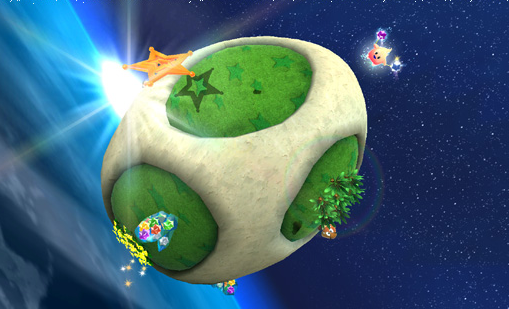 5 October 2014 at 04:50 #33019
@purofilion I speculated about the possibility of everything occurring in some other ‘place’.
Perhaps the Doctor was taken into the Matrix on Gallifrey at the end of The Time of the Doctor instead of being actually given a new set of regenerations, and this entire season is like a set of virtual Tasks of Hercules to see whether he deserves to actually be set loose back in the universe again, and Missy is managing the simulations, as if they were in a viseogmae, but just debriefing the pawns (hence the chess motif) after the Doctor has beaten each level.
Sounds bonkers, though.
5 October 2014 at 04:43 #33016@dickiebow I liked this episode a lot because I feel like it built up tension in the beginning and the doctor’s little monologue about humanity spreading across the universe at the end was Peter’s first really great doctor moment for me.
I wanted to like this episode, because it had interesting things to say about the dynamic between the main characters, and the changes that the Doctor has undergone recently.
Where it fell flat for me, and this is something that Who does on occasion, is that for some reason it abandoned any pretence of scientific knowledge, and replaced it with “fantastical scientism” (I don’t know if this is a real term, or if I’ve just pulled it out of my, ahem, subconscious).
What I mean by “fantastical scientism” is the use of sciencey sounding terms and concepts, and using them to handwave plot points in a lazy way.
(The other main offender in AG Who was The End of Time, which had interesting character moments, but ludicrous action scenes).
It’s not just that the fantastical scientism sounds so wrong, it is that in this episode there was no need for the mistakes. The parasitic spider beasties didn’t have to be “single-celled prokaryotes”, they could simply have been described as parasites of the space egg (is Moon Dragon the official name?)
Use of the Space shuttle made no sense, especially for a one-way suicide mission. A Saturn V rocket would have been more sensible, and perhaps more iconic. (Still would not have had the payload capacity, though!)
The anomalous mass gain could have been explained with established Who fantastical mechanisms, such as the creature originating in E-space, and simply needing to incubate in our universe. Instead, the mass gain was used to explain the production problem of not being able to simulate lunar gravity, but not given a sensible in-Whoniverse explanation.
I was looking forward to this episode all week, so I’m feeling pretty raw that it was so unclever, because Who can often be clever without sacrificing its emotional impact.
5 October 2014 at 03:31 #33008@lisa Hi all — So this was partly a pro-life argument and also pro-space exploration argument episode
I would agree with you there – although I’m not entirely sure how intentional the pro-life angle was on the part of the production team.
Here’s something a bit on/off topic I recently saw a vid on you tube
It definitely makes a change from the silver spray-painted performance artists that usually haunt Covent Garden. I might pop down to see it this week, if I get time.
5 October 2014 at 02:59 #33004Actually, my maths in post #32995 is totally bogus!
I’ve had a little think about it, and I think it should be:
1) Assuming the Trolley impact is always fatal:
If you do nothing, then the survival rate is 17%
If you sacrifice the fatman, the survival rate is 83%2) Assuming the Trolley impact is fatal 25% of the time:
If you do nothing, then the survival rate is 79%
If you sacrifice the fatman, the survival rate is still 83%As you can see, my maths is definitely up for debate here!
5 October 2014 at 02:05 #33000@purofilion
Basically, the Trolley problem seeks to explore whether people instinctively agree with Spock’s axiom “The needs of the many outweigh the needs of the few, or the one.”
In short, do you flip the switch on a runaway train so that it only hits one person on a siding, instead of letting it run over five people on the mainline.
It pits a rational accounting of how actions affect differing groups of people against the moral and emotional reasoning of human beings.
From Wikipedia:
The general form of the problem is this: There is a runaway trolley barreling down the railway tracks. Ahead, on the tracks, there are five people tied up and unable to move. The trolley is headed straight for them. You are standing some distance off in the train yard, next to a lever. If you pull this lever, the trolley will switch to a different set of tracks. However, you notice that there is one person on the side track. You do not have the ability to operate the lever in a way that would cause the trolley to derail without loss of life (for example, holding the lever in an intermediate position so that the trolley goes between the two sets of tracks, or pulling the lever after the front wheels pass the switch, but before the rear wheels do). You have two options: (1) Do nothing, and the trolley kills the five people on the main track. (2) Pull the lever, diverting the trolley onto the side track where it will kill one person. Which is the correct choice?
I also enjoy this variant (which is why I was blathering on about fat blokes):
As before, a trolley is hurtling down a track towards five people. You are on a bridge under which it will pass, and you can stop it by dropping a heavy weight in front of it. As it happens, there is a very fat man next to you – your only way to stop the trolley is to push him over the bridge and onto the track, killing him to save five. Should you proceed?
Resistance to this course of action seems strong; most people who approved of sacrificing one to save five in the first case do not approve in the second sort of case. This has led to attempts to find a relevant moral distinction between the two cases.
5 October 2014 at 01:57 #32999@purofilion Is it too late (must be quite late where you live?) to put my hand up about tense?
It’s never too late to talk about tenses! Especially when the talk is from someone who is as knowledgeable about literature as you are!
When it comes to literature, I only know what I tend to like, and what I tend to dislike. And I have found out (to my more edumacated wife’s chagrin) that what I tend to like does have a preponderence of exploding spaceships.
I really think that I must give Wolf Hall another chance – my immediate dislike was a visceral reaction to the present tense, which was probably due to my most recent negative experiences with it. I’m certainly intrigued by Tudor history.
5 October 2014 at 01:42 #32997@mtgradwell Then, the crew enters an abandoned/derelict base, they restore the power, the lights come on and INSTANTLY it’s safe for them to remove their helmets. As if it wouldn’t take time to get the air pressure and temperature back to something tolerable. Again I can see why they did it, but…
That’s one I didn’t pick up on! And yes, it is another one for the ‘silly’ pile.
So, the story committed sins in the following areas that I’ve noticed: Engineering, ecology, physics.
Probably politics as well, because I can’t for the life of me understand why the last remaining space shuttle would be crewed exclusively by British astronauts.
Oh yes – definitely politics – I forgot about the votes of Africa, Asia and Australasia not counting because it is daytime there.
5 October 2014 at 01:31 #32995I’m enjoying this, because the Trolley problem always causes me horrid cognitive dissonance (a bit like the death penalty – I feel that *even* if the death penalty can be demonstrated to have a deterrent effect, it is still a moral line that a government should not be allowed to cross.)
Our little Moon Dragon isn’t the Trolley Problem. Or if it is a variation of the Trolley Problem, it’s one where diverting the trolley will definitely cause the one person on Track B to die, but if you don’t do anything there’s a 75% chance that the trolley will stop before it reaches the five people on Track A.
If the Trolley Problem was formatted in that way, most people would refuse to divert the trolley. The reason they didn’t in tonight’s script was that THEY were the people on the track.
Faced with the possibility of dying, they chose to commit murder. Fortunately, Clara stopped them.

Actually, in the example you’ve given, the maths still seems to stack up in favour of tipping the Fat Controller in front of his runaway trolley, as based on probability, chucking the stout chap will save 1.25 lives of the 6 at risk, whereas not dropping Sir Topham Hatt over the edge only saves one of the six lives.
5 October 2014 at 01:21 #32993@bluesqueakpip Yup. In no particular order: Robin Hood exists, there’s a dragon in the Moon, dinosaurs were much bigger than we think they were, Daleks can become aware of their own evil, there appears to be life after death and bankers can repent of their misdeeds.
Am I spotting a pattern here?
I think you’re on to something, although the notion that bankers can repent of their misdeeds is the most ludicrous of the lot. Reality can only take so much warping before the spacetime elastic snaps back and causes a nasty red mark.
-
AuthorPosts


