Forum Replies Created
-
AuthorPosts
-
29 October 2022 at 12:19 #73634
@bluesqueakpip <waves>
But I agree that, when we look back, we will see this as a great ‘opening up’ era
Yes, and I am really grateful for it. The seeds were sown in The Doctor’s Wife, with the off-screen appearance of the Time Lord, the Corsair, described as sometimes regenerating male-embodied and sometimes female-embodied. And Missy and Whit-Doc and Martin-Doc have fully realised the concept of a female Master and female Doctors on screen.
I also think you’re right that Chibnall found writing a female doctor harder than he thought it would be.
Michelle Gomez’s Missy, in the Capaldi era, was absolutely excellent, inhabiting the Master’s capricious cruelty, villany, and obsessive Doctor-focussed mania with the strong continuity needed for the gender-swap to “take”. However, the fact that Moffat wrote The Master-as-Missy, i.e. the Master in a female incarnation, as the most redeemable version of the Master we’ve met, so that eventually, in World and Time Enough, she takes the Doctor’s side against her previous incarnation, falls, regrettably I think at least, into a gender stereotyping trap (no doubt unconscious) that women are “softer”.
As far as Whit-Doc goes, both the Doctor’s delightful, and oftentimes bombastic, arrogance, together with the Nu-Who era Doctor’s flirtatiousness, were excised from this female Doctor incarnation, again to her detriment (IMHO). Now, that partly reveals the mechanisms of the patriarchy. Whilst society is conditioned to accept that male arrogance can be endearing, and to accept that a hundreds-of-years older man romancing a teen girl can be sympathetic e.g. the entire vampire Twilight series (and here, Ecclestone and Tennant Doctors + Rose), we all know that female arrogance is socially punished (even if warranted) and that if the same romantic dynamic in the TARDIS had been an older woman Doctor and a teen boy or a teen girl, there would have been BIGLY complaints.
In the end, the writers’ room went with an unspoken (to one another) more age appropriate (to human eyes) Yaz-WhitDoc romantic attachment, inspired by the “Thasmin” fandom of this pairing. And I appreciated it, even as it gave the strong impression that, because this was a queer (in human terms) romantic undercurrent, the kiss afforded Nine-Rose, Ten-Rose and Eleven-River was bottled.
Jo Martin’s Doctor was truly ground-breaking as the first black female Doctor, and I really regret that she was only afforded a bit part, when she inhabited the role so commandingly. I would have loved to follow her own adventures further.
But I am all in on Ncuti Gatwa and can’t wait to see what happens next.
23 October 2022 at 22:37 #73578Hello Everyone!
I got absolutely soaked in a really wild thunderstorm on my way to the pub at tea time, so had to come home and try to dry the chill off my bones in time to settle in for The Power of the Doctor.
I was watching the incredible special effects and thinking, you know, I really wish we had lower production values and more frequent episodes – the gaps in between are sooooo long.
That said, this was a really super special, and a fitting goodbye for Whit-Doc.
Really delighted we got another outing for Jo Martin’s Doctor – she’s got such a sardonic and fabulous presence.
Favourite moment was definitely the “WTF” look shared by one of the Daleks and one of the Cyber-Masters as the Master got down to Boney-M’s “Ra ra Rasputin”. Sacha Dhawan was absolutely great – the vulnerability and the psychopathy so finely balanced. Lots of psychoanalytic things to say about the fact the Master wished to regenerate into the Doctor in a kind of Time Lord body-merge. He claimed that he intended to then thoroughly traduce the Doctor’s reputation for all time, by doing dastardly deeds in the “name of the Doctor”, but obviously, this course of action also revealed his desperate desire to both utterly possess the Doctor and to destroy himself.
It was touching to see Ace and Teagan again and I’m a huge fan of Nu Who’s revisiting of once-young-now-older companions, and the poignancy with which it throws into relief the Doctor’s experience of space/time, compared to that of his shorter lived earthly companions. The “Doctors’ Anonymous” support group for ex companions at the end was <chef’s kiss>.
Whit-Doc’s era was quite uneven, and took a long time to find its feet (in my view at least) but it has done brilliantly at opening up the being-ness of the Doctor going forward, so that in the future s(he) can be played by an actor of any gender and any ethnicity.
I’m gutted to see Whit-Doc go now, just when I feel she’s fully inhabiting The Doctor, but such is the nature of time and Doctor Who. I felt the same about Capaldi. Being heartbroken by a regeneration and filled with anticipation for the next incarnation is fundamentally what it means to be a Whovian!
Pretty sure the last sunrise the Doc witnessed was on the top of Durdle Door. A symbolic doorway, Durdle is apparently, according to Wikipedia, derived from the Old English “thirl”, meaning to pierce) and this time, it seems time is running backwards into Tennant Doc. Whit Doc’s expressed (to Yaz) intense desire for more time as herself (a similar sentiment to that expressed by Tennant at his own regeneration) may have been what has summoned this old incarnation back for unfinished business?
Pretty sure RTD is going to engineer a reunion with Rose at some point, just to make that section of the fanbase go wild.
Aren’t we lucky to be living through this new Who golden age?
2 January 2022 at 19:16 #72747Hope you’re feeling better @scaryb , and @winston that the rest of your family stay Covid free. It’s everywhere right now – bloomin’ Covid Christmas, as Raymond Briggs would say. I’ve been indoors for the last ten days with my sis, as she tested + on Christmas eve. So far I’ve escaped – lots of open windows! We are out of Covid-gaol tomorrow.
Proper Victorian convalesence warranted though.
1 January 2022 at 23:15 #72740HNY everyone.
I was delighted that Yaz’s romantic feelings for the Doc were acknowledged in text.
It’s really, deeply meaningful for gender non-conforming and LGBTQ+ fans to have watched the Doctor become gender-fluid by way of regenerations and now, in the Doc’s awkward fashion, perhaps romantically, fond of certain humans regardless of gender.
My child-self would have been absolutely astonished and amazed that such wonders could ever have happened on page and on-screen in the official narrative.
That aside, I’m glad the Doctor’s genocidal actions with the Flux are coming back to haunt her. She has really stirred a Dalek hornets’ nest now.
Like @cathannabel I love a time loop, and was there a Covid pandemic response metaphor in there? Humans doing the same thing over and over again, and getting killed, but over time, learning to trust one another and work together to finally escape the death trap (deadly virus/ time-loop of crap government response).
9 December 2021 at 13:09 #72660@ichabod – your characterisation and frustration did make me smile 🙂
I do appreciate feeling slightly crazed (as above) by the kitchen-sinkyness of it all. Some of the mystery I liked, however, because the universe is mysterious, after all.
I mean yes, totally, what was The Grand Serpent’s motivation? He seems to have been a dictator on Vinder’s home planet and he infiltrated/ contributed to the founding of UNIT on Earth and was working with the Sontaarans because??? He wanted to be Grand Serpent of the universe?
I think he was meant to be a representation of every petty megalomaniac tyrant to ever have cursed the ordinary folk – a snakey space Trump.
He works metaphorically in a way he doesn’t work logically. If we see him as a manifestation of Ouroboros, the eternal birth, death and rebirth of the universe, aligned with the forces of destruction, then he has been exiled to contemplate his incomplete ruination on a space rock, because, even from the ashes of destruction wrought by a megalomaniac power-tripping dictator, life rises again. What do binary demi-species eat though? Space dust?
Azure and Swarm, who claim to represent Time, whose people were destroyed (according to them) by the Doctor and Division, and their mysterious skull-like passenger-forms (which seemed very like Time-Lord techy) were very intriguing.
Tecteun used them (by “injecting them like poison”) to try and destroy the universe she was done with. It seems as if they were natural agents of entropy (destruction) and of “free time” before the Time-Lords wrested control of time itself, using the Doctor’s “Timeless Child” DNA.
The figure of Time in Doctor form, who dissolved Azure and Swarm at the end of The Vanquishers – was she a member of their species? A mythic embodiment of Time Herself?
The title of the episode, “The Vanquishers”, made me think about war poetry, which frequently speaks of “the vanquished”. Like Laurence Binyon’s famous WW1 poem, “For the Fallen”, which speaks of the dead as immortal, as timeless now:
………….. (this isn’t the full poem)
They shall grow not old, as we that are left grow old:
Age shall not weary them, nor the years condemn.At the going down of the sun and in the morning.
We will remember them.
They mingle not with their laughing comrades again;
They sit no more at familiar tables of home;
They have no lot in our labour of the day-time;
They sleep beyond England’s foam.But where our desires are and our hopes profound,
Felt as a well-spring that is hidden from sight,
To the innermost heart of their own land they are known
As the stars are known to the Night;As the stars that shall be bright when we are dust,
Moving in marches upon the heavenly plain;
As the stars that are starry in the time of our darkness,
To the end, to the end, they remain.https://www.poetryfoundation.org/poems/57322/for-the-fallen
Nietzsche said (in Human, All Too Human 1878-80) “Against war it may be said that it makes the victor stupid and the vanquished revengeful. In favour of war, it may be said that it barbarises in both its above-named results, and thereby makes more natural; it is the sleep or the winter period of culture; man emerges from it with greater strength for good and for evil”.
So, there is a sense in which the partial destruction of the universe has created powerful motivation for revenge, e.g. in Karvanista as the sole survivor of his species, in any of the Sontaarans, Daleks and Cybermen who may remain (none of whom are going to be best pleased with the Doctor, right?). And also, out of the ruins and the ashes, new possibilities.
It seems the Timeless Child must join with the Time Watch which contains the multitudes of her past selves. Who will she become, in the process?
7 December 2021 at 10:34 #72646Hi Everyone,
I only managed to watch yesterday and did get a vertiginous sense of kitchen sink. I’m still digesting.
There are elements I’ve appreciated very much about this “mini-series”. I feel Whittaker now fully inhabits the role of the Doctor. Her relationship with Yaz has developed an emotional meaning which anchors relations on board the Tardis. The larger themes have been enticing.
@miapatrick I was shocked by the Doctor’s genocidal decision not to warn the Dalek and the Cybermen fleets about the Sontaran trap.
But I wondered whether that was a signal that the Doctor’s past lives in the Time Watch are closing in on her. Who knows what atrocities she may have committed whilst working for Division. Karvanista’s revelation that he’d been a companion of hers once, who would have done “anything” for her before she summarily left him ,was intriguing. He was clearly a companion to one of her “hidden” selves.
And why did one of these “hidden” Doctors (presumably with Division) destroy Swarm and Azure’s people? Is that also a metaphor, for the Time Lord’s wresting of control of Time from the natural forces of the universe?
I think the Doctor discovering she’s been controlled and used by her Wicked Step-Mother and Division, and more so, steeped in blood whilst doing so, is a brilliant new darkness to add to Time Lord mythology.
It has the possibility to add so much to the Doctor Who narrative, going forward. Stories could take place with past reincarnations of the Doctor (once they’ve been “unveiled” from the watch) as well as with future ones.
For now, no wonder Whit-Doc doesn’t want to know, and entrusts her past to the bowels of the Tardis.
She’s promised a more emotionally open relationship with Yaz – a bit of a huge psychological step for the Doctor! And one that’s clearly doomed. Evidently, she thinks Yaz may not feel the same way about her anymore, once she integrates with her past selves. Certainly that integration will transform her, one way or another.
@miapatrick Yes I’d like it if the Doctor’s parentage thread had evolved. Possibly Bel’s pregnancy was simply there as another metaphor for the birth and death of the universe and the birth and death of Whit-Doc, in the same way that the, rather deliciously saturnine, Grand Serpent was.
The Master, is still in the mix, as the Doctor was warned about him by her swarmy clone.
In a sense, the Master is the Doctor’s child, given that she is the genetic progenitor of Time Lord regenerative abilities.
29 November 2021 at 17:46 #72576@miapatrick “I think we have seen the Doctor’s parents, and they’re human”
Yes, I’ve seen the spec elsewhere on the interwebs that Bel and Vinder are the Doctor’s parents.
I mean certainly, the fact that Bel is pregnant, does seem pregnant with meaning.
In terms of timey-wimeyness, there would be a time paradox going on though?
Bel and Vinder are alive contemporaneously with the events of Tecteun’s plan to destroy the universe using the Flux and therefore Baby-Doctor, if she is in Bel’s belly, is not-yet-born and has not yet been found by Tecteun and used to give birth to the Time Lords, at the same time as Whit-Doc (some umpteen reincarnations leter) is the indirect cause of Tecteun’s universe-destroying hissy-fit.
What is very cool about this, however, is it makes sense of all the serpent symbolism (the Grand Serpent and his tattooed minions). I mentioned the Ouroboros, the serpent which swallows its own tail – which is an alchemical symbol of death and rebirth.
So are witnessing the death and rebirth of the universe and the death and birth (rebirth) of the Doctor simultaneosly?
28 November 2021 at 20:57 #72567Hi Everyone,
Like you, @oochillyo , I enjoyed this episode.
The Doctor’s new origin story is a bit galactic fairytale isn’t it?
A foundling, she confronts the Evil Step-Mother who experimented on her as a child. A mother who stole her genetics to create her (adoptive) species, recruited her to meddle in and control Time, and mind-wiped her when she rebelled. A mother now orchestrating the genocide of a whole universe, in a last ditch attempt to control her “timeless child” again.
It’s not easy to find out your Mum is Space Mengele.
That sounds too flippant, I know, but that’s also the reality of who Tecteun is – a scientist who is a genocidal child-experimenter.
It must be beyond horrifying for the Doctor.
I do agree with those on the previous thread who grumbled about the Special One -ification of the Doctor, which this storyline under Chibs has pulled off. I too preferred her/him as an ordinary(ish) maverick.
On the other hand, the grand multi-verse scope and the mystery of the Doctor’s original origin-species is intriguing.
It strikes me Tecteun is a very Aztec god sounding name. Human sacrifice, particularly of the heart, was very significant in Aztec culture.
This was very grand in horizon(s), and absolutely gorgeous, yet again, to look at. The production values are incredible; Tecteun’s cherry blossom tree Tardis interior, for one. I do rather miss dusty old corridors and sticky-back plastic outfits from the days of old though.
The Grand Serpent is a Goa’uld from Stargate (snakey beings which possessed human bodies, with a penchant for Egyptology) isn’t he? Not quite sure where he fits in (except as an Ouroboros embodiment) but loving the acting.
Swarm and Azure seem to be the avatars of the forces of dark matter or dissolution in the universe.
Really enjoyed reading the thread on the previous episode, Village of the Angels, btw, with some great theorising from @mudlark and @jimthefish and @scaryb and others. Scary, you’re back – yay! I had a hectic work week and missed commenting as a result.
18 November 2021 at 19:09 #72459@craig I’ll join with @cathannabel and @blenkinsopthebrave and @mudlark and @winston in thanking you so much for everything you’ve done for us in keeping this forum going.
I know it’s taken plenty of your time and energy (and some money too). It’s your gift, so if you’re weary, you should look after yourself first. We appreciate you.
But, I remember when @htpbdet was with us, and he just could not get on with Matt Smith’s Doctor. He knew however, that change would come.
And when @bluesqueakpip found that Capaldi Doc just did not do it for her? She too, knew that change would come.
As other wise folk on here have said before, the Doctor regenerates (and so do the showrunners). Soon enough we will be in a new RTD era, with a new Doctor, and it will all feel different again.
The Whit-Doc era has not been everything I hoped it would be, albeit the Tom Baker mash-up with Tilda Swinton’s Orlando, in lace and thigh boots, was always the stuff of my own peculiar fantasy.
What a bonkers, British institution Doctor Who is.
I hope, with my whole heart, that in another 50 years, it’s still going. Someone not-yet-born will fall truly, madly, deeply in love with it, and revive it (after a hiatus in the 2040s and 50s). The Tardis interior will be green, vegetative, ancient tree-like. The Doctor will be gendered in a way we don’t have a name for yet. A historical episode set in 2021 will encounter a young Greta Thunberg, and the kids of tomorrow will be as delighted and as awed, as we are to encounter Rosa Parks.
14 November 2021 at 20:40 #72390Blimey, well that was a bit of a head-spinner.
This episode One, Upon Time perhaps takes us back, by allusion, to the episode in which Capaldi regenerated into Whit-Doc – as that episode was titled Twice Upon a Time.
As we are meeting Jo Martin’s “Fugitive Doctor” again, it seems confirmed she’s a previous incarnation whose existence has been wiped from our Doc’s memory. Do the episode title parallels suggest she’s between Capaldi-Doc and Whit-Doc, or are we still thinking much further back (pre-Hartnell)?
The Passenger seems Time-Lordy to me – bigger on the inside. Similar to the Genesis Ark which imprisoned millions of daleks during the Time War.
The Mouri and the Doctor seem natural allies, as controllers of time.
Of course, in Greek mythology the Moirai were agents of fate. Atropos cuts the thread of each mortal’s life, when the time comes – such a reference pressages Whit-Doc’s demise (regeneration).
So Swarm and Azure are “poison” introduced into the universe by whom? Was the old(er) woman giving the “poison” speech a Time Lord agent? She certainly seems to view this poison as a cleansing kind of cure.
Bel (the girl with the Irish accent and Tamagotchi pet) is searching for her loved one, Vinder, through broken time. Dan is now doing the same, as the Passenger has captured his date. Both sets of parted lovers narratively mirror the Doctor and Yaz. Why are Weeping Angels hunting Yaz in particular?
Visually this was stunning – from gold daleks to the exquisite crystalline faces of Swarm and Azure and the golden livery of The Grand Serpent.
Perhaps The Grand Serpent is a reference to an ouroboros – the universe with its tail in its mouth, ending and beginning? It seems we are chasing the Doctor’s origin story, which is also the Time Lords; origin story.
1 November 2021 at 23:33 #72276@bluesqueakpip – I love the idea that Dan is the Master (maybe chamelion-arched?).
@whereami62 – the credits described blue crystal-face dude as “Swarm”.
But there’s a lot we don’t know. Swarm the blue entity seems to consume life-force in a similar way to the space-cloud called the Flux. So, are they they same entity, say, at different stages in a life-cycle?
@mudlark – Ah but time can be re-written, so the end of the world witnessed by Rose and Ecclestone-Doc is one future, but that’s not to say, surely, that the Flux couldn’t end our blue planet sooner, changing earth’s time-line?
I do appreciate a science realism check though, on the age of the universe. Probably just arts graduate fuzzyness on Chibnall’s part. Or, (to add some bonkers speculating) could it be clue this story will involve multiverses?
1 November 2021 at 18:49 #72272Merry meet everyone!
Thanks to @craig for keeping the Forum going.
I’m excited for a serial story, as I much prefer a contiguous narrative thread to pull on, Minotaur style.
There WAS a lot going on and I feel I need a re-watch – bit of a Halloween smorgasbord of aliens, with Sontarans, dog-aliens, whoever blue-crystal-face (Swarm) is, Weeping Angels, and a new companion in Dan.
I loved the food-bank setting, Dan’s empty cupboards all too real, sadly, for many. A clear link made to Victorian industrial revolution Britain, and the poor being worked to the bone in the mines (digging for what, if not coal?).
The Flux (space diarrhea?) disintegrates matter, dust to dust.
The Weeping Angels are a huge clue to think about time out of order (as @bluesqueakpip says) as they send people back in time to consume their would-have-been futures. Perhaps the Time Lords used Weeping Angels on the Doctor to conceal her true origin story from her?
Hunger, disintegration, vampirism (which is what Weeping Angels do too, in a timey-wimey sort of way) – the Flux as a metaphor for voracious power/ capitalism consuming people and planet.
The Sontarrans and the drum-beat of endless war.
Swarm (blue crystal-face) consumes others to rejuvenate himself. Just like the Time Lords.
The Doctor always knew her people were not good people (controlling, patrician); that’s why she ran away.
But now? Eugenicists who canibalised another species to engineer themselves?
I feel JW has hit her stride as the Doctor now, which makes it a big tragic that she’ll soon be gone.
But grief and loss and still going on? These are the persistent themes of Nu Who.
Waves at everyone x.
27 July 2020 at 09:06 #70858Hey everyone <waves> Came here too when I saw the news on Twitter this morning.
Absolutely gutted about Dan. Without his Doctor Who exhuberance and the extensive space provided back then below the line of his recaps on The Graun, we wouldn’t have this lovely place. I’ll always think fondly of the Moffat/ Guardian “golden years” on his blog.
LGBT Doctor Who fandom has lost a prominent member.
May his spirit wander with the TARDIS now.
27 January 2020 at 01:22 #69396@jimthefish He’s there for the benefit of a bit of fan service rather than being narratively necessary.
Except, Jack is only one of a handful of the Doctor’s previous companions who can time-travel independently. And we do seem to be getting gratifyingly timey-wimey. Maybe the Jack who the “Fam” just met came from further up the present time-stream, in order to bring his cyberman warning?
I saw a great theory elsewhere on the interwebs, which I can’t claim credit for, that perhaps the Jo Martin character isn’t, in fact, the Doctor, but is an AU River Song. Their supporting points were quite convincing. River can fly the TARDIS. The parents’ graves recall Amy and Rory. The Jo Martin character was certainly quite happy using weapons, but said impatiently to Whit Doc, “I know!” when WhitDoc said, “The Doctor doesn’t use weapons.”
I’d put that weapons-usage inconsistency down to a Mirror-verse effect, but, I do like this as a bonkers theory.
@mudlark The fact that the Ruth Doctor had no knowledge of Gallifrey’s destruction would be consistent with this, but it would mean working out a way in which alternative – as opposed to parallel or bubble universes – could intersect.
Yes, that lack of knowledge of Gallifrey’s destruction for Jo Martin’s Doc is what, combined with the Orphan 55 signpost that multiple time-lines for Earth are out there, which the TARDIS can visit, is what led me to the alternative time-line theory.
The Doctor’s speech to the “Fam” in Orphan 55, that the future of Earth they’d seen there wasn’t inevitable, it depended on humans actively working to avoid that apocalyptic future, makes me think the Doctor is going to have to figure out, back in time, what the Time Lords could do, in order to avoid the Master’s (apparent) destruction of Gallifrey.
I’m quite excited about a Time Lord fascist empire, which, although in Jo Martin’s Doc’s imperial time-line Gallifrey seems to have avoided destruction, also clearly can’t be good.
Perhaps the Doctor is going to have to navigate between the Scylla of Gallifrey’s destruction in her own time-line and the Charybdis of Jo Martin Doc’s time-line, where Gallifrey isn’t destroyed, but the Time Lords are full-on imperial fascists.
Or perhaps, as we’ve speculated already, the Time Lords were fascistic in every time-line, in their use of genetic experimentation, and that is what has led to both outcomes we’ve seen thus far – imperial Gallifrey and destroyed Gallifrey. And the Doc must find another way.
26 January 2020 at 22:51 #69392@jimthefish Oh I’m pretty confident the “cyberman” clue will pay off in a future story.
The Captain isn’t for everyone, I know that. But I personally love his swashbuckling, piratical, big bisexual energy 🙂
In a way, it was a smart writers’ move not to have Jack and WhitDoc meet, because I kind of think this version of the Doctor might get on less well with the Captain than the previous versions he’s travelled with. She might find him a tad too bombastic, given her own down-to-earth demeanour.
<div class=”vmod”></div>26 January 2020 at 20:45 #69385@miapatrick Yes, in terms of the distance WhitDoc has been keeping from her companions, from a character point of view, we can argue it make makes sense, particularly after all the trauma of the Time War and its aftermath and losing River and then Clara and Bill, all in upsetting ways.
Although, that’s also, perhaps, a little generous to the S11 writing, because that “strategy” has made for a rather flat series of Doctor-companion relationships on the TARDIS up to this point. It looks to me as if there’s been a significant re-think in the writers’ room for S12, based on reactions to S11.
Although, it remains to be seen if the high of Vinay Patel’s excellent episode (and to be fair he shares the writing credit with Chibnall) will be continued.
I should also say I loved Ritu Arya’s Gat, the Time Lord hunting down Jo Martin’s version of the Doctor. The relationship between them was intriguing (possibly old lovers?) so I’m sorry she’s (apparently) dead.
Agreed, it’s not much of a stretch to imagine a Time Lord imperial dictatorship. And that’s an excellent theme to be exploring now, in the context of what the Chibnall era has done best, in my view, up to now – depicting the Doctor as resolutely anti-fascist. Because what do you do when you find out your own people are the fascists this time?
26 January 2020 at 20:16 #69378Wow, well Vinay Patel is officially my favourite writer on Chibnall’s team.
That was the first time I’ve felt really gripped with the excitement that is Doctor Who at its best since the start of the Chibnall era.
Loved seeing Captain Jack again – always a fave Nu Who character for me, and he came bearing a cyberman mystery too. And (and this is good writing) – excellent dramatic tension, because Jack and the Doctor didn’t get to meet again (and of course we want them to). Hah, Graham’s head must be spinning, wondering about the Doc and Jack’s past after that hearty kiss :-).
Jo Martin made an excellent, slightly scary, alternative time-stream Doctor, and the tension between her and WhitDoc was perfect – just the sort of mutual, appalled fascination and contempt I remember with fondness from previous multiple Doctor stories.
It looks as if we’re meeting the Doctor from another time-stream (now it’s been established in Orphan 55 that other time-streams are a thing) – kind of a Star Trek style Mirrorverse, in which the Time Lords are running an imperial dictatorship of some kind?
WhitDoc telling her companions that she’s lived for thousands of years and they don’t really know her, was a great moment. I really felt the alien shine out of Whittaker, as if she’s been putting on a persona for “the Fam” up to this point. Looking forward to more of this.
Overall, I want to thoroughly celebrate the episode, and can only hope this calibre of story is going to continue.
We certainly have a lot of threads to follow now – Captain Jack, the last cyberman, the Doctor’s other self, an Imperial Gallifrey, the Master, possible Gallifreyan genetic experiments… I’m delighted.
21 January 2020 at 23:15 #69315@mudlark I like your idea that the Scythra (I know it’s officially Skithra, but I like my spelling better) are a hive species.
@bluesqueakpip Yes, I can buy your distinction in terms of the Spyfall mind-wipe for tech-whizz Lovelace (as she’d seen the future) vs the lack of mind-wipe for tech-whizz Tesla. But, as you and @jimthefish and @mudlark say – it’s still a morally problematic act. And I hope it is indeed revisted as part of the Time Lord arc.
@blenkinsopthebrave That is a good bonkers theory about some kind of timey-wimey filching of time-tech by the Time Lords, despite @mudlark ‘s lack of archeological evidence 🙂 Which exchange makes me miss River, time-travelling archaeologist extraordinaire, herself.
On the question of the Time Lords and potential genetic experimentation in order to “create” themselves, I had a flash-back to Genesis of the Daleks, and Davros’ experimentation on the Kaleds to mutate them into Daleks.
How much would Davros crow if it turned out the Doctor’s own people were guilty of similar genetic “enhancement”.
And wow that would put a new spin on the Time War.
19 January 2020 at 23:03 #69244@mudlark Yes – the origins of Elon Musk’s own Tesla company are more complex than the “genius inventor founder” mythology:
https://www.businessinsider.com/tesla-the-origin-story-2014-10?r=US&IR=T
19 January 2020 at 22:58 #69242@miapatrick Yes, I wish we’d spent more time with Lovelace. She deserved a whole episode of her own.
And also, glaring incongruity – why did Lovelace have to get her memory wiped, but Tesla (who saw the inside of the TARDIS) didn’t?
Just to re-ignite the ethics of the mind-wipe debate @jimthefish was having earlier!
BTW, I don’t think the Scythra’s ship got blown up – they skedaddled in the nick of time. I was momentarily shocked when I thought the Doc had just blown it up.
A scavenger race like the Scythra are a bit of a puzzle, because surely, they’re intelligent, so why not tinker about the high-tech stuff they filch and figure some of it out? The tech they had which could disguise them as re-eyed humans was particularly impressive.
19 January 2020 at 20:42 #69232@bluesqueakpip Good thinking about a Scythra scavenger parallel to the Time Lords.
If we put that together with the genetic mutation focus of the last two episodes, I think we might guess the answer is that the Time Lords scavenged genetics and then (dark, but great story) undertook genetic experiments on their kids, perhaps to make them “time sensitive”?
19 January 2020 at 20:27 #69229Well, it seems the Chibnall era is going to be remembered best for its historical episodes.
I enjoyed this one.
The Scythra (Skithra?) Queen was a gorgeous scorpion-alien, with all those talons and teeth and head protuberances. A little similar to the Empress of Racnoss, perhaps.
Tesla’s story had that nice sense of time-travel poignancy to it, as Team TARDIS knew he’d have a bitter end, and only be recognised after his death.
In reality, I’m not sure Tesla would have taken so readily to the Doctor though. He was, unfortunately, not a fan of the “New Woman”.
The “Fam” looked good in their period costumes.
I’d have to say it didn’t match Rosa or The Demons of the Punjab, because I think what made those two episodes stand out was the level of emotional investment the companions felt in what was happening.
I enjoyed the Doctor’s fan glee at meeting Tesla. It shone a light, again, on the Doc’s peculiar fondness for Earth, as all Tesla’s tech was beyond primitive for a Time Lord, but she loves human ingenuity.
This Doctor would actually benefit from having a science-nerd companion on the TARDIS who could geek out with her, I think.
A little nod to the Gallifrey-in-ruins arc near the end, when the Scythra Queen asks if the Doc has ever seen a totally destroyed planet.
Some beautiful cinematography, like that night-train under the moon.
The Chibnall era is still not gripping me with delight, but I’ll take it.
18 January 2020 at 17:24 #69205I just realised, that Sacha Dhawan was also in Sherlock, in The Six Thatchers, as Ajay (one of Mary’s old assasin gang) as well as being in Dracula and now Doctor Who,
In S4 of Sherlock, things were definitely not what they seemed, especially because of Culverton and his mind-wipe/ alteration drug TD-12.
In Dracula Part 2, as I said before, things were not what they seemed either, as Van Helsing eventually realised, her chess game with Dracula was in her mind while he was eating her. Also Sacha Dhawan’s character was a doctor who had prepared a deadly drug for his daughter to take, rather than let her be eaten by Dracula.
If Who was still being show-run by Moffat I’d say Sacha Dhawan’s casting as the Master in light of these other two scenarios should seriously lead us to consider whether things are not as they seem in S12 of Who.
Could the Master have drugged the TARDIS or the Doctor in some way?
But, as this is the Chibnall era, this may be a dead end. On the other hand…
14 January 2020 at 21:49 #69096@jimthefish I’m not massively keen on Gallifrey’s re-destruction personally. It all depends how it plays out, of course
I’m not massively keen on it either. I LOVE Gallifreyan stories, but it feels a bit odd, after the long and wondrous arc of the Time War across Doctors Ecclestone to the War Doctor (and then Capaldi Doc’s search for the Gallifreyan pocket universe) to start a a new era with WhitDoc and then suddenly retread a major story from the previous era.
Only this time, instead of all the long build up and mystery, it’s just wham! The Master has (apparently) single-handedly found the pocket universe with ease (which we saw Capaldi Doc magnificently struggle to access) and wiped everyone out with a flick of a wrist.
That’s what @phaseshift and and I were saying on the Spyfall thread – why is Chibnall recycling so many past Who elements in S12?
@bluesqueakpip had a good theory that it might be a plot-point and the Master was the one doing the recycling.
Time will tell…
However, I suspect that TPTB are making the mistake of listening to “hater” online fandom chatter too much. All that complaining about Moffat and his “over-complexity” and his arcs. So, when Chibnall takes over, we get an arc-less first season for Whit Doc. And lo and behold, fandom chatter hates on that too. So, now an arc re-tread is pulled out for S12!
Of course, it’s not possible to totally ignore audience feedback, particularly as social media metrics are now part of the data that get shows renewed or cancelled.
I am feeling a bit frustrated that (to my mind) WhitDoc is not getting to shine as much as she could, in the Chibnall era.
I like each of her companions, but, I wonder, does she? Her connection to them seems a bit abstract.
I keep thinking the grandfather/ grandson dynamic of Graham and Ryan is there for a reason (some parallel delving into the Doctor’s own familial past).
Time will tell…
I like your idea that the Master may be about to drive a wedge between the Doctor and Yaz, and I don’t think that would be a problem in terms of the racial politics of the show. The Master has been established as nefarious over many previous, caucasian, incarnations. And Yaz doesn’t have to go full Turlough. It could be a case of her feeling frustrated that the Doctor won’t open up emotionally about her past, and the Master worming his way into her confidences by telling a load of (tall) tales about the Doctor’s history.
As for E-space, it’s also a pocket universe as I recall, and difficult to traverse to and from. The TARDIS only fell in there by accident.
13 January 2020 at 21:12 #69057@jimthefish Congrats Dr. Fish!
@mudlark – I got the impression Lucy was self-medicating with (illegal) drugs and drink, so that enabled her to party “vivaciously” whilst being depressed inside. But, I am not a clinician, likewise.
Either way, we can perhaps agree, she was “in love with death” because she was unhappy, on some deep level, with herself.
13 January 2020 at 20:28 #69053@craig you are indeed Emperor 🙂 And Tim Minchin is fab.
Essentially, the whole of Nu Who, up until the “fix it” of The Name of the Doctor, has the Doctor as having committed genocide against his own people. In The Satan Pit, the Beast refers to Tennant Doc as “the killer of his own kind” and we eventually find out what that means.
What I really loved was that this was a mystery, in the background (what exactly happened to Gallifrey and what was the Doctor’s role in it, including the emotional mystery of his deep grief and avoidance) which, very gradually came to light, until finally we met The War Doctor and realised the full horror of the Doctor’s actions.
And yes, we can argue it never actually happened, in terms of the Doctor using The Moment, but I continue to believe that in one time-line, it did, and then in another, with the help of other incarnations and Clara, it was avoided.
So, you can’t really get any morally darker than that – pressing that red button on the ultimate weapon, even though it was to stop a hideous, endless war raging across time.
We also see the Nu Who Doctor take up arms (again, given he was on the front lines during the Time War) and go to war in A Good Man Goes to War. Again, he’s in a pretty morally questionable state at that point – obviously he’s massively pissed off about Amy’s capture – and (and I remember we discussed this at the time) he’s complicit in the destruction of a cyber-ship.
WhitDoc, by contrast, is the first regeneration to be truly “past” the Time War, because she begins her journey knowing Gallifrey is safe in its pocket universe (whereas Capaldi’s Doc still wasn’t sure if it had survived, and had to go looking for it). So, she appears, to me, at any rate, lighter, and able to be (like her costume, as I discussed last season) refracted light, a force for good, in the universe.
Of course, now she is faced with a mirror of her Time War past – as her long-standing fremeny, The Master, appears to be responsible for Gallifrey’s destruction, again.
I do think Chibnall made a conscious decision that, as we see fascism resurge around the globe, WhitDoc would be actively anti- fascist, and I like that. I agree the “messages” are delivered through some overly emphatic dialogue sometimes, rather than being simply allowed to emerge from the stories. However, perhaps Chibnall’s view is that this is not the time for subtlety (which links to what you were saying @missrori), it’s a time to stand up and be counted.
@badwolfalice asking some good timey-wimey questions, I see.
I thought the Orphan 55 earth must be in a different time-line to The End of the World timeline (in which Ecclestone’s Doctor takes Rose to see the end of Earth on Platform 9). So, I assume the TARDIS can visit different time-lines, but not, without great difficulty, as previously established in Meglos, Full Circle and Warrior’s Gate, and in Nu Who in Doomsday, different universes.
But the rules around time in Who are complicated, particularly as the Doctor so frequently tells us there are rules, and then breaks them!
13 January 2020 at 17:35 #69040P.S @jimthefish and @missrori I’d like to continue the discussions about the Doctor’s morality, as I think it’s a really interesting topic (and personally I don’t think WhitDoc is more morally dubious than previous Nu Who Docs) but this is a General Open Thread for TV shows other than Dr. Who so we need to take it somewhere else on the forum! Perhaps under the latest episode is as good as any?
13 January 2020 at 17:26 #69038@jimthefish <waves at old fishy comrade> I also loved the BBC’s Dicken’s adaptation. I thought it was beautifully shot – amazing use of light and shadow. Guy Pearce was excellent and it was great to see Vinette Robinson again (who played Rosa Parks in Rosa last season of Doctor Who). Bringing some of the darker Victorian issues (around abuse) to light made for excellent characterisation of Scrooge, without letting him off the hook for his behaviour in any way.
@peacefrog I too loved Dirk Gently – it was completely off the wall, and generally zanily great fun. Unfortuately, the BBC really had no choice but to drop it. Just Google “Max Landis” and “The Daily Beast” and you will see that the guy was about to become a major #MeToo PR liability, which the Beeb really couldn’t afford in terms of its excellent reputation for childrens’ programming. Of course, these were allegations, rather than a conviction, and as such the BBC did not publicise them, or publicly link its Dirk Gently termination decision to them in any way. I simply surmise…
@miapatrick @phaseshift @jimthefish A Penny Dreadful re-watch sounds fun (I was disappointed with the ending, but overall thought it an excellent show). I can’t guarantee I’ll have time, but I’ll at least drop in.
13 January 2020 at 17:12 #69037@missrori I absolutely love Nausicaa and I totally agree – it wasn’t the Dregs’ fault that they were the way they were – a broken eco-system had resulted in their genetic mutation, so it’s a shame the Doctor couldn’t communicate with them more as a species.
I agree with you @rob , it wasn’t clear what level of sentience they had. Were they “mindless” predators, or did they have some kind of intelligent social organisation? Presumably the former, or the Doctor would surely have tried speaking with them (they didn’t seem to possess language).
This article is quite good @missrori (using some of the academic data on persuasion) on techniques for persuading errant relatives!
https://www.vox.com/2016/11/23/13708996/argue-better-science
If you have a loving family, that’s great, and important, and finding ways to tap into that love is better than falling out.
13 January 2020 at 00:41 #68995@spider Yes, the, “Bat’s aren’t real part” was definitely funny – I enjoyed that.
@mudlark and @miapatrick – Perhaps it was a combo of nuclear and environmental catastrophe, as you say. The nuclear element might better explain the genetic mutation of humans into Dregs, which did, you’re right, somewhat resemble the Alien (also an apex predator).
The Dregs were very scary, I can imagine, for kids, and it was particularly gruesome that poor old Benni begged to be killed after they’d got hold of him, presumably because they were playing with their food?
I wondered if that marriage proposal of Benni’s, at the end of a long relationship, and then one of them dying shortly after, had unpleasant resonances for the Doctor, in terms of her loss of River (I am still holding out hope that we will get a River/ WhitDoc reunion, although I know River’s story was apparently “done”, as she’d reached Darillium).
@mudlark – yes, the “Orphan” of the title has a number of resonances. Not least for the Doctor, who is now, as far as she knows, orphaned (again) in terms of not having most of the rest of her species alive and well on Gallifrey.
I said, on T’Other Place (which is particularly grim today) that this seemed to be another “re-cycling” of earlier Nu Who, in that the Ecclestone Doctor takes Rose to The End of the World just after he has lost Gallifrey and is grieving its loss. I always thought that was fantastically dark of RTD, as essentially the Doctor takes a very young Earth woman to experience the shocking destruction of her planet, on her first trip in the TARDIS, almost so she can get a glimpse into the enormity of loss he is suffering. That was pretty morally grey (talking about grey Doctor morality, @jimthefish).
Now we have WhitDoc ending up on Orphan 55, apparently “accidentally” (but maybe the TARDIS was responsible) on a ravaged Earth with her human companions, after just discovering Gallifrey has (apparently) been destroyed all over again.
The re-cyling definitely has to mean something here, I think. It’s so apparent.
It must be to set up a moral question, about the difference between the Doctor and the Master. Because, in The End of the World, the Ecclestone Doctor (we know now) believed he had destroyed Gallifrey, for the greater “good” – i.e. to ensure the end of the last great Time War – an incredibly morally grey decision, which led him (as we saw later) to repudiate the War Doctor regeneration as not worthy of the title “Doctor”.
Now, the Master has (apparently) destroyed Gallifrey (or rather, the great citadel and, as far as we saw, all the people) because he also discovered something unconscionable about the Time Lords.
So what makes the Doctor different from the Master?
We know that the answer in The Day of the Doctor (and elsewhere in Nu Who) has been that his/her companions, have ensured the Doctor engages with compassion.
I think, in giving that speech to Yaz and Graham and Ryan at the end, about how the future earth they’ve seen doesn’t have to be that way, must partly have been a pep-talk to herself. She has saved Gallifrey once before, so she can do it again. The image the Master showed her doesn’t have to be permanent. Time can be re-written.
12 January 2020 at 20:20 #68988Well, that was a kind of Planet of the Apes AU wasn’t it – only this time it’s environmental apocalypse rather than nuclear apocalypse which is (very much) on our minds.
I quite liked the Doctor’s blunt speech about humanity needing to change, and it being up to us. I wish she’d completely broken the fourth wall and just looked straight to camera for the whole speech.
I enjoyed the focus on Ryan, who got to go off on his own for some of the episode, as it gave us more time to breathe with him (as I mentioned wanting last week in relation to each companion). I do like Ryan’s character very much. He’s gentle, a bit out of his depth (as you would be, chucked into alien environments) but trying to feel his way through, with a good moral compass.
Some elements present might be mirrors, if we are going to re-visit the Doctor’s relationship with her Gallifreyan family as part of the Timeless Child arc: the broken Mother-Daughter relationship (where the mother had abandoned her child, as far as the child was concerned) and the Green-haired Father-Son relationship (where the father wouldn’t listen to his child, until the very end).
We know about Susan, but we don’t know about Susan’s parent (the Doctor’s child) and I continue to wonder if that mystery might unfold itself.
I Googled “Orphan 55” to see if it meant anything, and there is an “orphan” cannabinoid receptor encoded in the GPR55 gene: https://en.wikipedia.org/wiki/GPR55
Coupled with the genetic mutations, thanks to environmental apocalypse, of humans into the “Dregs”, there seems to be a genetic alteration theme running through both Spyfall and Orphan 55, which makes me think that may be connected to the Time Lord arc. Perhaps the Time Lords’ did genetically engineer “time-sensitives” by experimenting on children.
12 January 2020 at 00:57 #68971@phaseshift Sounds like a good book 🙂
I haven’t seen Moffat’s Jekyll and now feel compelled to get hold of it, as there’s obviously quite a trilogy going on there – Jekyll, Dracula and Sherlock.
Did you see Penny Dreadful (UK TV series for Showtime a few years ago)? That was a really interesting mash-up of a number of Victorian gothic narratives, including Frankenstein and Dracula and Dorian Gray, and even Carmilla/ Countess Bathory (and a bit of De Sade). It had Eva Green in it (I love her) and Billie Piper, who is also phenomenal.
That’s interesting, what you and @jimthefish were discussing in terms of consent. Donna’s fate was horrific, even though the Doctor did it to save her life.
I suppose, in this most recent mind-wipe case, the Doctor knew Ada Lovelace had an important role to play in Earth history, and so perhaps she had to mind-wipe her to ensure she didn’t change time, in that respect.
What you say about Lucy and consent is interesting. Lucy did consent to Dracula biting her, in this Moffat and Gatiss’ version, but she didn’t fully know what she was consenting to (being turned into Dracula’s “Bride”).
I also reallly wondered why Dracula didn’t turn Van Helsing into his “Bride” on the Demeter. She was pretty fearless about death, and so surely, should have been an ideal “Bride” for him. Instead, he chose to just ingest her, carrying her with him to the new world in the blood. Was that a mark of respect? That he didn’t take away her automony by turning her into a “Bride”?
Of course, that rather speaks to the deliberately ambigious ending, which I mentioned above. What if Van Helsing, having ingested Dracula’s blood, is not dying any longer, but being reborn as a vampire after all?
12 January 2020 at 00:04 #68965@mudlark I think Lucy was depicted as both self-absorbed, as you say, and depressed. She was obsessed with being “pretty” but she also recognised that people reacted to her superficially because of her looks, so her sense of self-worth was actually quite disturbed, which, sadly, led her to be attracted to death, as an escape.
Really the poor treatment of Lucy and Mina in Moffat and Gatiss’ version made me envision a wholly different modern take, in which Lucy and Mina are modern members of a St. Trinians’ style school and absolutely wipe the floor with both Dracula and Van Helsing (a Schoolmaster)’s feeble attempts to counter the vampire. I have just watched What We Do in the Shadows though, so I have more comedic takes on the brain right now.
@phaseshift That’s a good point about medieval Dracula in the “modern” (Victorian) world as far as the novel was concerned. I too enjoyed the shift to modernity in the third episode.
Completely agree with you about the parallels with Sherlock.
And indeed for BBC Sherlock fans, there were a number of Sherlock “clues” in Dracula. For example, Dracula and Van Helsing play chess on board the Demeter (and if you listen you can hear a few bars of the Sherlock theme as they first do so). Dracula refers to Van Helsing as being on the “losing side”. That is what Sherlock says to Irene Adler, in Moffat and Gatiss’ version, when he bests her by guessing she’d used his name as her phone password; “Sentiment is a chemical defect found in the losing side.” Van Helsing actually wins the metaphorical chess game between herself and Dracula, eventually, precisely because he succumbs to sentiment – he cares for her.
Additionally, the chess game on the Demeter actually takes place in Van Helsing’s mind, while Dracula is feeding off her in cabin No 9. The promo pictures for Sherlock S4 were a chess game between Sherlock and Mycroft, with Watson looking on. So, for those (like me) convinced that Sherlock S4 took place, at least partly, in John’s mind whilst he was lying in a coma after being shot by Mary (just as The Abominable Bride took place in Sherlock’s drugged mind) this could be read as an inter-textual clue supporting that reading. Agatha Van Helsing (a Sherlock avatar) is in a dream-world and she has to figure out what’s real and what’s not, just as Sherlock, and Sherlock fans, had to in The Abominable Bride.
I’m sure there are other Sherlock Easter-eggs in Dracula, but I’d need a re-watch to ferret out more!
11 January 2020 at 23:34 #68964@craig Thanks – and yes it was my fault – I was trying to copy and paste too much Wikipedia about DNA separating techniques!
@claire54 My overall take is, now that we have a female doctor, the writers don’t know what to do with her.
Yes, unfortunately I do not think Chibnall has been equal to the task.
Elements which I’ve found jarring in the writing of her, is that WhitDoc is not only the first female Doctor, but she is the first Doctor in Nu Who to be depicted (at least so far) as completely uninterested in flirting. Now, of course, that was par for the course (mostly) in BG Who, so it’s not a characteristic of the Doctor I find difficult per se.
But, making the first female Doctor devoid of desire (apparently) when all her Nu Who predecessors have had a twinkle in their eye, seems to speak to an anxiety about/ inability to write that twinkle in female form. I think it’s a cop out and it disappoints me. We’ve been given a (surface) heterosexual Doctor in Nu Who, through the Doctor’s relationships with Rose and River, plus his flirtations with Madame du Pompadour, Amy and Clara, and then all the interesting questions about Gallifreyan sexuality posed by our new understanding (since The Doctor’s Wife and the Corsair) of regeneration as gender-fluid, have been side-stepped by making WhitDoc apparently asexual (not that there is anything wrong with asexuality – it’s the writers’ cop-out I object to).
Another element where I feel WhitDoc has not been well served, is in terms of the way elements of this Doctor’s personality have been written. The Doctor is, let’s face it, usually an arrogant sod, charmingly arrogant, to be sure. WhitDoc isn’t. Again, I don’t have a problem with a less arrogant incarnation, per se, but making the least arrogant version the first female version, speaks to a “gender burden” I feel is being imposed by Chibnall, which feels very earth-bound, rather than Gallifreyan, to me.
Give me a flirty, piratical, arrogant swashbuckling female Doctor. I don’t want the Doc to be nicer, just because she is in a female incarnation.
However, as @nerys says – we feel what we feel, and each to their own. We all have our subjective reactions to different Doctors. I will always remember trying to convince @htpbdet (now sadly no longer with us) to add an “S” to the end of his acronym for SmithDoc, but he never would, because that incarnation just didn’t do it for him.
And I know @bluesqueakpip never felt comfortable with the CapaldiDoc.
So it goes.
I actually do love many elements of WhitDoc – I love her scientific bent, her absolute ability to rig up some bit of impressive tech from rusty old junkyards and spare parts (which reminds me in particular of Pertwee’s Doctor). I like her moral clarity (her anti-fascism). So, as I said further up the thread, it’s not an actor problem for me here, it’s a writer problem.
@vervain I like your thoughts about the Untempered Schism, and I certainly think that whatever the Master has learned about the Timeless Child and the origins of the Time Lords seems to have re-triggered his trauma and psychosis, which we learned during the Simm Master era was attributable to his experience when he was forced to look into the Schism as a child.
In that sense, the mystery may fit with @bluesqueakpip ‘s thoughts on The Ones Who Walked Away from Omelas. What if the Time Lords sacrificed or experimented on an original child (or children) in some horrific way, in order to develop the child-looking-into-the-Untempered-Schism ritual of Time Lord initiation (which is pretty horrific in itself)?
9 January 2020 at 08:16 #68909@lisa and @bluesqueakpip
Ahhhh – thanks re the fish!
I just Googled “CO fish” (combining “C” and “O” code-names) and found this on Wikipedia
https://en.wikipedia.org/wiki/Q-FISH#CO-FISH_(chromosome_orientation-FISH)
<b>”Fluorescence <i>in situ</i> hybridization </b>(<b>FISH</b>) is a molecular cytogenetic technique that uses fluorescent probes that bind to only those parts of a nucleic acid sequence with a high degree of sequence complementarity. It was developed by biomedical researchers in the early 1980s<sup id=”cite_ref-1″ class=”reference”>[1]</sup> to detect and localize the presence or absence of specific DNA sequences on chromosomes.
<h3><span id=”CO-FISH_(chromosome_orientation-FISH)” class=”mw-headline”>CO-FISH (chromosome orientation-FISH)</span></h3>
Another adaptation that utilizes PNAs and FISH is known as CO-FISH (Chromosome Orientation-FISH) which allows for the labelling of chromosomes with PNAs in a strand specific manner. This method involves the selective removal of newly replicated strands of DNA (through the use of BrdU incorporation), resulting in only single stranded target DNA. By using different colored unidirectional PNA probes, it becomes possible to uniquely label sister chromatids.”………………..
So maybe there is a DNA “joke” going on here on the Master’s part.
@bluesqueakpip re The Ones Who Walked Away from Omelas – I read that story when I was quite young and still remember the chills it gave me. She remains one of my favourite writers.
Yes, eugenics is the other side of the fascist extermination of the “unfit”, of course, so some kind of Time Lord eugenics programme would be fascinating.
The Time Lords have already been depicted as highly hierarchical, and we’ve never learned why “ordinary Gallifreyeans” lived outside the city-dome whilst all the Time Lords lived inside. Is there more to going to the Time Lord academy than acing your grades? A “time sensitivity” breeding programme?
I haven’t read Eatwell and Goodwin, but it looks interesting so I will add it to my list.
@mudlark I agree, I don’t think the “Timeless Child” will turn out to be the Master and the Doctor’s child – this does seem like a Time Lord origin story.
But that doesn’t mean the Doctor’s own children won’t come into the storyline, particularly if they are “hybrid” (part human, through River) and might be considered “impure” by a Time Lord eugenics programme.
8 January 2020 at 22:55 #68913OK I’ll have to try and say this in a different way!
@lisa and @bluesqueakpip
Many thanks re the fish!
I just Googled “CO fish” (combining “C” and “O” code-names) and found this on Wikipedia
https://en.wikipedia.org/wiki/Q-FISH#CO-FISH_(chromosome_orientation-FISH)
Perhaps there is a DNA “joke” going on here on the Master’s part.
The Ones Who Walked Away from Omelas – I read Le Guin’s story when I was young and still remember how much it affected me. She is one of my favourite writers.
Some kind of Time Lord eugenics programme would be fascinating.
It’s always been a very hierarchical society. Perhaps there is more to getting into the Time Lord academy than acing your grades? A breeding programme for “time sensitivites”?
I will add Eatwell and Goodwin to my reading list
@mudlark This does seem like a Time Lord origin story and the child is at the heart of that.
But that doesn’t mean the Doctor’s own children won’t come into the storyline. Perhaps they are “hybrid” (part human) and would be considered “impure” by a Time Lord eugenics programme.
8 January 2020 at 22:48 #68911@craig I’m having trouble posting as the website thinks I’ve ghost-posted already?!
8 January 2020 at 19:42 #68905@miapatrick I felt as though the 7% not human DNA was a big part of Barton’s coldness here.
Yes, true. But there was a bit of an odd discrepancy there, as Barton seemed fully intellectually functioning with his 7% alien DNA (if not morally) but others “infected” with the alien DNA became simply “shells” and “memory sticks”, like his poor old Mum. His grudge against his Mum seemed life-long, so I don’t think we can blame the aliens for that!
@missrori Frankly, this episode is coming off as rather bitterly timed. A lot of people here in the U.S. are wondering if we’re heading towards WWIII, Australia’s burning down, and there’s nothing left for good people to do. Sorry Doctor. Darkness Always Wins.
It feels like that here too in the UK (at least for some of us). I have been following scholars of fascism who are making some very clear parallels (Jason Stanley in particular is good on this). So, in that sense, a recycled return to WW2 (again) actually makes sense. I’d have preferred the entire episode to be set there, in that case, to give the parallels time to breathe, particularly more of Noor Inayat Khan’s story.
The strength of Chibnall’s Who, despite its several flaws, in my view, has been its clear insistence that the Doctor is anti-fascist, hence why Rosa and Demons of the Punjab were such stand-outs.
S/he has always been anti-fascist. The entire War Doctor story – the decision to destroy Gallifrey, to stop an endless war, was so horrifyingly anti-Doctor, which is why the Doctor initially refused to acknowledge the War Doctor as a legitimate regeneration.
Your comment has actually talked me into the Master’s (recycled) destruction of Gallifrey (or apparent destruction).
What is the difference between the Master and the Doctor? Both destroyed Gallifrey (in one timeline). We’ve just been told the Master is happy to masquerade as the “master-race” on Earth, and we’ve just had a story about alien DNA… So whatever the Timeless Child story is, it might be about racial “purity” (and what BS that is).
@lisa and @bluesqueakpip
What fish picture? How could I miss a fish picture?!?!?!
You know, all this talk about The Timeless Child, and children, makes we wonder whether the Master and the Doctor had a child together, somewhere deep in their history. We do know the Doctor had at least one child, because of Susan (granddaughter). Wouldn’t that be a kicker? On the other hand, in view of the DNA and racial “purity” (as BS) themes – perhaps we will find out that Susan was the child of the Doctor and River’s child, by means of timey-wimeyness, in which case part-human.
Re your feelings about S11. I’ve wanted to see a female Doctor for so long, so I’ve been struggling with the fact that I just don’t think Chibnall is as good a writer or showrunner as RTD or Moffat. At least to my mind, WhitDoc hasn’t been as well served as she should have been.
However, I like @bluesqueakpip ‘s theory that all the “recycling” we both found annoying in Spyfall is part of a larger point, perhaps about the Master’s inability to let go of the past.
It’s certainly good to see more bonkers theorising on here already than we squeezed out of last season.
5 January 2020 at 23:55 #68847@spider haha I loved your dalek riff.
@craig and @mudlark – dammit, now I fancy a G n T too!
Well, Spyfall was a romp I grant you, and I wish I didn’t feel this way, but it left me kind of cold, sadly.
I felt Chibnall chucked the kitchen sink at it, from cameo Stephen Fry, to new Master, but that I couldn’t find the emotional beats, the pulse of the story.
I could have enjoyed a whole episode just of the Doctor meeting Ada Lovelace, or a whole episode learning about why the difficult relationship between Daniel Barton and his Mum led him towards collaborating with aliens to commit planetary-wide genocide (!), or a whole episode of the Master as a Nazi (not a camp Nazi – if we’re going to do the Nazis, let’s see the true horror), or a whole episode of Graham, Yaz and Ryan on a mission to find out more about the Doctor, and sneakily exploring the recesses of the TARDIS, then getting lost and into trouble (from the wardrobe to a booby trapped laboratory).
Instead, I felt out of breath, but flat.
The elements also felt very recycled – once again WW2 and the Victorian period. Once again the destruction of Gallifrey. After the amazing The Day of the Doctor and Hell Bent/ Heaven Sent Gallifrey-focussed episodes, the Master’s out of the blue swift destruction of the Time Lord home-world in its bubble universe (which??? should have been really difficult to get to???) just didn’t have the same kind of emotional resonance.
However, I’ll admit it does set up an intriguing arc, promising to delve deeper into Time Lord origins – and I am grateful for an arc.
And I did love Ada Lovelace. I am just disappointed the Doctor didn’t flirt with her, having grown used, I suppose to flirty Doctors.
I hate to say it, but Chibnall isn’t really doing it for me a writer on his own show, and I wish he’d write fewer episodes himself. The stand-out episodes for me last season were Rosa and Demons of the Punjab.
I am fond of WhitDoc, but she seems remote, and I do think that’s a problem with the writing, not with her.
Maybe it’s me.
I would like some more Doc one-on-one companion time – so she can have some more intimate conversations/ experiences with Graham, Yaz and Ryan separately. Which they can then gossip about as a trio later.
4 January 2020 at 22:18 #68811Also on the subject of Dracula, I should add, that in some vampire lore, since Bram Stoker, vampire blood has supernatural properties, including as a curative for injuries.
So, it’s possible that Agatha/ Zoe was, in fact, regenerating from her cancer, thanks to drinking Dracula’s blood.
In which case, Dracula would not die from feeding on her.
So, there remains the possibility that both survived that final encounter (and both knew they would).
In that case “the game” (another Sherlock reference) is not, as Agatha/Zoe said “over”.
4 January 2020 at 21:07 #68810@pedant @fatmaninabox @miapatrick
Oh good, we are discussing Moffat and Gatiss’ Dracula!
I said this on T’Other Place, after seeing Part 3:
“I think it played with the source material quite beautifully (“bloofer lady”) and found a way to incarnate the Victorian gothic themes of sublimated carnality, purity, corruption and death into the contemporary world.
This Dracula is a creature of mesmerising seduction, but he is, in fact, always seducing himself, searching for “brides” who seem not to fear death (which he personifies, in the midst of his rotting eternal life) and forever coming up short.
And Agatha Van Helsing, his counter-part, his match, is a nun, a woman who has sworn vows of anti-seduction (celibacy).
But she does seduce Dracula, and she does it with her mind, through her own fearlessness, because she is so open about her doubt in the reality of God and salvation, yet she is bravely ready to meet her death anyway (twice).
I loved the final tableau of Death and the Maiden, only it is the maiden who seizes hold of death, even across time, and in the end wrests the Count into the loving arms of the finite.
I think Moffat and Gatiss definitely had some fun, in terms of thematic cross-overs with their Who and Sherlock, quite apart from the evident cross-over casting.
The time travel element was there – Agatha “re-incarnated” in her descendant Zoe and then inhabited by her spirit (via blood transference) and so was the duelling “frenemy” dynamic of the Master vs The Doctor and Sherlock vs Moriarty, echoed again here in Dracula vs Agatha.
I suppose we could say that all three productions (in Moffat/ Gatiss’ hands) share the sentiment that real seduction happens in the mind.”
https://www.theguardian.com/tv-and-radio/2020/jan/01/dracula-review-bbc1-steven-moffat-mark-gatis
I’ll add that I enjoyed many of the comedic notes – Dracula sending a vampire emoji was 🙂 As were some of Drac’s hammy lines in Part 1 – “I don’t drink… wine.”
But I was disappointed by the treatment of Mina and Lucy – Mina as, essentially, a blonde screamer (although yes, we learned she founded the Harker Institute off-screen) and Lucy as a vapid and depressed over-selfie-taker. The actress for Lucy, Lydia West, was great, but I guess I am tired of older generation takes on “selfie culture”, particularly female selfie-culture, when really it is no different from the line in overly flattering portraiture the aristocracy indulged in for hundreds of years. Besides which, John Berger put it best, when he said (in Ways of Seeing): “you painted a naked woman because you enjoyed looking at her, put a mirror in her hand and you called the painting ‘vanity’, thus morally condemning the woman whose nakedness you had depicted for your own pleasure.” There are particular cultural pressures bearing down on young women in relation to the “prettiness” Lucy so values and loathes about herself, and morally condeming young women for participating in selfie-culture is a shallow take on those pressures.
Mina, in particular, in the novel, is a fascinating character, because she is infected (half-vamped) but she actively fights Dracula and she survives. Moffat and Gatiss kind of amalgamated Mina and Van Helsing into their Agatha.
It’s true, you can’t do everything in a 3 part rendition of quite a long novel, and I really did enjoy the fan-fiction gap in-fill of Part 2 (which fleshed out the voyage of the Demeter) and the contemporary setting of Part 3. Agatha Van Helsing was inspired writing and acting, and OK, they went for a double act, a duel between Dracula and Van Helsing, which definitely worked.
2 January 2020 at 16:05 #68763Waves Happy New Year at everyone – lest auld acquaintance be forgot etc 🙂
Good to finally have some new Who to muse upon!
I love the idea that “O” is the incarnation between Simm and Missy. Certainly would explain why “O” is in a snit.
I’ve been wondering about the significance of Barton’s search-engine VOR. VOR is (apparently) I discovered after a Google, a form of short-wave radio navigation, involving morse code, used by planes:
https://www.thebalancecareers.com/vor-navigation-system-282557
So I’m sure this sciency Doctor will figure out a way to connect the crashing plane and VOR to save them, and I’m sure “O” knew she would too.
There’s also (not an interpretation for the kids) VORE which is short for vorarephilia which is a paraphilia about being consumed by, often, weird alien creatures (in the realms of t’interwebs). But psychologically, it can be understood as a desire to merge with another, and that’s always seemed to be the Master’s dynamic with the Doctor – a desire to kill/ consume/ merge/ connect.
18 November 2018 at 22:46 #65738The question is whether this highly automated world is going to be like the Industrial Revolution – temporary disruption that eventually ended up in a much higher standard of living for everyone – or a permanent state of mass unemployment.
Well, that’s the thing I didn’t like so much about this episode. Nice-ish middle-management, historically, are not the engine of betterment.
The Industrial Revolution only resulted eventually in “a much higher standard of living for everyone” (although that hasn’t been an unabated trajectory) because workers and campaigners (and occasional civic-minded industrialists like the Quaker-owners of Cadburys etc. who built model homes and schools for their workers) fought tooth and nail to end 18 hour work days, to end child-labour, to improve industrial safety, to implement anti-pollution laws etc., like the famous Match Girls strike of 1888.
Before those long battles, the movement from agricultural to industrial life for ordinary people resulted in some drastic health and mortality and exploitation casualties.
I agree the episode played an interesting game, by over-turning set expectations, and it probably did so in order to spark this sort of discussion.
Politically, for me, this one pulled its punches in a way Rosa and Demons in the Punjab did not.
18 November 2018 at 21:51 #65732Well, a satire on Amazon can’t be bad, although their inner workings hardly need satirizing, they are so dystopian all on their own.
Charlie was essentially a Luddite and I can’t help but have a lot of sympathy with the Luddites, who didn’t wish their traditional crafts and skills to be undermined in the labour market by industrial machine innovation.
Luddites were proto-trades unionists and, in response to the harsh transformations of the Industrial Revolution, many of them were militant, not only smashing machinery but also organising as a fighting force and sometimes sending death threats (to magistrates, apparently).
Charlie was also cast as a terrorist, as he was prepared to murder innocent customers in order to destroy Kerblam’s reputation. Personally, I would have preferred it if McTighe hadn’t gone down that route. I likewise found it too glib a resolution that “nice after all” middle management (yeah when is that ever true) would somehow go away and create an “organics” centered company after all, just like that, profit margins of the invisible owner-capitalists (including the mysterious “First Lady”?) be damned.
Nonethless, I like the fact that McTighe set up the conditions for a good discussion. Because there’s little doubt that a world of work like Kerblam! is coming, with waves unemployment in the face of robotic automation. From driverless cars to automated shelf pickers in pharmacies and food warehouses, these changes are already rolling out.
The reality of death is everywhere in WhitDoc’s tenure, as sweet-natured Kira is turned to goo by Charlie’s deadly bubble-wrap bomb. This is a deliberate Chibnall choice and a little poke, in a friendly way no doubt, at Moffat, who rather famously couldn’t let death be the end.
I really love the fact that WhitDoc uses Venusian Aikido – it’s lovely to have that connection to Pertwee.
Also, the Fez was intriguing – a nice nod to Smith’s Doctor, but also a poignant object of remembrance.
Together these form a reminder that the Doctor is a very complex being, with many lives behind her.
Yaz is shaping up to be a very wise companion. She doesn’t ask to go back in time and save the Kerblam! worker who saved her (she has learned, and learned well, about not messing with time-lines) but her kind-hearted request that they take his necklace keepsake to his daughter moves the Doctor and they have a nice moment of harmonious sympathy. Amongst the “shipping” crowd, Yaz/WhitDoc is taking off quite nicely.
@pedant “Once again, the obvious baddie is not the baddie….”
Yes there does seem to be a theme developing. It is, I think, also about not being a bystander, even if you are a cog caught in a machine – it’s about standing up and trying to do something (as it turns out middle-management dude was doing, secretly investigating the worker disappearances).
12 November 2018 at 20:11 #65588@nerys and @bluesqueakpip
On the subject of Yaz not looking back…
That sense of wanting the Doctor and Yaz to look back, wanting them indeed, to rush and save Prem, is created there deliberately (furthered by the fact they don’t, indeed, look back).
It echoes the moment on the bus in Rosa when, in particular mirrored for us through the eyes of Graham, we are encouraged by the story structure to want desperately for the Doctor and companions to be able to help Rosa and to feel gutted that they can’t.
It’s a really great piece of continuity narrative build, from Rosa to Demons of the Punjab, and we’ll have to see if it’s going somewhere in particular, but it’s creating a negative space in the narrative arc screaming, “We MUST DO something to stand up to bigotry!!!” which, as I’ve said upstream, Chibnall and team are thereby inviting us to apply in our own time.
11 November 2018 at 21:11 #65550Well, like @bluesqueakpip and @sontaran2589 I loved that.
Vinay Patel did an amazing job as the script-writer here.
And the music was wonderful, with all its Indian melodies and notes.
I loved the Vajarians. I mean, look at them withe their tusks and pointy ears and fabulous rows of eyes:
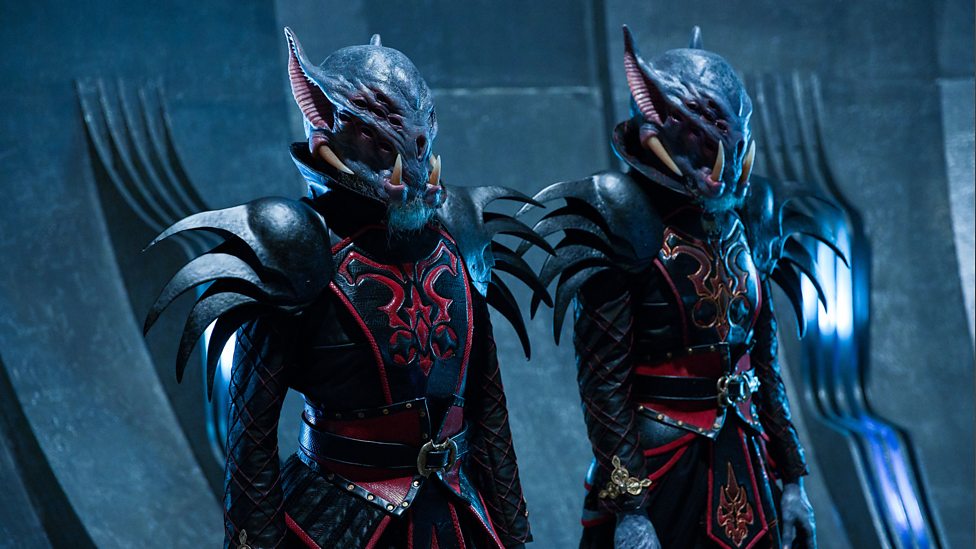 And of course, they weren’t the demons of the Punjab at all, but ex-assassins who had become religious guardians of lonely deaths throughout the universe, after the sad destruction of their own planet (perhaps another eddy of the Time War?).
They might be modelled on the Rakasha, who in Hinduism, are a sort of demon-class of warrior beings (not necessarily “evil” though) with long finger nails and illusionist powers.
The actual demons of partition were, of course, people, fuelled by sectarianism and the legacies of British colonialism. This seems to be a central theme in Chibnall’s Who. The “real” monsters have been human in Arachnids in the UK, Rosa and now in this episode, when they have followed paths of intolerance and chosen a desecration of the ethic of care (for one another, for the planet/s).
I like Chibnall’s vision for this Doctor – that we are living in dark times and so the Doctor has GOT to be a light shining in the universe. Her speech about love, officiating at Prem and Umbreen’s bitter-sweet union, was in that vein:
“Something I believe in – my faith – love – in all its forms – is the most powerful weapon we have, because love is a form of hope, and like hope, love abides in the face of everything….”
Of course Demons in the Punjab was perfect for Remembrance Day, not only because the Vajarians are “remembrance demons” but because WW1 was a global war.
There have been a number of debates in the British media-sphere in the past few days, some pointing out the horrid appropriation of “patriotism” to white nationalism by the Tommy Robinson crew, when, for example, one million Indian soldiers died in WW1 fighting on the Allied side.
We have to ask, are the lights going out on dreams of unity everywhere, right now?
If any of you saw Macron’s Remembrance Day speech today, a deliberate rebuke to Trump and ethno-nationalisms on the rise in Europe, about nationalism being the opposite of patriotism, you could see history weighing heavy on his shoulders. Where are we heading and what should we do?
The message I am getting, loud and clear, from this Doctor, is that whilst you can’t always interfere the way you would like to in historical time-lines, in your own time, you can stand up, like Rosa did, like Prem and Umbreen did.
5 November 2018 at 20:46 #65428@bluesqueakpip – Ohhh nice on the meaning of Tsuranga – so that means the title of the episode could be understood to be “The Salvation Connundrum” which makes perfect sense, given the pre-programmed self destruct in the hospital ship in what must, surely, be a war-zone, as we have a sonic mine, a General and a hospital ship combined….
For those of you torturing me with the Doctor’s red/blue rainbow stripe T-shirts, this is the pattern (or rather, lack of it) so far:
Blue – The Woman Who Fell to Earth ( Relative Present)
Blue – The Ghost Monument (Relative Future)
Red/Maroon – Rosa (Relative Past)
Blue – Arachnids in the UK (BUT changes to red/maroon in the last scene back in the TARDIS) (Relative Present)
Red/Maroon – The Tsuranga Conundrum (Relative Future)
Thank you i-player fast forward!
5 November 2018 at 19:45 #65424Oh, and @mudlark – it was really difficult to tell the colour of the Doctor’s T-shirt this week, because of the lighting, but I think it was her reddish maroon one as opposed to her blue one.
That means any plotting of red for past (relative to the Doctor’s companions) and blue for future, with reference to cosmological red-shift, is out the window, as I’d have expected a blue T-shirt this week in that case.
There could be another “code” at work, such as blue for places/times the Doctor has never been before (like Desolation in The Ghost Monument) and red/maroon for places/times she has. She had been to the 67th century before (the time in which this episode was set) because she chit-chats with the General about it.
It’s a blue T-shirt at the end of The Woman Who Fell to Earth, which she acquires in the charity shop, but when Team TARDIS lands in the same time/place (Sheffield, Earth) for Arachnids in the UK, it’s her red/maroon one. So this might work. Dammit! I will have to keep a list – you have all (and I blame you @pedant) sucked me in again 🙂
5 November 2018 at 19:28 #65422@pedant “So Pting has proved spectacularly popular on Twitter. Watch out for the cuddly energy-sucking toy coming to a Christmas stocking near you.”
Yes, I’ve seen lots of positive comments about the Chibnall era more generally on Tumblr too. And Tumblr tended to be a space with a sizable audience which absolutely loathed Moffat’s Who (largely because of the way he wrote women).
Both us here @craig ‘s place and the basket of deplorables over on The Graun (not everyone of course, but egads there is a culture of entitled whingeing BTL on Dan Martin’s reacps which it is truly quite difficult to wade through) have to recognise that we are not the primary target audience for Doctor Who – kids and young people are.
I saw a really cute picture of a birthday cake on Twitter (can’t find it now or I’d link the pic) someone had made for their two delighted little boys, of the Stenza assassin’s face from The Woman Who Fell to Earth (a blue cake with loads of white chocolate bits to represent the teeth stuck on it) so, if the Chibnall era monsters are resonating with them, that’s the way it should be.
I remember when the farting Slitheen caused a stir back in RTD’s day with lots of pearl-clutching about the childish tone. I wasn’t that keen on the Slitheen myself, but again, the kids are Who’s future, so…
I am very much enjoying the rather melancholic luminosity Whittaker brings to the Doctor, even though I really do miss the timey-wimey pzazz of Moffat. I think that Chibnall’s vision of the Doctor as refracted light in the universe which I mentioned was reflected in Whittaker’s rainbow T-shirt costume, was confirmed by the words of the requiem litany for the General this week, which WhitDoc recited with real feeling (and which I quoted on Dan’s blog) as the camera panned to a close-up on her face:
“May the saints of all the stars and constellations bring you hope, as they guide you out of the dark and into the light, on this voyage and the next, and all the journeys still to come, for now and evermore….”
I think the WhitDoc probably feels that she herself has come out of a period of great darkness (the Time War and its long aftermath) and that she is now, in this new incarnation, finally in the light once more, and back to her pre-Time War, rather wandering credo, to be a Doctor most of all, of “hope” (as she says).
4 November 2018 at 22:08 #65399Yes, I like the idea of the P’Ting as an escaped bio-weapon.
Clearly the hospital ship and the General meant the Doctor and friends had arrived in some kind of a war-zone, that and the sonic mine. Not to mention the alarming fact that the ship was programmed to transmit a signal to base concering the P’Ting breach which would have resulted in automatic ship-detonation, life forms on board be damned (and which the Doctor therefore had to find a fix for).
I particularly liked the intriguing exchange between the Doctor and General Cicero when it turns out the Doctor has crossed paths with her history before, and has indeed a “whole volume” dedicated to her exploits. I wondered if it could have been an old eddy of the Time War and that was why the Doctor recited the words for the dead so movingly alongside the others at the end.
Plus, I forgot to say above, that naming the baby Avocado Pear was funny. It made me think of Deadpool 1 (which luckily none of the 9 year olds watching will have seen) – you’ll know the line if you’ve seen the movie.
-
AuthorPosts